Key Takeaways
-
Tight tolerance machining uses advanced CNC, EDM and grinding to hold precise dimensions for complex aerospace and UAV components.
-
Standards such as ISO 2768 and ASME Y14.5 control dimensions, while AS9100D and ITAR compliance support defense and aerospace programs.
-
Common challenges include tolerance failures, scaling issues and fragmented supply chains, which integrated suppliers address through unified capabilities.
-
Key processes include 5-axis CNC for complex geometries, multi-axis milling and turning, and precision fabrication within a single facility.
-
Precision Advanced Manufacturing provides certified, scalable services for mission-critical programs; get a quote for an aerospace project today.
Defining Tight Tolerance Machining for Aerospace Programs
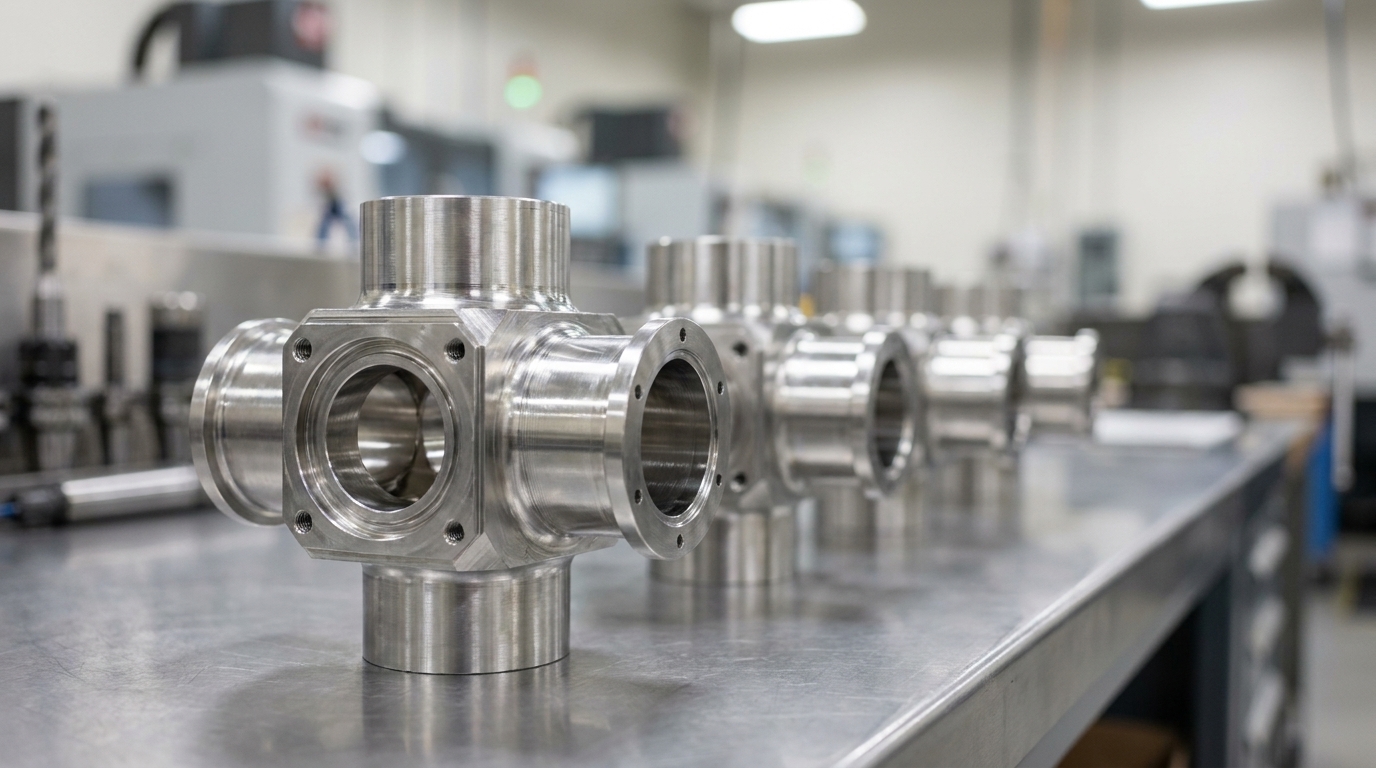
Tight tolerance machining uses advanced CNC and fabrication processes for metal components in aerospace and UAV applications. These processes achieve exceptional precision through multi-axis CNC, EDM and grinding techniques.
Precision Advanced Manufacturing maintains repeatability across production runs. Temperature-controlled environments, high-precision tooling and quality inspection protocols align with aerospace requirements and support consistent results.
Standards That Govern Tight Tolerance Machining
Standards create a common language for dimensions and quality across programs and suppliers. ISO 2768 provides standardized general tolerance classes for machined parts. These standards support consistent dimensional control across international supply chains.
ASME Y14.5 governs Geometric Dimensioning and Tolerancing (GD&T) in the United States. Precision Advanced Manufacturing follows ISO and ASME standards through certified quality systems and structured inspection protocols, which support reliable program outcomes.
Challenges in Tight Tolerance Metal Components Machining for Aerospace
Aerospace programs face significant risk when tolerance failures occur. Many suppliers struggle with out-of-spec precision machining tolerances. These issues create delays, rework costs and schedule pressure. ITAR and AS9100D compliance failures add regulatory and contractual risk.
Scaling from prototype to production creates obstacles because many suppliers lack integrated capabilities. Without these capabilities, programs depend on handoffs between multiple vendors, which introduce quality variations and delays. This fragmentation also weakens material traceability across the supply chain.
Precision Advanced Manufacturing addresses these challenges through integrated solutions. Certified processes deliver high-precision components with consistent quality. Robust traceability reduces inspection burden and supports compliance. Discuss program requirements with our team to reduce risk.
Core Processes for CNC Tight Tolerance Machining
Advanced tight tolerance machining relies on sophisticated processes and equipment. 5-axis CNC machining reaches complex contoured surfaces, undercuts, compound angles and cooling passages in aerospace components by tilting and rotating the tool, which reduces setups, improves surface finish and limits positional errors.
Multi-axis CNC milling and turning form the base of precision manufacturing and pair with EDM for intricate internal profiles and hard alloy machining. Grinding processes hold tight diameter control for shafts and journals, while precision sheet metal fabrication supports structural components. Specialty welding with thermal distortion control maintains dimensional integrity in lightweight assemblies.
Precision Advanced Manufacturing brings these capabilities together in one facility, which removes handoffs that compromise quality and extend lead times. The integrated approach includes engineering for manufacturability, advanced 5-axis machining for complex geometries and comprehensive finishing services that deliver components ready for integration.
Selecting a Supplier for Aerospace Tight Tolerance Parts
Supplier selection depends on performance across several critical areas. Key indicators include delivery rates, quality systems, production capacity and standards compliance.
AS9100D and ITAR compliance require current certifications and audit records that satisfy regulatory expectations. Beyond compliance, scalability depends on prototype-to-production capability that maintains quality at volume. This scalability relies on full documentation for traceability, which then supports on-time reliability backed by strong performance metrics.
Integrated services reduce supply chain fragmentation and simplify management. When evaluating suppliers, prioritize those with machining, fabrication, welding and finishing in one operation, since this integrated approach mentioned earlier provides control and accountability.
Precision Advanced Manufacturing aligns with these requirements. Comprehensive certifications, scalable production and structured documentation systems support success from prototype through full-rate production.
Precision Advanced Manufacturing for Mission-Critical Precision
Precision Advanced Manufacturing delivers integrated multi-axis CNC machining, precision fabrication and finishing services under AS9100D, ITAR and ISO 9001 certifications. The scalable production platform supports smooth transitions from prototype development to sustained manufacturing while maintaining quality and compliance.
Procurement teams gain cost predictability through right-first-time precision that removes rework and expedited orders. Program managers see risk reduction through proven processes and reliable delivery performance. Supplier quality engineers benefit from comprehensive inspection and documentation systems that simplify audits and support specification compliance.
Engineering support improves manufacturability from project inception, and advanced multi-axis capabilities handle complex geometries that challenge standard machine shops. Case studies show UAV component scaling and prototype-to-production transitions without operational disruption. Start a project with proven manufacturing performance.
Frequently Asked Questions
What materials are used for tight-tolerance machining?
Tight tolerance machining typically uses dimensionally stable metals such as aluminum alloys, titanium alloys and stainless steels. These materials provide predictable thermal expansion and mechanical stability that support precision during machining. Aluminum alloys offer strong machinability and corrosion resistance, while titanium provides strong strength-to-weight ratios for aerospace applications. Material selection depends on application requirements such as strength, weight, corrosion resistance and operating environment.
What is the role of AS9100D and ITAR in tight tolerance machining?
AS9100D provides a quality management framework designed for aerospace manufacturing and supports consistent processes, traceability and documentation for mission-critical components. ITAR registration allows handling of defense-related technical data and components with strict controls on access and export. Together, these certifications align tight tolerance machining operations with aerospace and defense requirements and provide documentation and process control for regulatory compliance and program success.
How do programs scale from prototype to full production in tight tolerance machining?
Successful scaling relies on integrated capabilities that keep processes and quality consistent from initial prototypes through high-volume production. This approach uses validated manufacturing processes, scalable equipment capacity, established quality systems and comprehensive documentation. Programs benefit from suppliers with multi-shift production capacity, proven process control and the ability to hold tight tolerances across changing production volumes without disruptive process changes or supplier transitions.
What integrated services does Precision Advanced Manufacturing provide?
Precision Advanced Manufacturing provides comprehensive manufacturing services in one operation, including advanced multi-axis CNC machining, precision sheet metal fabrication, specialty welding with thermal distortion control, secondary finishing operations, hardware installation and complete kitting services. This integration removes handoffs between multiple suppliers, reduces quality risk, improves schedule control and provides single-source accountability for complex aerospace components that require tight tolerances and full traceability.
How are complex geometries handled in tight tolerance machining?
Complex geometries rely on advanced manufacturing processes such as 5-axis CNC machining for simultaneous multi-directional cutting, EDM for intricate internal profiles and hard-to-machine materials and precision grinding for critical surface finishes. These processes support machining of undercuts, compound angles, cooling passages and other features that conventional 3-axis equipment cannot reach. Success depends on sophisticated CAM programming, high-precision tooling, temperature-controlled environments and comprehensive inspection capabilities that verify dimensional accuracy across all features.
How are cost and deadline concerns addressed in tight tolerance machining?
Precision manufacturing reduces cost by limiting rework, scrap and expedited delivery charges. Integrated capabilities shorten lead times and simplify coordination. Proven processes support schedule predictability, and strong quality systems prevent delays from out-of-spec parts. Scalable platforms adjust to program requirements without disrupting production.
Mission-critical programs depend on reliable suppliers, and informed selection reduces risk across cost, schedule and quality. This guide supports evaluation of tight tolerance machining suppliers and structured risk mitigation. Connect with the certified manufacturing team.