Key Takeaways for Aerospace 5-Axis CNC Machining
- 5-axis CNC machining coordinates five axes at once to produce turbine blades, wing spars and other complex aerospace parts in single setups, which reduces errors compared with 3-axis methods.
- It machines titanium, Inconel and aluminum while holding aerospace-grade tolerances and maintaining material traceability for mission-critical compliance.
- Key advantages include shorter cycle times, smooth surface finishes and fewer production handoffs, which reduces sourcing risk and schedule delays.
- AS9100D, ITAR and ISO 9001 certifications support consistent quality, full documentation and scalable production from prototype through long-term programs.
- Precision Advanced Manufacturing provides multi-axis machining, engineering support and dependable aerospace production as a single, accountable partner through its integrated services.
How 5-Axis CNC Machining Supports Aerospace Programs
5-axis CNC machining coordinates five axes simultaneously to reach complex contours and undercuts in a single setup. This single-setup approach accesses features that 3-axis or 4-axis machines reach only through multiple repositioning steps. Consolidated operations reduce handling, which improves precision for aerospace components that cannot tolerate alignment errors.
The technology delivers distinct advantages for demanding aerospace parts. By machining complex geometries such as turbine blades in one setup, manufacturers reduce repositioning that degrades dimensional accuracy. This setup consolidation also shortens cycle times because programmers can select cutting angles that keep tools engaged efficiently throughout the operation.
Surface quality improves through stable, continuous tool paths that maintain consistent chip loads. These controlled paths reduce chatter and tool deflection, which supports smooth finishes on thin walls and lightweight structures. The reduction in repositioning errors supports consistent results on parts that must remain both light and strong.
Core Aerospace Components Suited to 5-Axis Machining
Aerospace manufacturers apply 5-axis CNC machining to components that combine intricate shapes with demanding precision requirements. These conditions make the technology suitable for turbine blades, engine casings, structural ribs, wing spars and landing gear components that exceed the practical limits of 3-axis machining.
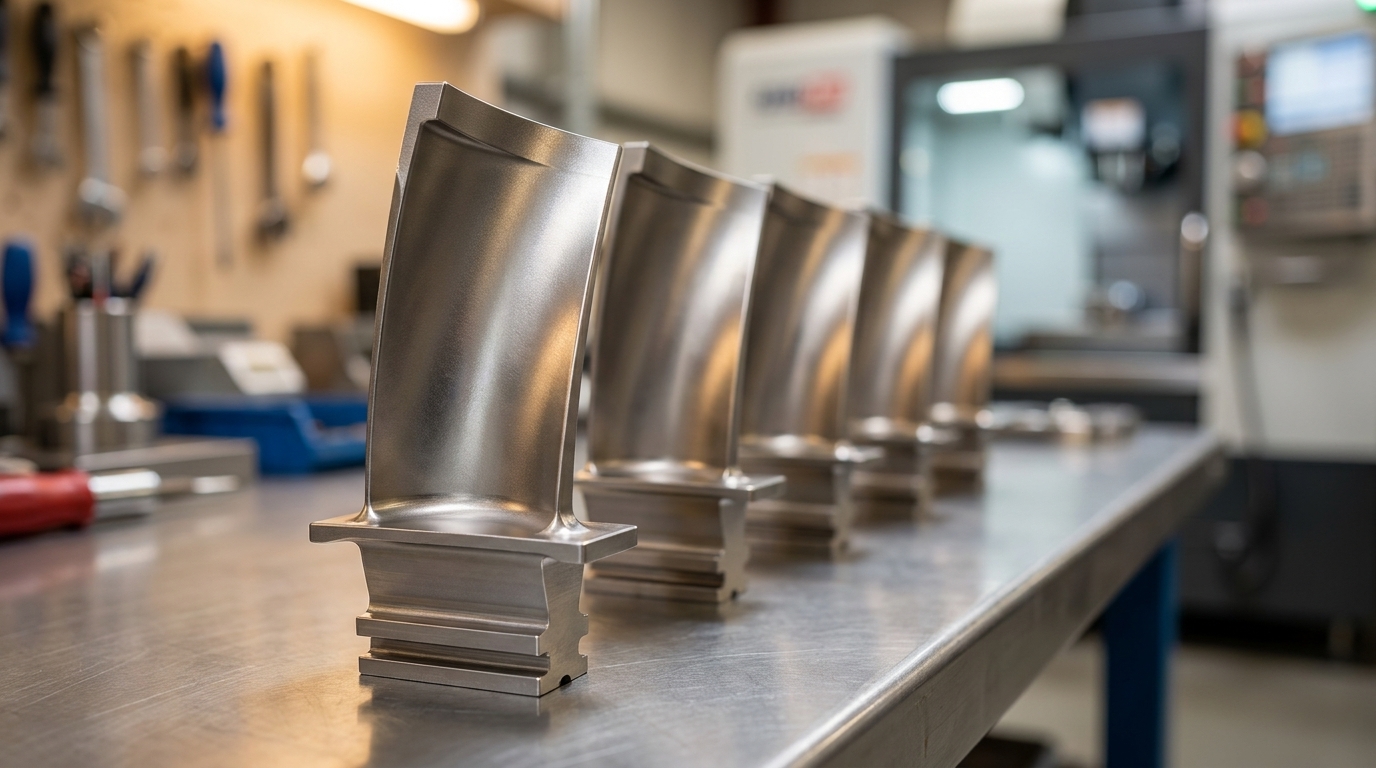
Turbine blade production illustrates this value clearly. Blades use twisted airfoil profiles and complex root and tip features that must align across the entire engine stage. Continuous 5-axis interpolation maintains surface quality and profile accuracy along the airfoil. Traditional multi-setup methods introduce alignment variation that can affect performance in high-temperature engine environments.
Structural components benefit from the same capabilities. Wing ribs, bulkheads and landing gear parts often combine multiple materials with precision bores, pockets and weight-saving cutouts. Coordinated 5-axis operations machine these features in fewer setups, which reduces fixture changes and handoffs between separate manufacturing steps.
Precision Advanced Manufacturing applies 5-axis CNC and fabrication capabilities to large structural applications that require stable processes. The team maintains the quality standards aerospace programs specify for both primary structures and supporting hardware.
Materials and Tolerances in Aerospace 5-Axis Machining
Aerospace applications rely on materials that withstand extreme temperatures, loads and environments while limiting aircraft weight. These conditions drive the use of titanium alloys such as Ti-6Al-4V for engine and structural components. Titanium combines high strength-to-weight ratio with corrosion resistance, which supports long service life in harsh conditions.
These materials create machining challenges that 5-axis technology helps manage. Titanium’s low thermal conductivity concentrates heat at the cutting zone, which accelerates tool wear and can distort thin sections. Continuous control of tool orientation in 5-axis machining improves chip evacuation and distributes heat more effectively, which reduces distortion on critical features. Nickel-based superalloys such as Inconel 718 support high-temperature engine performance but require controlled engagement angles that 5-axis systems maintain along complex paths.
Beyond titanium and nickel superalloys, aluminum alloys and composites complete the material portfolio for aerospace 5-axis machining. These materials support lightweight structures but require careful control of cutting parameters to prevent delamination, burrs or dimensional drift. Optimized feeds, speeds and tool geometries maintain the tolerances aerospace programs specify even on thin webs and large envelopes.
Complete material traceability links each part to its heat lot, certifications and inspection records. This traceability supports regulatory compliance, program audits and long-term fleet management for mission-critical platforms.
Challenges and Practical Solutions in 5-Axis Aerospace Machining
Complex programming forms a primary challenge in 5-axis aerospace machining. Multi-axis tool paths require capable CAM software and programmers who understand both machine behavior and aerospace design intent. Precision Advanced Manufacturing addresses this through advanced CAM systems and engineering support that refine tool paths for both efficiency and part quality.
Thermal distortion in titanium machining presents another significant concern. Heat buildup can cause dimensional variation that affects fit, fatigue life and sealing surfaces. High-pressure coolant delivery, tuned cutting parameters and stable fixturing reduce temperature spikes, while in-process and post-process inspection confirm that dimensions remain within specification.
Scaling from prototype to production introduces additional complexity. Stable processes, documented work instructions and robust quality systems ensure that parts produced during development match those produced at full rate. Precision Advanced Manufacturing’s AS9100D certification supports this continuity by tying prototype process validation directly to production control plans and documentation.
Tool wear management becomes critical when machining superalloys and titanium. Coated cutting tools, optimized engagement strategies and predictive maintenance programs extend tool life while preserving surface finish and dimensional accuracy. Request a quote to discuss how these tool wear strategies apply to specific titanium and superalloy grades used in current aerospace programs.
Why Compliance and Scalability Matter for Aerospace Procurement
AS9100D, ITAR and ISO 9001 certifications establish structured quality management for aerospace work. Aerospace programs rely on these standards to confirm that suppliers control processes, documentation and change management. Certified systems reduce audit burdens for program teams and support consistent traceability across part lifecycles.
Market growth in the aerospace and defense segment through 2031 increases the need for scalable supplier partnerships. Rising demand for complex components places pressure on manufacturers to expand capacity while holding quality steady. This combination requires partners that pair multi-axis capability with disciplined quality systems and production planning.
Precision Advanced Manufacturing supports these needs with certified processes and scalable production resources. Multi-axis machining, fabrication and finishing within one organization reduce supplier fragmentation and coordination effort. This integrated structure helps maintain consistent quality across prototype lots, low-rate initial production and full-rate production volumes.
Evidence of Proven Aerospace Manufacturing Performance
Precision Advanced Manufacturing delivers mission-critical aerospace components through certified quality systems and coordinated manufacturing capabilities. The certifications discussed above support compliance with aerospace requirements and provide systematic quality management across machining, fabrication and finishing operations.
Services that span CNC machining, precision fabrication, welding and finishing reduce the handoffs that often introduce variation in aerospace supply chains. The traceability established through material certification extends across routing, inspection and final acceptance, which eases the management burden for procurement and quality teams.
The company’s aerospace record shows consistent performance on applications where function and schedule adherence carry high stakes. Detailed documentation and inspection systems provide the transparency aerospace programs expect while confirming that delivered parts match engineering specifications.
Frequently Asked Questions
What materials does Precision Advanced Manufacturing handle for 5-axis aerospace machining?
Precision Advanced Manufacturing machines a range of materials used in aerospace structures and engines. Material traceability described earlier includes heat lot records and certifications required for aerospace programs. The team works routinely with titanium, nickel-based superalloys and aluminum alloys used in high-temperature and high-load environments.
What CAD compatibility and certifications support defense programs?
The company uses advanced CAD and CAM systems that accept standard aerospace file formats, including common native and neutral models. AS9100D, ITAR and ISO 9001 certifications support compliance with defense and aerospace requirements. Documentation systems maintain the traceability and quality records that defense programs specify.
How does scaling work from prototype to production?
Precision Advanced Manufacturing supports scaling through multi-shift production capacity and established quality procedures. Processes validated during prototyping carry into production with controlled revisions, which maintains consistent quality while meeting program schedules. Integrated machining and fabrication capabilities reduce the need to qualify new suppliers during ramp-up.
Can complex geometries and tight tolerances be achieved reliably?
Multi-axis CNC capabilities machine complex contours, undercuts and precision features in single setups, which limits stack-up error. Advanced tooling, stable fixturing and experienced programming maintain required tolerances across production runs. Rigorous inspection, including in-process checks and final verification, confirms dimensional accuracy for each lot.
What support is available for supplier transitions?
Engineering support and structured documentation help programs transition work from incumbent suppliers with minimal disruption. The team conducts pilot builds and validation runs that confirm fit, form and function before full transfer. The material and process traceability described earlier supports smooth integration into existing supply chains while protecting program timelines.
Conclusion: 5-Axis Partners for Aerospace Requirements
5-axis CNC machining addresses aerospace sourcing challenges through certified partners that provide integrated capabilities, full traceability and engineering support. Successful programs rely on suppliers with recognized certifications, scalable production platforms and disciplined quality management. Request a quote to discuss how Precision Advanced Manufacturing supports mission-critical aerospace components from development through sustained production.