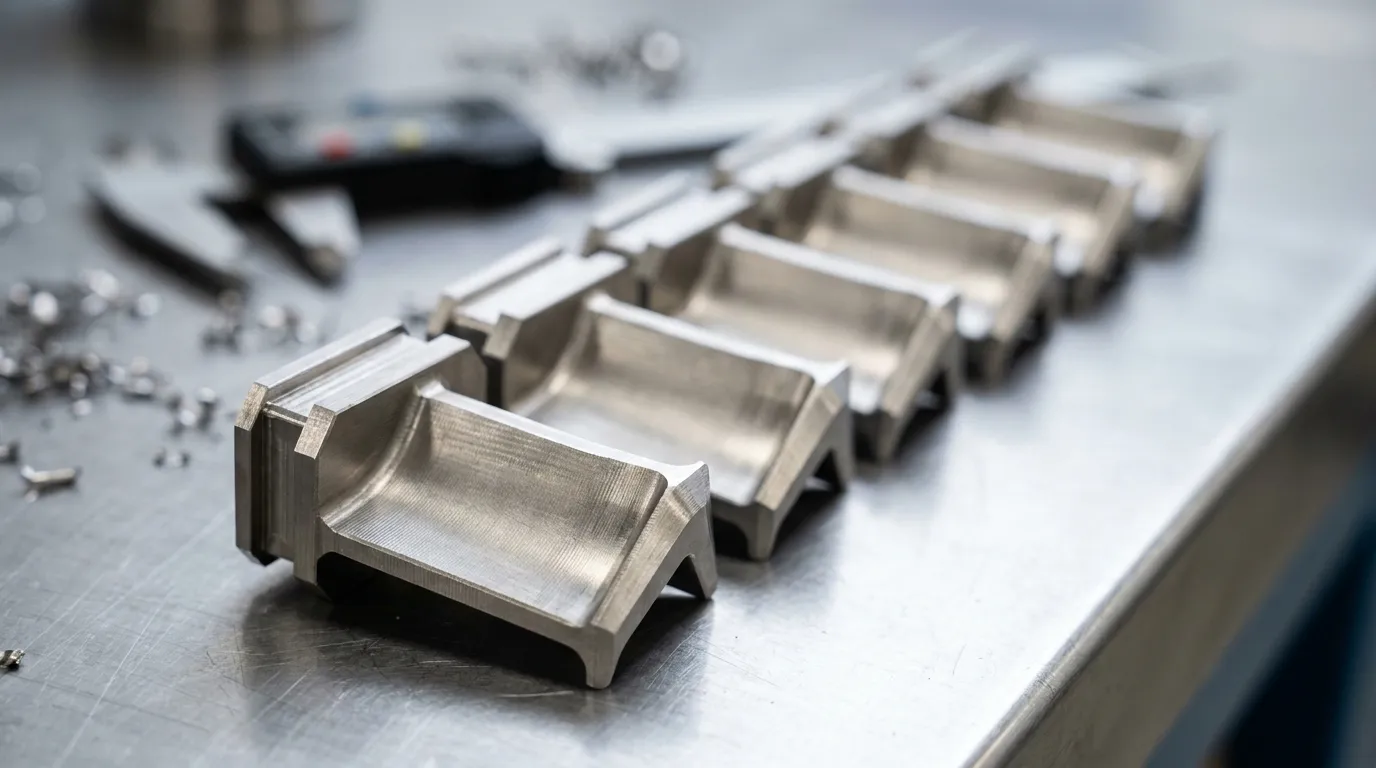
Key Takeaways for Austin CNC Partner Selection
- Austin metal CNC fabrication decisions shape aerospace and defense program outcomes for compliance, cost and schedule performance.
- Selecting a certified partner with AS9100D, ISO 9001:2015 and ITAR registration reduces compliance failures and supplier qualification risks.
- Integrated capabilities, including multi-axis machining, sheet-metal fabrication, welding and finishing under one roof, reduce handoff risks and quality gaps.
- Scalable production from prototype to full-rate within the same quality system prevents costly mid-program supplier transitions.
- Precision Advanced Manufacturing delivers certified, integrated Austin CNC fabrication capability for aerospace and defense programs. Start a program evaluation with a detailed quote.
Program managers and procurement teams can use a structured checklist to compare Austin CNC suppliers against aerospace and defense requirements.
7-Question Buyer Checklist for Austin Metal CNC Fabrication Partners
- Does the supplier hold active AS9100D and ISO 9001:2015 certifications with documented audit history?
- Is the supplier ITAR registered with the U.S. Department of State and enforcing access controls for controlled technical data?
- Does the facility offer multi-axis CNC machining, sheet-metal fabrication, specialty welding and secondary finishing under one roof?
- Can the supplier demonstrate a documented prototype-to-full-rate production transition without a supplier change?
- Does the supplier provide full material traceability, mill certifications and First Article Inspection documentation?
- Does the supplier offer engineering support and design-for-manufacturability review at program inception?
- Can the supplier provide kitting, hardware installation and finishing services that deliver ready-to-integrate components?
Precision Advanced Manufacturing meets every criterion on this checklist. Begin a program evaluation to verify compliance and capability fit.
Technical Capabilities for Austin Precision Machining Programs
Austin precision machining for aerospace and defense programs requires more than basic three-axis milling. Aerospace CNC machining regularly achieves standard tolerances of ±0.0005 in or tighter for flight-critical components. Maintaining that accuracy across production runs requires multi-axis equipment, skilled programmers and disciplined process controls.
Precision Advanced Manufacturing operates advanced multi-axis CNC milling and turning centers that produce complex, tight-tolerance components for space, satellite, aerospace and UAV systems. The facility combines this machining capability with precision CNC sheet-metal fabrication, including waterjet and laser cutting, stamping, forming and bending, to handle structural and enclosure work alongside machined components.
Specialty welding completes the technical offering. Precision Advanced Manufacturing applies TIG, MIG and precision laser welding with thermal distortion control. This capability supports lightweight aerospace assemblies where structural integrity cannot be compromised. Global buyers increasingly seek full-service metal fabrication suppliers capable of design engineering, prototyping, production and assembly, and consolidating these capabilities under one roof eliminates the handoff risk that fragments quality accountability across multiple vendors. Those capabilities only deliver program value when they operate within certified quality systems that meet aerospace and defense compliance requirements.
Quality and Compliance Systems for AS9100D CNC Fabrication in Texas
AS9100D CNC fabrication in Texas requires more than a posted certificate. AS9100 builds on ISO 9001 and adds aerospace-specific requirements such as risk management, stringent documentation and product integrity control throughout complex supply chains. Suppliers must demonstrate active certification with audit history, not just initial registration.
Precision Advanced Manufacturing operates under these certified quality management systems and maintains ITAR registration with the U.S. Department of State. Every project runs under defined quality checkpoints, full material traceability and documentation aligned with aerospace quality standards. This documentation includes material certifications, in-process inspection records and First Article Inspection per AS9102.
Buyers in aerospace and defense use standards like AS9100 to compare suppliers by compliance fit, industry specialization and ability to meet regulated production requirements including traceability. Many Austin-area machine shops serve general industrial markets and lack the aerospace-grade certification infrastructure that defense and aerospace programs require. The absence of AS9100D or ITAR registration represents a disqualifying condition for most regulated programs.
Production Scalability with Austin CNC Fabrication Partners
Austin CNC fabrication partners that excel at prototyping often lack the process discipline and capacity to sustain full-rate production. The supplier change that occurs when a program transitions from development to production introduces re-qualification costs, documentation gaps and schedule risk that erode program margins.
Precision Advanced Manufacturing supports the full product lifecycle from project-specific prototype development through sustained, multi-shift production without requiring a supplier transition. The same quality systems, tooling documentation and process controls validated during prototyping carry forward into production. This continuity eliminates the re-qualification costs and setup delays that occur when changing suppliers mid-program. Lead times and setup requirements drive CNC pricing, so a scalable, predictable partner with consistent processes becomes one of the most effective cost-control tools available to program managers.
Scalability also depends on capacity. Precision Advanced Manufacturing operates across two specialized facilities in California and Texas. This footprint provides the production depth to support high-volume, multi-shift programs while maintaining the quality standards validated at prototype.
Integrated Services that Reduce Handoff Risk in Austin Defense Fabrication
Precision metal fabrication for Austin defense programs requires components that arrive ready to integrate, not parts that require additional finishing, hardware installation or assembly work at the customer facility. Every additional handoff between vendors introduces a quality risk and a schedule dependency. The handoff risk described earlier compounds when components require finishing, hardware installation or assembly work at multiple facilities.
Precision Advanced Manufacturing consolidates engineering support, CNC machining, sheet-metal fabrication, specialty welding, kitting, hardware installation, brush finishing, laser marking, deburring and secondary finishing, including anodizing, passivation, plating, sandblasting and ultrasonic cleaning, under one roof. Engineering support and design-for-manufacturability review are available at program inception. This early collaboration allows teams to refine designs and tolerances before first article. Engineering teams that integrate manufacturing expertise into design development consistently achieve lower fabrication cost compared to sequential design-manufacturing approaches.
Kitting services consolidate individual components into organized kits that streamline assembly, reduce handling and lower production costs. This capability directly supports program managers who manage complex integration schedules.
Total Program Risk and Cost-of-Failure in CNC Supplier Choice
Apparent cost savings from selecting a non-certified or lower-capability Austin metal CNC fabrication shop rarely survive contact with program reality. Parts requiring tight tolerances increase CNC machining costs because machines must run more slowly and require additional in-process checks and final inspection, and shops without the equipment or process controls to meet those tolerances generate scrap, rework and delays that cost more than the initial price difference.
Compliance failures carry consequences that extend beyond individual parts. ITAR violations expose programs to federal penalties and contract termination, while AS9100D non-conformances trigger supplier corrective action requests, re-qualification audits and potential removal from approved vendor lists. These outcomes can halt production and jeopardize program timelines. Buyer decisions in defense are influenced by a supplier’s ability to prove both quality-system maturity and information-security readiness, not just machining capability.
Supplier transitions mid-program compound these risks. The re-qualification burden mentioned earlier becomes acute mid-program, when validation runs and documentation reviews consume schedule margin that programs can no longer afford. Precision Advanced Manufacturing reduces this risk by providing complete documentation, material traceability and engineering support from prototype through full-rate production.
Materials and Processes for Austin Aerospace CNC Machining
Austin aerospace CNC machining programs work across a range of materials selected for performance in demanding environments. Common aerospace CNC materials include 7075-T6 aluminum for structural parts and aerodynamic surfaces, Ti-6Al-4V titanium for engine and landing-gear components, Inconel 718 and 625 nickel superalloys for turbine and exhaust applications and 15-5 PH and 17-4 PH stainless steels for high-strength structural applications.
Precision Advanced Manufacturing works with a broad range of metals and alloys suited to aerospace, defense, space and UAV programs. These materials include stainless steels, aluminum alloys, carbon steels and exotic alloys. Processes include multi-axis CNC milling and turning, waterjet and laser cutting, precision welding and integrated finishing. Aerospace CNC suppliers must maintain full material traceability to mill sources and heat-treatment lots, including mill test certificates, chemical composition and mechanical test data conforming to AMS, ASTM or MIL specifications, a documentation standard built into Precision Advanced Manufacturing’s quality system.
Next Steps for Partnering with Precision Advanced Manufacturing
Precision Advanced Manufacturing delivers ITAR-registered, AS9100D- and ISO 9001:2015-compliant Austin metal CNC fabrication capability for aerospace, defense and advanced industrial programs. Integrated multi-axis machining, sheet-metal fabrication, specialty welding, kitting and secondary finishing operate under one quality system. This structure eliminates supplier fragmentation and reduces total program risk from prototype through full-rate production.
Supply chain resilience, secure sourcing and regionalization are defining procurement priorities in 2026. A certified, integrated Austin fabrication partner functions as a program requirement for regulated aerospace and defense work.
Precision Advanced Manufacturing’s aerospace and defense specialists collaborate with program teams to define requirements, part specifications and critical timelines. Teams receive tailored quotes that cover capabilities, certifications, materials and production strategy. Programs then move from prototype to full-rate manufacturing with certified quality and full traceability at every step.
Connect with the aerospace and defense team to start a program evaluation today.
Frequently Asked Questions
Program managers and procurement teams evaluating Austin fabrication partners often focus on certifications, scalability, integration, cost and supplier transitions. These questions address those priorities directly.
What certifications should an Austin metal CNC fabrication partner hold for aerospace and defense programs?
Aerospace and defense programs require suppliers with active AS9100D and ISO 9001:2015 certifications backed by documented audit history. ITAR registration with the U.S. Department of State is mandatory for any program involving defense articles or controlled technical data. These certifications confirm that a supplier operates under quality management systems designed for risk management, full traceability, process validation and non-conformance control, the baseline requirements for regulated aerospace and defense supply chains. Precision Advanced Manufacturing maintains the certifications described above across its operations.
How does Precision Advanced Manufacturing support the transition from prototype to full-rate production?
Precision Advanced Manufacturing supports the full product lifecycle within a single quality system. The same process controls, tooling documentation and inspection protocols validated during prototype development carry forward into multi-shift, high-volume production. This structure eliminates the re-qualification burden and schedule risk associated with changing suppliers mid-program. Engineering support is available at program inception to refine designs for manufacturability, and scalable capacity across two specialized facilities supports production ramp without operational disruption.
What integrated services does Precision Advanced Manufacturing offer beyond CNC machining?
Precision Advanced Manufacturing consolidates multi-axis CNC milling and turning, precision CNC sheet-metal fabrication, specialty welding with thermal distortion control, kitting, hardware installation, brush finishing, laser marking, deburring and secondary finishing, including anodizing, passivation, plating, sandblasting and ultrasonic cleaning, under one roof. This integrated model eliminates handoffs between vendors, reduces quality risk and delivers fully finished, ready-to-integrate components that accelerate assembly and testing timelines for program managers.
Is certified precision manufacturing more expensive than using a general machine shop?
The initial quote from a certified precision manufacturer reflects the cost of aerospace-grade process controls, documentation and quality systems. General machine shops that lack these systems may quote lower initial prices but generate higher total program costs through rework, scrap, compliance failures and supplier transitions. For mission-critical programs where out-of-spec parts cause downstream delays and integration failures, delivering parts correctly the first time provides the most cost-effective approach. Precision Advanced Manufacturing’s quality controls and tight-tolerance machining reduce rework and scrap across the program lifecycle.
Can Precision Advanced Manufacturing handle a mid-program supplier transition?
Precision Advanced Manufacturing supports supplier transitions by providing documentation, material traceability and engineering support to maintain program continuity. The team can begin with pilot builds or validation runs to minimize risk while integrating into existing supply chains. Full inspection reporting, material certifications and process documentation are provided at every stage. This transparency gives supplier quality engineers and procurement teams the visibility and confidence needed to qualify a new source without disrupting active production schedules.