
Key Takeaways
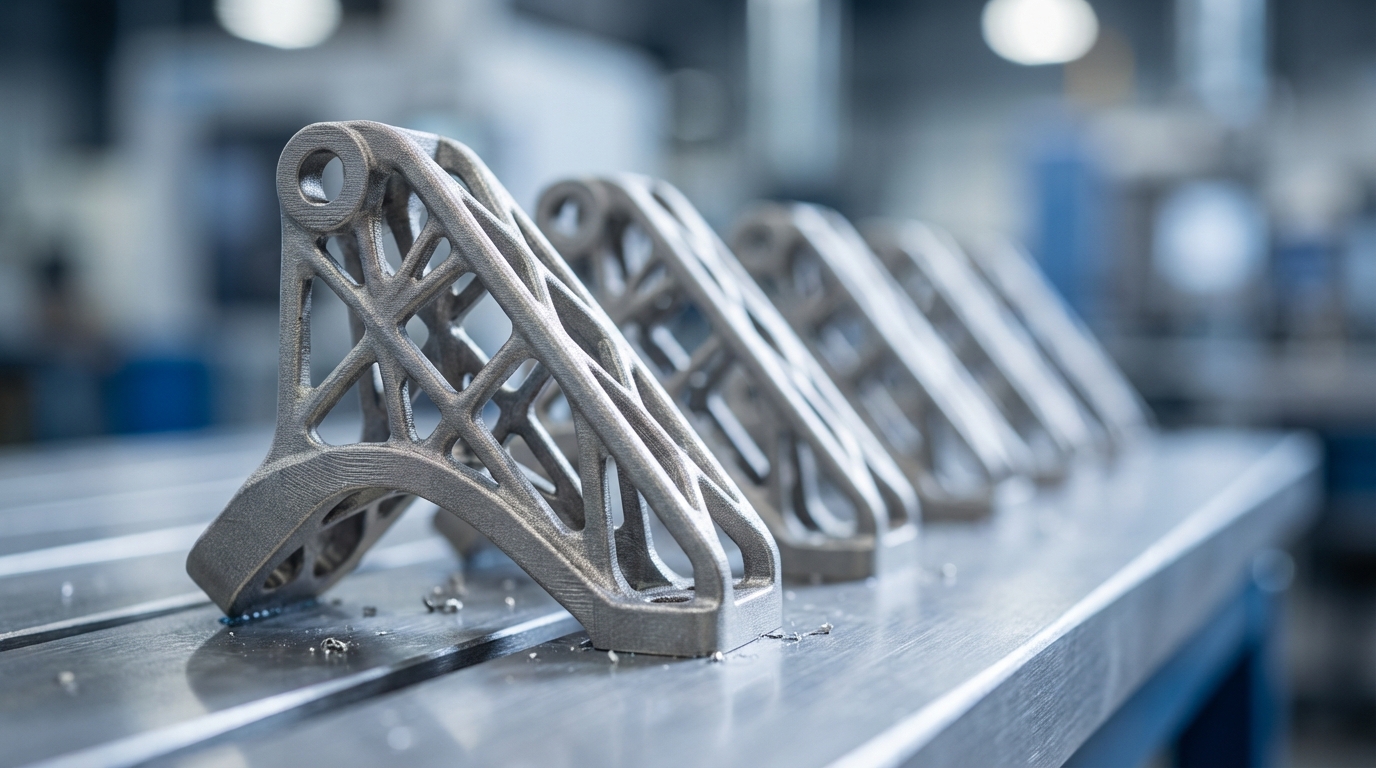
- Additive manufacturing cuts weight by up to 40% and consolidates parts for aerospace structures like engine brackets and wing ribs using Ti-6Al-4V titanium.
- Core processes include DMLS/SLM for ±0.002″ precision, EBM for faster builds, and binder jetting for cost-effective scaling in aircraft and space programs.
- Certified materials such as Ti-6Al-4V, Inconel 718, and AlSi10Mg deliver strong strength-to-weight performance with clear FAA and EASA qualification pathways.
- Hybrid AM plus precision CNC machining solves tolerance, surface finish, and certification hurdles, as shown by SpaceX and Blue Origin programs.
- Partner with Precision Advanced Manufacturing for AS9100D and ITAR-compliant hybrid manufacturing solutions tailored to aerospace structural components.
Five Proven AM Advantages for Aerospace Structures
Additive manufacturing delivers measurable performance gains for aerospace structural components across five core areas.
- Part Consolidation: Complex assemblies shrink from many components to a single printed structure. GE’s LEAP engine fuel nozzle combines numerous parts into one printed component, which removes assembly interfaces and reduces potential failure points.
- Weight Reduction: Topology optimization combined with additive manufacturing achieved a 37% mass reduction in aerospace bracket designs. Physical fatigue testing confirmed lightweight, fatigue-resistant structures suitable for demanding flight conditions.
- Design Freedom: Internal channels, lattice structures, and advanced topologies that traditional machining cannot produce become practical. Engineers can place material only where loads demand it, which improves performance and reduces mass.
- Rapid Prototype-to-Production: Digital workflows remove tooling and fixture delays. Teams move from prototype validation to production in weeks instead of months while using the same core process parameters.
- Material Efficiency: Near-net-shape builds reach about 90% material utilization compared with subtractive methods. This efficiency cuts waste and raw material costs for high-value aerospace alloys.
Industrial-scale metal AM is growing more than 25% annually. Aerospace demand for high-volume, end-use parts with shorter lead times and greater design flexibility drives this expansion.
Core AM Processes for Aircraft and Space Structures
Four primary additive manufacturing processes support aerospace structural production, and each fits different tolerance, speed, and cost needs.
|
Process |
Tolerances |
Build Speed |
Cost |
|
DMLS/SLM |
±0.002″ |
Medium |
High |
|
EBM |
±0.005″ |
Fast |
Medium |
|
Binder Jetting |
±0.010″ |
Fastest |
Low |
Direct Metal Laser Sintering and Selective Laser Melting deliver the highest precision for critical structural parts, reaching ±0.002″ tolerances suitable for flight-critical hardware. Electron Beam Melting offers faster build rates with slightly looser tolerances, which works well for larger structural elements. Binder jetting supports high-volume production at lower cost, although secondary processing is required to reach final density and properties.
Metal additive manufacturing now plays a central role in producing lightweight parts, improving manufacturing efficiency, reducing production costs, and improving fuel consumption in aircraft. Powder bed fusion technologies remain the primary choice for titanium and aluminum structural aerospace components.
Certified AM Materials for Aerospace Structures
Three primary alloys lead certification efforts for structural aerospace components, and each material aligns with specific environments and load cases.
|
Material |
Density (g/cm³) |
Tensile Strength (MPa) |
Cert Status/2026 Advances |
|
Ti-6Al-4V |
4.5 |
345-1380 |
FAA-qualified, 40% weight savings over steel |
|
Inconel 718 |
8.2 |
690-1400 |
High-temp qualified, LPBF-certified |
|
AlSi10Mg |
2.7 |
300-500 |
Lightweight structures, rapid qualification |
Ti-6Al-4V Grade 5 titanium dominates structural aerospace use because it combines high strength, low weight, and corrosion resistance with proven certification pathways. The alloy delivers about 40% weight reduction compared with steel while still supporting demanding load-bearing roles. Inconel 718 supports high-temperature components such as engine parts and turbine housings, where oxidation resistance at elevated temperatures is essential. AlSi10Mg aluminum enables cost-effective lightweight structures for non-critical or secondary structural applications.
Recent progress includes Innospace’s support-free 3D printing of titanium aerospace components using Ti-6Al-4V Grade 23. This work demonstrates scalable parametric pressure vessels for space missions with lower weight and simpler manufacturing.
Real-World AM Use in Commercial, Defense, and Space Programs
Leading aerospace organizations now rely on additive manufacturing for structural components across launch, defense, and commercial fleets.
- SpaceX: Raptor engine brackets produced with hybrid AM and machining, which combines printed geometries with precision CNC finishing for tight tolerances.
- Blue Origin: Structural ribs for launch vehicles that use titanium AM to reduce weight and integrate cooling channels directly into the structure.
- Relativity Space: UAV frame components built with large-format metal printing to support rapid prototyping and fast production ramps.
- Commercial Aviation: Engine brackets, landing gear elements, and cabin structural parts that follow established qualification pathways to reach certification.
These programs focus on load-bearing structures where conventional manufacturing restricts design improvements. Recent work on spherical titanium pressure vessel domes for aerospace highlights the maturity of AM for complex structural geometries.
Certification Hurdles for Flight-Critical AM Parts
Flight-critical additive parts face four main certification challenges that require disciplined engineering and documentation.
- Material Anisotropy: Layer-by-layer construction creates directional properties. Hybrid post-processing with controlled heat treatment and machining helps achieve near-isotropic mechanical behavior.
- Fatigue Performance Gaps: AS9100D testing protocols confirm long-term durability through accelerated fatigue testing and statistical process control, which supports consistent production quality.
- FAA and EASA Qualification Requirements: Extensive documentation, testing, and repeatability requirements demand powder traceability, stable parameter sets, and validated workflows to satisfy regulators.
- Documentation and Traceability: ITAR compliance requires complete material genealogy, process parameter records, and inspection documentation across the entire manufacturing chain.
Successful certification programs follow established frameworks such as the Gulfstream G800 FAA and EASA type certifications achieved on April 16, 2025. This aircraft provides a recent example of dual certification for a platform that incorporates advanced manufacturing technologies.
Hybrid AM and CNC Machining for Production Scale
Hybrid manufacturing that combines additive builds with precision CNC machining solves tolerance, surface finish, and scalability challenges for aerospace structures.
Hybrid manufacturing cells pair 3D printers with CNC machines to blend additive and subtractive processes. This approach improves efficiency and supports production-scale aerospace programs.
Precision Advanced Manufacturing uses an integrated model to deliver complete solutions for mission-critical aerospace components.
|
Problem |
Precision Solution |
Benefit |
Metric |
|
Scaling Bottlenecks |
Multi-shift, 52k sq ft CA and TX facilities |
On-time delivery |
Proven scalability from prototype to production |
|
Tolerance Requirements |
Multi-axis CNC finishing |
Certification-ready parts |
Exceptionally tight tolerances achievable |
|
Quality Compliance |
AS9100D and ITAR systems |
Regulatory alignment |
100% traceability |
|
Material Complexity |
Exotic alloys expertise |
Proven performance |
SpaceX and Blue Origin validated |
The hybrid model meets surface finish requirements through precision machining of critical features while preserving the geometric advantages of AM. Hybrid manufacturing that combines 3D printing with CNC machining achieves tighter tolerances, smoother surfaces, and faster production times for aerospace parts in 2026.
Precision Advanced Manufacturing’s work with SpaceX, Blue Origin, and other aerospace leaders confirms its ability to deliver certification-ready structural components through integrated machining and fabrication workflows.
Request a quote to review precision manufacturing options for your aerospace structural components.
Procurement Checklist for AM-Ready Aerospace Suppliers
Successful AM adoption starts with careful supplier selection across five critical evaluation points.
- Certifications: Confirm AS9100D, ITAR registration, and ISO 9001:2015 compliance for aerospace-grade quality systems.
- Hybrid Manufacturing Capability: Verify integrated AM and precision machining capacity that supports complete part finishing and tight tolerance control.
- Material Traceability: Require powder genealogy tracking, process parameter documentation, and detailed inspection reports.
- Production Scalability: Evaluate multi-shift operations, facility size, and equipment redundancy to support long-term program growth.
- Proven References: Look for a customer base that includes SpaceX, Blue Origin, and other tier-one aerospace manufacturers.
Precision Advanced Manufacturing stands out as a U.S.-based precision manufacturer with ITAR compliance, SpaceX-proven performance, and 52,000 square feet of certified capacity across California and Texas. This right-first-time approach lowers program risk and cost while scalable operations support on-time delivery for critical aerospace programs.
Frequently Asked Questions
Can 3D printed parts meet FAA certifications for structural components?
3D printed aerospace structural components can meet FAA requirements when they follow established qualification pathways. Ti-6Al-4V titanium has already achieved certification for flight-critical applications when paired with robust validation testing, documentation, and hybrid post-processing. The Gulfstream G800 dual FAA and EASA certification shows that advanced manufacturing technologies can integrate successfully into certified aircraft platforms.
Which suppliers offer strong hybrid AM capabilities for aerospace applications?
Leading hybrid manufacturing suppliers in aerospace provide ITAR-compliant operations and integrated multi-axis CNC finishing. Precision Advanced Manufacturing operates 52,000 square feet of facilities in California and Texas with scalable capacity, AS9100D certification, and full traceability systems for mission-critical aerospace work.
What materials work best for 3D printed space structural components?
Ti-6Al-4V titanium and Inconel 718 serve as the primary materials for space structural components because they combine high strength with proven certification history. Ti-6Al-4V delivers about 40% weight savings compared with steel while still supporting heavy loads. Inconel 718 handles high-temperature environments with strong oxidation resistance for engines and propulsion systems.
Which 3D printing aerospace companies are scaling successfully in 2026?
Precision Advanced Manufacturing continues to scale through advanced manufacturing that blends precision CNC machining with fabrication. Partnerships with SpaceX, Blue Origin, and other aerospace leaders validate production-ready capability for structural components that require tight tolerances and certification compliance.
What are the main pitfalls of additive manufacturing for space applications?
Material anisotropy remains the primary technical challenge for space applications because layer-wise builds create directional properties that can affect structural performance. Hybrid post-processing that combines controlled heat treatment with precision CNC machining helps achieve near-isotropic mechanical characteristics for flight-critical components.
Conclusion: Turning AM Potential into Certified Hardware
Additive manufacturing for aerospace structural components delivers 30% to 50% weight reductions, part consolidation, and design freedom that traditional methods cannot match. Success depends on disciplined certification planning, smart material selection, and hybrid manufacturing strategies that handle tolerance and scaling requirements. Procurement teams should favor suppliers with proven aerospace experience, integrated capabilities, and established certification compliance.
Request a quote from Precision Advanced Manufacturing to explore certified precision manufacturing solutions for mission-critical structural components.