Last updated: April 17, 2026
Key Takeaways
- Hybrid additive-subtractive manufacturing pairs AM design freedom with CNC precision to produce certified aerospace brackets, engine mounts, and structural hardware.
- Technologies such as L-PBF, DMLS, and DED deliver 20–50% weight reduction using Ti6Al4V and Inconel for high-strength, lightweight parts.
- Quantified program gains include 50–80% faster lead times, up to 50% lighter components, and roughly 30% lower production costs than conventional methods.
- Certification challenges around surface roughness and repeatability are addressed through HIP, precision machining, and rigorous NDI.
- Partner with Precision Advanced Manufacturing, a U.S.-based AS9100D/ITAR hybrid provider, for scalable, flight-ready aerospace parts.
Where Aerospace Programs Use AM for Structural Components
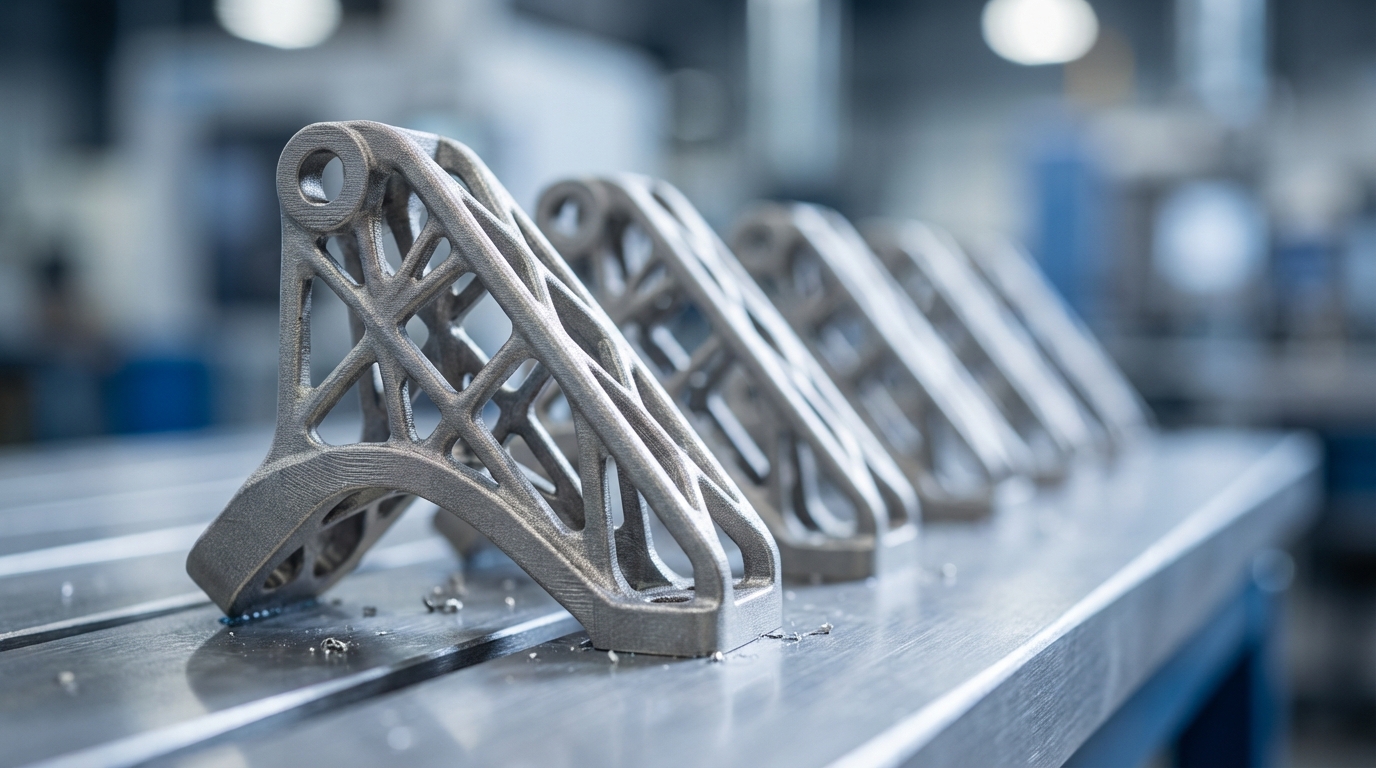
Aerospace manufacturers apply additive manufacturing to structural components where weight reduction and complex geometry create clear performance gains. Typical use cases include brackets, engine mounts, ducting systems, and airframe components that benefit from topology optimization and consolidated assemblies.
Airbus uses wire-directed energy deposition (w-DED) for A350 cargo door surround components that replaced traditional forged parts. Boeing has demonstrated practical AM implementation for fastener hardware, and SpaceX consolidated multiple engine parts in the Raptor rocket to cut weight and simplify assemblies.
Key structural component categories include:
- Engine brackets and mounts that require high-temperature resistance
- Airframe brackets with complex, multi-directional load paths
- Ducting systems with integrated cooling channels
- Satellite structural nodes and frames
- UAV components tuned for weight-critical missions
Topology optimization removes material from low-stress regions while maintaining required strength, which delivers significant weight savings in these applications. Request a quote for hybrid AM aerospace structural components to see how these approaches can support your program.
Leading AM Technologies and Materials for Aerospace Structures
Metal powder bed fusion (PBF) and directed energy deposition (DED) dominate aerospace structural component production, with each process suited to specific geometries and volumes. PatSnap’s 2026 analysis of 70 patent records identifies PBF and DED as core technologies for titanium, nickel superalloys, and aluminum structural parts. The comparison below shows how each technology balances precision, tolerances, and throughput so you can align the process with your component requirements.
| Technology | Materials | Typical Tolerances | Production Speed |
|---|---|---|---|
| Laser Powder Bed Fusion (L-PBF) | Ti6Al4V, AlSi10Mg | ±0.1mm | Shorter lead times for small and medium brackets |
| Direct Metal Laser Sintering (DMLS) | Ti6Al4V, Inconel 718 | ±0.1mm | Higher throughput than casting for complex parts |
| Directed Energy Deposition (DED) | Titanium, Nickel superalloys | ±0.2-0.5mm | Several kg/hour deposition |
| Wire Arc AM (WAAM) | Steel, Aluminum, Titanium | ±1-3 mm | High build rates for large structural parts |
Norsk Titanium’s plasma-based DED achieves high deposition rates for large titanium aerospace parts using real-time closed-loop control. Ti6Al4V Grade 5 titanium delivers high tensile strength with an excellent strength-to-weight ratio for demanding structural components.
Benefits and Quantified Advantages for Aerospace Programs
Additive manufacturing delivers measurable gains across schedule, mass, and cost, turning traditional design and manufacturing constraints into program advantages.
Key quantified benefits include:
- Lead time reduction of 50–80% compared to traditional manufacturing
- Components up to 50% lighter than traditionally manufactured counterparts through topology optimization of brackets, manifolds, and structural nodes
- Up to 30% cost savings in production compared to traditional methods
- Design freedom that enables internal cooling channels and lattice structures not achievable with conventional processes
2026 IMTS trends highlight multi-material AM capabilities that support embedded sensors and advanced functionality within structural components. These benefits translate into fuel savings, higher payload capacity, and more efficient platforms across commercial, defense, and space programs.
However, realizing these gains in flight-critical hardware requires alignment with strict aerospace certification frameworks that have guided traditional manufacturing for decades.
Certification Challenges and Solutions in Aerospace AM
Aerospace additive manufacturing faces significant certification hurdles, and hybrid approaches help close these gaps through proven post-processing and quality controls.
Primary certification challenges include limited historical industry data, achieving production-level part-to-part repeatability, and understanding Key Process Variables (KPVs) that drive final part performance. These issues make it difficult to certify AM metal components within existing airworthiness structures without robust process definition.
Critical certification elements include:
- Management of material anisotropy and structural non-uniformity
- Advanced non-destructive inspection (NDI) to detect internal defects
- Process Control Specimens (PCS) for ongoing production verification
- Development of fatigue crack growth and fracture toughness data across build conditions
The AIA guidance provides methods of compliance for PBF and DED processes to FAA regulations including 14 CFR 2x.603, 2x.605, and 2x.613. The framework emphasizes building block test pyramids that progress from microstructure characterization to full vehicle validation. Meeting these certification requirements exposes fundamental limitations in pure AM processes that hybrid approaches are designed to solve.
AM Limitations and the Hybrid Advantage with Precision Machining
Pure additive manufacturing struggles to meet surface finish and dimensional tolerance requirements for flight-critical aerospace components. PBF processes often fail to achieve required surface roughness values, so conventional surface finishing such as machining becomes mandatory to reach aerospace specifications.
Critical AM limitations stem from the layer-by-layer build process and demand integrated post-processing to meet aerospace standards:
- Surface roughness of Ra 5–20 µm from powder-based processes that requires machining to reach aerospace finish specifications
- Dimensional tolerances that exceed ±0.1 mm and call for precision CNC machining on critical features
- Residual stress from rapid thermal cycling that needs heat treatment before final machining
- Support structures that enable complex geometries but must be removed and finished to drawing requirements
Precision Advanced Manufacturing addresses these limitations with integrated hybrid capabilities that combine AM with precision post-processing. Multi-axis CNC machining achieves ±0.0004″ tolerances, while TIG and MIG welding support distortion control for complex assemblies. Complete fabrication, deburring, and finishing services keep all certification-critical steps under one roof.
This hybrid approach supports scalable production from prototype through full-rate manufacturing while maintaining aerospace quality standards. AS9100D and ITAR-compliant processes provide the traceability and documentation required for flight-critical applications. Request a quote for hybrid AM aerospace structural components to apply these integrated capabilities to your next build.
Selecting a Reliable Hybrid AM Partner for Aerospace Programs
Choosing the right additive manufacturing partner requires careful evaluation of certifications, integrated capabilities, and proven aerospace performance. The table below highlights the key differentiators that separate fully integrated hybrid providers from vendors that rely on multi-party coordination.
| Evaluation Criteria | Requirements | Precision Advanced Manufacturing | Typical Competitors |
|---|---|---|---|
| Certifications | AS9100D, ITAR, ISO 9001 | Full compliance with documentation | Limited or partial compliance |
| Integrated Capabilities | AM + CNC + Welding + Finishing | Complete under one roof | Multiple vendor coordination |
| Scalability | Prototype to production | Multi-shift capacity | Limited production scaling |
| Geographic Presence | U.S.-based for ITAR compliance | California and Texas facilities | Variable domestic presence |
Precision Advanced Manufacturing’s track record in space, satellite, and UAV applications gives program teams confidence for mission-critical work. Engineering support covers manufacturability analysis, tooling development, and process refinement to keep programs on schedule from initial design through sustained production.
Frequently Asked Questions About Hybrid AM for Aerospace
Is additive manufacturing reliable for flight-critical structural components?
Additive manufacturing supports flight-critical components when paired with hybrid post-processing and robust certification protocols. The FAA and EASA now provide frameworks for AM component approval that require comprehensive testing, process control, and quality documentation. Hybrid workflows that combine AM with precision machining and finishing deliver the surface finish, dimensional accuracy, and material properties needed for reliable flight hardware.
What post-processing techniques are essential for aerospace AM parts?
Essential post-processing steps include stress relief heat treatment, hot isostatic pressing (HIP) to reduce porosity, precision machining for critical surfaces, support removal, and surface finishing. Powder removal from internal passages, dimensional verification, and non-destructive testing confirm that parts meet aerospace specifications. The exact sequence depends on part criticality, material choice, and application requirements.
How do hybrid AM-subtractive methods benefit aerospace applications?
Hybrid methods combine AM design flexibility with subtractive manufacturing precision and surface quality. This combination enables complex internal geometries while still achieving tight tolerances and smooth finishes required for aerospace hardware. Hybrid workflows shorten lead times versus traditional manufacturing while maintaining the quality and reliability standards demanded for flight-critical components.
What certifications does Precision Advanced Manufacturing maintain for aerospace work?
Precision Advanced Manufacturing operates under AS9100D and ISO 9001:2015 quality management systems and maintains ITAR registration for defense and space programs. These certifications support compliance with aerospace quality standards, traceability expectations, and regulatory frameworks for flight-critical component production.
Can additive manufacturing scale from prototype to full production in aerospace?
Modern AM systems and hybrid workflows scale from single prototypes to multi-shift production environments. Successful scaling requires process qualification, statistical process control, and integrated post-processing capabilities. Precision Advanced Manufacturing’s platform supports smooth transitions from development through sustained production while maintaining consistent quality and certification compliance.
The aerospace additive manufacturing market is projected to reach USD 44.96 billion by 2035, driven by hybrid approaches that deliver certified, flight-ready structural components. As the industry adopts these advanced methods at scale, partnering with experienced hybrid providers becomes a core requirement for program success. Request a quote for hybrid AM aerospace structural components today to apply Precision Advanced Manufacturing’s capabilities to your next mission-critical program.