
Key Takeaways
- Aerospace manufacturing in 2026 demands advanced capabilities like multi-axis CNC machining, precision welding, and hybrid additive processes to meet tight tolerances and exotic materials.
- AS9100D, ITAR, and ISO 9001 certifications with full traceability are essential for compliance in defense and space programs.
- Scalability from prototypes to multi-shift production requires flexible facilities and proven capacity planning to support growing program demands.
- Integrated services including finishing, kitting, hardware installation, and laser marking reduce supply chain risks and ensure single-source accountability.
- Partner with Precision Advanced Manufacturing for AS9100D-certified, ITAR-compliant expertise serving leading commercial space programs and request a quote today.
Defining Advanced Manufacturing Services in Aerospace
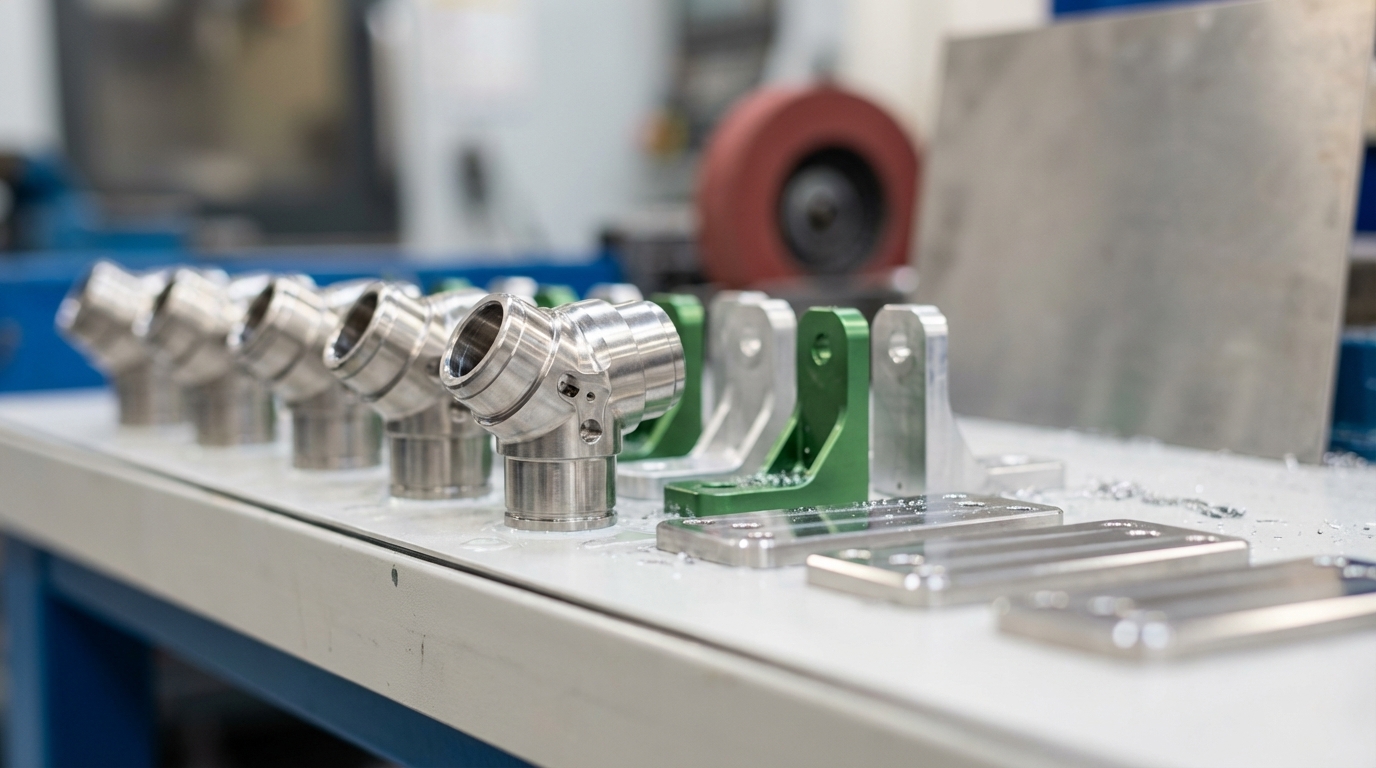
Advanced manufacturing services in aerospace cover high-precision processes such as multi-axis CNC machining, precision sheet metal fabrication, TIG and MIG welding, and integrated finishing services. These capabilities support tight-tolerance components for commercial aircraft, defense systems, space applications, and UAVs.
In 2026, greater use of 3D printing for production parts, especially complex geometries that reduce weight and consolidate components, with hybrid approaches combining additive processes with precision machining defines the evolving landscape. These services also integrate digital twins, automated inspection systems, and AI-driven scheduling to meet the demanding requirements of mission-critical aerospace applications. The first and most fundamental criterion for evaluating these services is the breadth and depth of technical capabilities.
1. Technical Capabilities: Multi-Axis CNC, Fabrication, Welding
Precision CNC Machining and Tolerances for Aerospace Components
Technical capabilities form the foundation of aerospace manufacturing excellence. Automation including robotic machining, automated inspection, and AI-driven scheduling tools will reduce lead times and enhance repeatability in 2026. This shift makes it essential to evaluate suppliers based on their multi-axis CNC capabilities, achievable tolerances of ±0.002″ or better for critical components, and capacity to handle exotic materials up to 10″ thick.
Precision Advanced Manufacturing operates advanced multi-axis equipment with Dynamic Waterjet technology that virtually eliminates taper, handling materials up to 96″x240″ with exceptional precision. Key evaluation criteria include integrated fabrication capabilities that combine CNC machining with precision welding and proven experience with superalloys and composite materials used in next-generation aerospace applications.
2. Quality and Compliance: AS9100D, ISO 9001, ITAR, Traceability
Meeting ITAR and Aerospace Quality Standards
Quality certifications and compliance frameworks represent non-negotiable requirements for aerospace suppliers. AS9100D incorporates over 100 additional requirements beyond ISO 9001:2015, including product safety, counterfeit parts prevention, and comprehensive risk management. Verify that suppliers maintain current AS9100D, ISO 9001, and ITAR registrations supported by robust documentation systems. Risk-based supplier classification requires Class A high-risk suppliers to maintain AS9100 and NADCAP certifications with financial assessments showing Altman Z-scores greater than 3.0.
Precision Advanced Manufacturing operates under full AS9100D and ITAR compliance, providing complete traceability and material certifications that reduce audit complications and keep defense and space programs aligned with regulatory expectations.
Get a quote from our AS9100D and ITAR-certified facilities to ensure your program meets all regulatory requirements.
3. Materials Expertise: Superalloys, CMCs, Exotics
Machining Exotic Aerospace Materials with Confidence
Materials expertise becomes increasingly critical as aerospace applications rely on advanced alloys and composite materials. By 2026, model-based definitions and digital twins will play a larger role in design, simulation, and testing, accelerating timelines and improving accuracy for complex material applications. Evaluate suppliers’ experience with titanium alloys, nickel-based superalloys, ceramic matrix composites, and other exotic materials that need specialized tooling and thermal management.
Building on the thick-material capabilities mentioned earlier, Precision Advanced Manufacturing applies advanced waterjet and laser cutting technologies with proven expertise in ballistic materials, carbon fiber composites, and aerospace-grade alloys. Suppliers should also demonstrate material traceability, proper storage protocols, and handling procedures that protect material integrity from receipt through final shipment.
4. Scalability: Prototype to Multi-Shift Production
Scaling Aerospace Production from First Article to Full Rate
Scalability determines whether a supplier can support program growth from early prototypes to full-rate production while maintaining quality and delivery performance. Boeing targets 47 per month MAX production by end of 2026 while Airbus targets more than 800 aircraft per year across families, creating strong demand for scalable manufacturing partners. Assess suppliers’ multi-shift capabilities, capacity planning systems, and ability to hold consistent quality across changing volumes.
Precision Advanced Manufacturing’s approximately 52,000 square foot facilities in California and Texas provide flexible, multi-shift operations designed to scale as program requirements grow. Key indicators include documented capacity planning, established workforce training programs, and proven production ramps completed without quality issues or missed deliveries.
5. Integrated Services: Finishing, Kitting, Hardware Install, Laser Marking
Reducing Supply Chain Fragmentation with One-Stop Services
Integrated service offerings reduce supply chain fragmentation that often causes delays and quality problems in aerospace programs. Fragmented systems in aerospace manufacturing cause operational complexity, such as delays in design revisions reaching the shop floor, prolonged material issue tracing, and quality problems detected only downstream after multiple operations.
Evaluate suppliers that provide secondary finishing such as anodizing, passivation, and plating, along with hardware installation, kitting, and laser marking under one roof. Precision Advanced Manufacturing offers integrated brush finishing, laser marking with ±0.0004″ repetition accuracy, PEM hardware installation, and complete kitting services. This integration supports consistent quality control, simpler logistics, and lower program risk through single-source accountability.
Get a quote for integrated manufacturing services that eliminate supply chain fragmentation.
6. Engineering Support: CAD/CAM, Manufacturability Optimization
Engineering-Driven Manufacturing for Aerospace Programs
Engineering support capabilities separate advanced manufacturing partners from basic machine shops. Integrated real-time manufacturing visibility connecting engineering, production, and procurement reduces pre-production time by up to 90 percent in leading aerospace manufacturers. Evaluate suppliers’ CAD and CAM capabilities, design for manufacturability expertise, and ability to refine designs for production efficiency.
Precision Advanced Manufacturing provides in-house engineering support including CNC programming, tooling development, and manufacturability improvements that strengthen efficiency from project kickoff. Suppliers should show advanced CAD and CAM systems, experienced engineering teams, and collaborative design reviews that catch potential issues before production, cutting costly design changes and schedule slips.
7. Reliability and Risk Reduction: Delivery, Documentation, Proof
Lowering Program Risk with Proven Aerospace Partners
Reliability metrics give clear insight into supplier performance and overall program risk. Supplier Quality Rating assesses performance across quality, delivery, cost, and service with critical metrics including incoming inspection pass rates, on-time delivery, corrective action response times, and supplier escape rates.
Evaluate suppliers’ on-time delivery performance, quality escape rates, and responsiveness to corrective actions. As discussed in the technical capabilities section, maintaining a high on-time delivery threshold remains critical for program success.
Precision Advanced Manufacturing demonstrates reliability with comprehensive quality documentation, including inspection reports and material certifications that support mission-critical aerospace applications. Effective risk reduction depends on suppliers with mature quality systems, financial stability, and a track record in applications where failure is not acceptable.
Frequently Asked Questions
What are advanced manufacturing services in aerospace?
Advanced manufacturing services in aerospace include precision CNC machining, sheet metal fabrication, welding, and finishing processes that produce high-tolerance components for commercial aircraft, defense systems, space applications, and UAVs. These services use technologies such as multi-axis machining, automated inspection, and digital manufacturing systems to meet stringent aerospace requirements.
Precision Advanced Manufacturing provides comprehensive advanced manufacturing services including multi-axis CNC machining, precision welding with thermal distortion control, and integrated finishing services under AS9100D and ITAR compliance.
What are ITAR compliant manufacturing aerospace requirements?
ITAR compliant manufacturing requires registration with the State Department, strong security protocols, controlled access to technical data, and complete documentation of all personnel with access to controlled information. Suppliers must maintain secure facilities, apply proper export controls, and provide full traceability for all components and materials.
Precision Advanced Manufacturing maintains full ITAR registration with established security protocols, controlled access systems, and detailed documentation procedures that support compliance for defense and space-related programs.
How do you ensure scalable production for aerospace prototypes?
Scalable production depends on established quality systems, flexible manufacturing processes, documented capacity planning, and the ability to hold consistent quality across changing volumes. Successful scaling also involves multi-shift capabilities, a trained workforce, and integrated systems that support smooth transitions from prototype to full-rate production. The dual-facility footprint mentioned earlier provides multi-shift operations with processes that scale from single prototypes to high-volume production while maintaining the AS9100D standards detailed earlier.
What qualifies AS9100D suppliers for UAV components?
AS9100D qualified suppliers must show comprehensive quality management systems, risk management protocols, product safety controls, and counterfeit parts prevention measures tailored to aerospace. UAV component suppliers also need expertise in lightweight materials, complex geometries, and rapid production cycles.
Precision Advanced Manufacturing combines AS9100D certification with specialized UAV experience, providing precision machining for complex geometries, exotic materials expertise, and integrated services that support the unique needs of unmanned aerospace systems.
How do suppliers handle complex geometries and exotic materials?
Suppliers handle complex geometries and exotic materials using advanced multi-axis CNC equipment, specialized tooling, thermal management expertise, and machinists trained in aerospace applications. They must demonstrate capability with materials such as titanium alloys, superalloys, ceramic matrix composites, and carbon fiber while holding tight tolerances and surface finish requirements.
Precision Advanced Manufacturing utilizes advanced multi-axis CNC equipment, Dynamic Waterjet technology, and specialized expertise to work with the previously mentioned 10″ material thickness capacity for demanding aerospace applications.
Conclusion: A Practical Framework for 2026 Supplier Selection
These seven criteria create a practical framework for selecting advanced manufacturing partners that can support aerospace programs in 2026’s challenging environment. The most critical factors include compliance and quality certifications, scalability from prototype to production, and integrated service offerings that reduce supply chain fragmentation. The U.S. Aerospace Parts Manufacturing Market was valued at USD 278.10 billion in 2025 and is projected to reach USD 346.72 billion by 2035, creating significant opportunities for programs aligned with reliable, certified suppliers.
Precision Advanced Manufacturing reflects these standards with dual facilities in California and Texas, comprehensive AS9100D and ITAR compliance, and the aerospace client relationships discussed earlier. Their integrated approach combining multi-axis CNC machining, precision fabrication, and finishing services under NAICS 332710 delivers the reliability, scalability, and quality required for mission-critical aerospace applications.
Request your quote today to secure your program’s success in 2026 and beyond.