
Key Takeaways
- CNC laser cutting holds ultra-tight tolerances from ±0.0005″ to ±0.002″, which supports flight-critical airframe and engine components.
- Processes aerospace-grade metals such as titanium, Inconel, aluminum, and stainless steel up to 1″ thick with laser and 10″ with waterjet.
- Delivers minimal heat-affected zones, clean edges, fast cycle times, and complex geometries without dedicated tooling.
- Meets AS9100D, ISO 9001:2015, and ITAR requirements with full traceability for defense, space, and commercial aerospace programs.
- Precision Advanced Manufacturing offers integrated laser cutting, machining, and finishing services for scalable aerospace production; request a quote today to match your specifications.
Precision Tolerances for Flight-Critical Laser-Cut Components
Aerospace components demand tighter tolerances than typical industrial parts. Ultra-precision tolerances of ±0.0005 inches (0.012 mm) or smaller are achievable in high-quality fabrication for tight geometries and demanding materials. For most aerospace parts, tight tolerances typically fall between ±0.001 and ±0.002 inches (0.025–0.050 mm).
Modern fiber laser systems support this level of accuracy on production runs. Fiber laser cutting achieves tolerances of ±0.03–0.05 mm, which are used on aerospace turbine components with near-zero margin of error. Consistent tolerance control in aerospace directly reduces component failures linked to fabrication errors, which protects both performance and safety.
|
Material |
Achievable Tolerance |
Repeatability |
HAZ Characteristics |
|
Titanium Alloys |
±0.002″ |
±0.001″ |
Minimal thermal distortion |
|
Inconel |
±0.03-0.05mm |
±0.001″ |
Controlled heat-affected zone |
|
Aluminum |
±0.001″ |
±0.0005″ |
Excellent edge quality |
|
Stainless Steel |
±0.002″ |
±0.001″ |
Superior surface finish |
Precision Advanced Manufacturing’s precision sheet metal fabrication and laser cutting processes hold these tight tolerances on real aerospace hardware. The team produces complex geometries while maintaining the dimensional accuracy required for reliable assemblies and repeatable fit-up.
Aerospace Metals and Thickness Capabilities
Aerospace CNC laser cutting covers titanium, Inconel, aluminum, stainless steel, and other specialty alloys, each with specific power and process windows. Both titanium alloys and Inconel for aerospace typically use 1000-1500W for thin sheets up to 1mm, 1500-2500W for 1-5mm sections, and 2500-4000W for material thicker than 5mm.
These power levels define the practical thickness range for each metal. For aluminum, 3kW systems cut about 6mm, 6kW systems reach about 12mm, and 8kW systems reach about 20mm. For stainless steel, 3kW handles about 8mm, 6kW about 15mm, and 8kW about 25mm, while carbon steel can reach about 40mm at 8kW. These ranges guide process selection for each program.
The following comparison shows how maximum thickness capabilities differ between laser and waterjet cutting across primary aerospace materials:
|
Material |
Laser Max Thickness |
Waterjet Max Thickness |
Typical Applications |
|
Titanium |
1″ (25.4mm) |
10″ |
Structural components, fasteners |
|
Inconel |
1″ (25.4mm) |
10″ |
Engine components, heat shields |
|
Aluminum |
1″ (25.4mm) |
10″ |
Airframe structures, panels |
|
Stainless Steel |
1″ (25.4mm) |
10″ |
Brackets, housings, fittings |
Precision Advanced Manufacturing runs laser cutting up to 1″ thick and Dynamic Waterjet cutting up to 10″ thick, which covers most aerospace plate and sheet requirements. The team also supports exotic alloys and specialized aerospace materials, with the exception of tempered glass and beryllium copper.
Core Aerospace Applications for CNC Laser Cutting
CNC laser cutting supports many of the most demanding aerospace manufacturing programs. The defense and aerospace sector holds about 10% of the global laser cutting machines market, reflecting strong adoption for lightweight materials, advanced alloys, and high-performance designs.
Primary aerospace applications include:
- Airframe structural components that require complex geometries and reduced weight
- Engine components and turbine parts that rely on heat-resistant materials and precise tolerances
- Satellite and spacecraft structures that operate in extreme thermal and vacuum conditions
- UAV components that demand lightweight construction and aerodynamic profiles
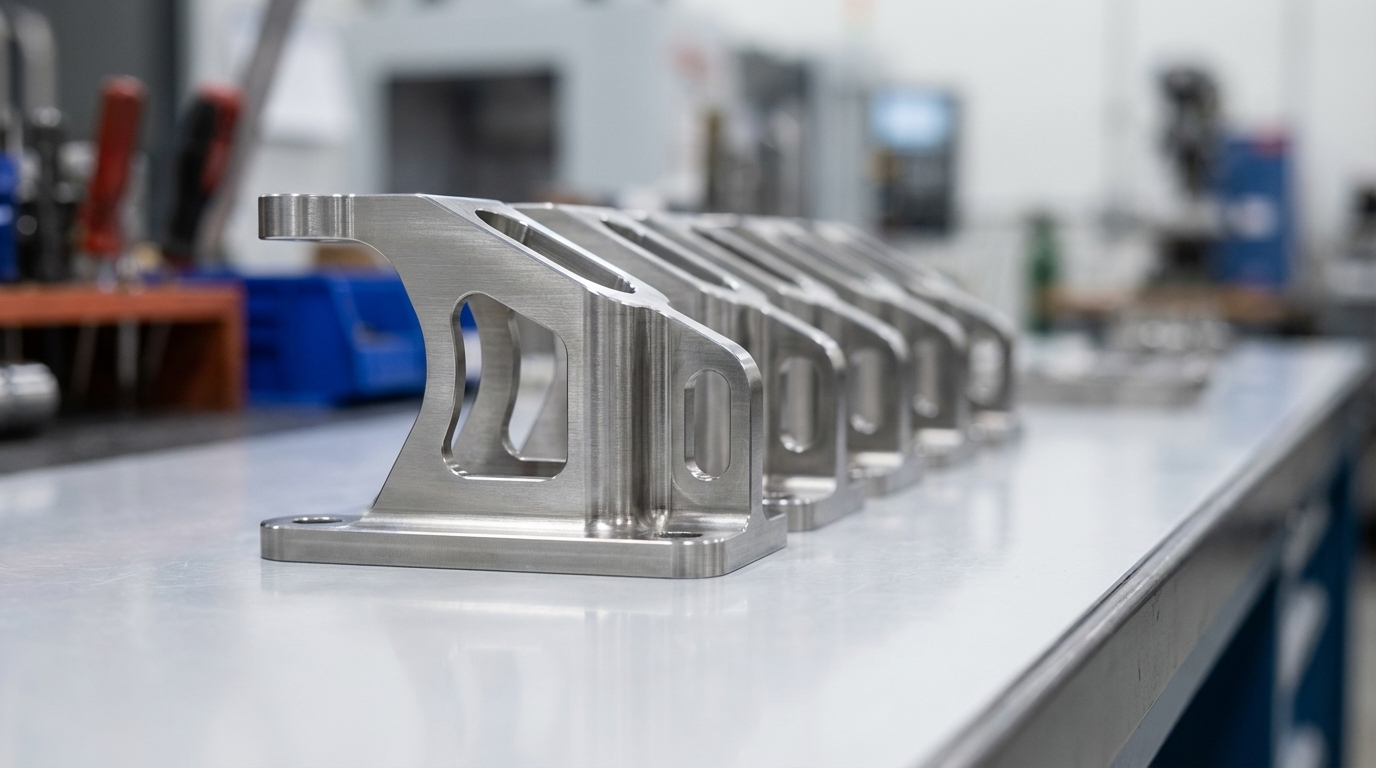
- Brackets, housings, and mounting hardware with intricate hole patterns and features
Laser cutting now plays a central role in aerospace manufacturing by providing precise, repeatable, and fast cutting for metals, alloys, and composites, which supports complex geometries, lower scrap, and higher throughput. Precision Advanced Manufacturing applies these capabilities to space and UAV programs, supplying components that perform reliably in both orbital and atmospheric environments.
Laser Cutting Technology Advantages for Aerospace Programs
Modern CNC laser cutting technology improves both part quality and production efficiency for aerospace metal fabrication. Fiber and CO2 lasers both support high-speed sheet processing with a small heat-affected zone and tight kerf control. Fiber lasers perform especially well on metals such as stainless steel and aluminum, which makes them a strong fit for high-precision aerospace work.
Key technological advantages include:
- Minimal heat-affected zones that help preserve base material properties
- Clean edge quality that reduces or eliminates secondary deburring and finishing
- High cutting speeds that shorten production cycles and support tight schedules
- Automated operation that improves consistency and repeatability across batches
- Capability to cut complex geometries without changing hard tooling
Laser welding, which uses related technology, also delivers high precision with a small heat-affected zone and low distortion, which suits delicate high-precision components. Precision Advanced Manufacturing combines CNC laser cutting with waterjet cutting, welding, and finishing services in one workflow. This integrated approach removes handoffs between suppliers and keeps quality control under a single system.
Teams that want to improve aerospace manufacturing efficiency can rely on precision laser cutting as a core process. Request a quote for CNC laser cutting capabilities to explore integrated fabrication support for your next program.
Aerospace Compliance, Certifications, and Production Scalability
Aerospace manufacturing standards continue to evolve as programs grow more complex. AS9100 will transition to IA9100 in 2026, which reflects the global nature of aerospace supply chains. The new standard adds product safety requirements such as continuous hazard analysis, stronger traceability, anonymous reporting, and deeper integration into the quality management system.
Critical compliance elements include:
- AS9100D certification with transition planning for IA9100, which defines the aerospace-specific quality framework
- ISO 9001:2015 quality management systems that provide the core quality processes
- ITAR registration for defense and space applications, required for controlled technologies
- Complete material traceability and documentation that support both AS9100D and ITAR obligations
- Counterfeit parts prevention protocols that protect supply chain integrity and program reliability
Precision Advanced Manufacturing holds AS9100D, ISO 9001:2015, and ITAR registrations and actively prepares for IA9100 requirements. The company’s scalable production platform supports smooth transitions from prototype builds to multi-shift production. Customers can increase volume as programs grow while maintaining quality and delivery performance.
Why Aerospace OEMs Choose Precision Advanced Manufacturing
Precision Advanced Manufacturing combines aerospace experience with integrated fabrication capabilities. Two specialized facilities in California and Texas, totaling about 52,000 square feet, support leading programs such as SpaceX, Blue Origin, and Firefly Aerospace.
Key competitive advantages include:
- Advanced multi-axis CNC machining and precision sheet metal fabrication that support tight tolerances
- Integrated laser cutting, waterjet cutting, machining, welding, and finishing within a single supplier
- Materials handling up to 96″ x 240″ with laser cutting to 1″ thick and waterjet cutting to 10″ thick
- Dynamic Waterjet technology that removes taper and improves accuracy on thick materials
- Complete finishing services including laser marking, deburring, hardware installation, and secondary treatments
The company’s engineering support team reviews designs early and improves manufacturability, which reduces production costs and strengthens component performance. This end-to-end approach reduces supplier fragmentation and keeps quality control aligned with mission-critical aerospace requirements.
Teams that need proven aerospace manufacturing support can work directly with Precision Advanced Manufacturing. Request a quote for CNC laser cutting capabilities and see how an integrated partner can support your next launch or flight program.
Frequently Asked Questions
What are the maximum material thicknesses achievable with different laser power levels?
Laser cutting capabilities depend on both material type and power level. For aerospace work, 1000-1500W systems typically cut thin sheets up to 1mm. Power levels from 1500-2500W handle medium thicknesses from 1-5mm. Sections thicker than 5mm usually require 2500-4000W systems. Precision Advanced Manufacturing’s laser equipment cuts materials up to 1″ thick, and waterjet systems extend thickness capacity to 10″ for heavy sections.
What tolerances can be achieved when cutting Inconel and titanium alloys?
Inconel cutting can reach tolerances of ±0.03-0.05mm with proper process control. Titanium alloys can be cut to ±0.002″ tolerances. Repeatability within ±0.001″ is typical for both materials when using calibrated fiber laser systems. These tolerance levels support aerospace requirements for flight-critical structures and engine components.
How do AS9100D and ITAR certifications impact laser cutting services?
AS9100D certification confirms that quality management systems meet aerospace expectations for process control, traceability, and documentation. ITAR registration authorizes work on defense and space programs that involve controlled technologies. Together, these certifications require robust procedures, verified material certifications, and complete traceability from raw material through finished part.
Can laser cutting services scale from prototype to full production volumes?
Modern laser cutting operations scale effectively from single prototypes to multi-shift production. Automated programming and stable process parameters support consistent results at any volume. Integrated quality control maintains tolerances and delivery performance as quantities increase. Multi-axis capabilities and advanced nesting software also improve material utilization across production runs.
How are complex geometries achieved on exotic aerospace materials?
Advanced fiber laser systems with multi-axis control create complex geometries on exotic materials through precise beam positioning and tuned cutting parameters. Dynamic cutting heads compensate for thickness variation, and specialized assist gases help manage the heat-affected zone. Programming expertise defines efficient tool paths that protect dimensional accuracy on intricate features.
Aerospace manufacturing requires precision, compliance, and reliability from every supplier. Precision Advanced Manufacturing combines advanced CNC laser cutting with deep aerospace experience to deliver the tolerances, material capabilities, and scalability that mission-critical applications demand. From early prototypes through full-rate production, the company’s integrated approach supports consistent quality while meeting stringent aerospace standards.