Key Takeaways
- Sourcing flight-critical space hardware from unqualified suppliers creates compliance failures, traceability gaps and schedule risk that programs cannot absorb.
- Qualified CNC providers hold AS9100D certification, ITAR registration, NADCAP accreditation for special processes and maintain full material traceability with AS9102 First Article Inspection.
- Texas space infrastructure growth, supported by nearly $150 million in grants through early 2026, increases demand for compliant local suppliers near major programs.
- Integrated manufacturing capabilities under one roof reduce program risk by removing supplier handoffs, documentation gaps and compliance exposure.
- Precision Advanced Manufacturing delivers AS9100D and ITAR-compliant integrated CNC machining for space components in Texas, and teams can request a quote to evaluate capabilities for the next program.
Space-Qualified CNC Requirements for Flight Hardware
Not every machine shop produces flight-critical hardware. Qualification starts with AS9100D certification, the aerospace quality management standard that enforces risk management, supplier oversight, process validation, non-conformance control and Statistical Process Control. Without AS9100D, a shop lacks the documented process discipline that space programs require.
ITAR registration is a separate, mandatory requirement. Under 22 CFR Part 120, any U.S. manufacturer of defense articles, including space and satellite components classified under USML Category XV, must register with the Directorate of Defense Trade Controls. ITAR registration remains mandatory for suppliers that handle space hardware.
Beyond AS9100D and ITAR, qualified shops support NADCAP-accredited special processes such as welding, heat treatment and nondestructive testing. First Article Inspection per AS9102 is mandatory for new aerospace parts and validates dimensional conformity, process capability and manufacturing repeatability before production begins. Full material traceability, including mill test certificates, heat-lot records, test results and conformance to AMS, ASTM or MIL specifications, must accompany every shipment.
Precision Advanced Manufacturing operates under AS9100D and ISO 9001:2015 certified quality systems and is ITAR registered. Every program runs with defined quality checkpoints, full traceability and complete documentation aligned to aerospace standards.
Texas Space Ecosystem and Supplier Proximity
Meeting qualification requirements is necessary, and location determines whether a supplier can support timelines and reduce logistical risk. Texas has become one of the most active space manufacturing ecosystems in the United States. The state hosts four spaceports or launch sites: Launch Site One West Texas (Blue Origin), Boca Chica (SpaceX), Houston Spaceport at Ellington Airport and Midland Spaceport. Proximity to Johnson Space Center in Houston places Texas suppliers inside the supply chains of major launch-vehicle and spacecraft programs.
State investment accelerates demand. The Texas Space Commission’s operating fund transfers rose from $155 million in FY 2024 to $387.9 million in FY 2026, a 150.3% increase, with total revenues nearing $1 billion from inception through FY 2026. By February 2026, the Commission had awarded nearly $150 million in competitive grants for spaceport development, space-related technology, research and workforce development.
That level of public investment translates directly into hardware demand. Programs funded through spaceport infrastructure and commercial space technology grants require qualified local suppliers that produce precision components on schedule. A Texas-based CNC provider with AS9100D and ITAR compliance reduces freight exposure, time zone friction and security risk compared to sourcing from out-of-state facilities.
Precision Advanced Manufacturing’s Texas operations position the company inside this ecosystem, supporting space and satellite programs that require proximity, compliance and integrated manufacturing capability.
Verifying ITAR Registration and Digital Traceability
ITAR compliance is not self-reported. Procurement teams request a supplier’s DDTC registration number and verify active status directly. Registration must cover the specific defense articles being manufactured, not just a general category. Suppliers that handle USML Category XV space and satellite components demonstrate that access controls, visitor logs and data-handling procedures meet ITAR requirements.
Digital traceability systems that link each part to raw material certificates, inspection data and operator records create reliable audit trails for aerospace and defense quality systems. Procurement teams request evidence of these systems before awarding work, not after a non-conformance event.
Precision Advanced Manufacturing’s ITAR-registered, AS9100D-certified quality system maintains complete audit trails from raw material receipt through final inspection. Material certifications, process records and inspection data are documented at every production step and support both internal audits and customer source inspections.
Teams ready to evaluate Precision Advanced Manufacturing for an upcoming space program can request a quote for Texas space CNC machining.
Core Certification and Compliance Checklist for Space CNC
A qualified space CNC supplier satisfies several concurrent compliance requirements, and each one addresses a distinct risk. AS9100D certification confirms that the quality management system meets aerospace standards and establishes the process framework that governs other requirements. Within that framework, ITAR registration confirms that the supplier is authorized to manufacture defense articles, while material certifications confirm that raw stock meets the specified AMS, ASTM or MIL standard.
These static qualifications require active process controls. SPC data confirms that process capability is monitored and controlled in production. Non-conformance control procedures confirm that out-of-spec conditions are documented, dispositioned and prevented from recurring.
These AS9100D requirements create the documented process discipline that space programs depend on, with capability studies that detect variation early.
Precision Advanced Manufacturing operates under the same certified quality management system across all applicable programs. The system covers every production step, from incoming material inspection through final dimensional verification and documentation package assembly.
Materials and Tolerances for Satellite and Launch Components
Space hardware operates in environments that demand material integrity and dimensional precision beyond standard commercial machining. Satellite brackets, optical mounts and launch vehicle structural components are typically produced from titanium alloys, aluminum alloys, Inconel, stainless steel and other exotic materials selected for strength-to-weight ratio, thermal stability and corrosion resistance.
Typical aerospace CNC requirements include tight tolerances for structural parts and surface finishes that meet aerospace expectations. These specifications protect structural performance and interface fit in orbital and launch conditions.
Consistent achievement of these tolerances requires multi-axis CNC capability. Multi-axis CNC milling expands manufacturability for complex aerospace geometries and reduces design constraints compared to shops limited to fewer axes.
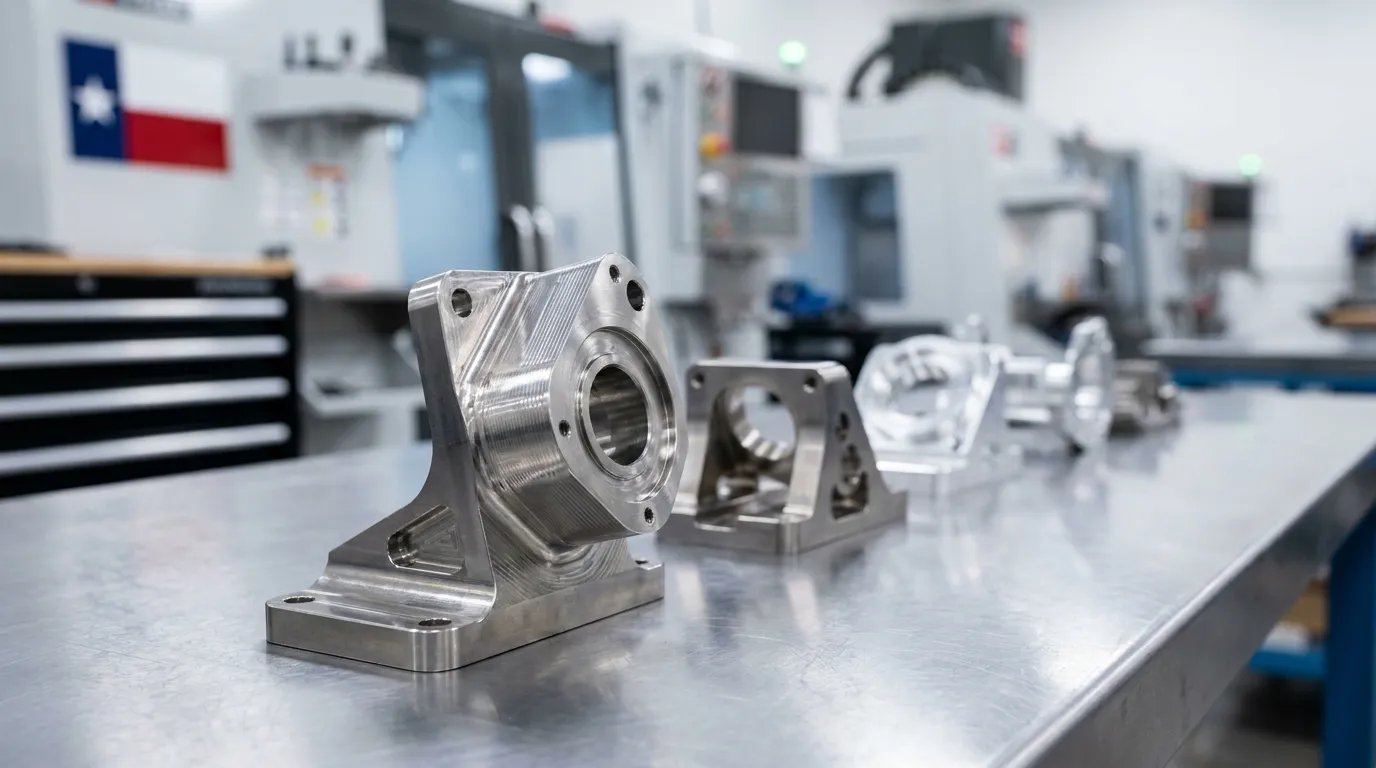
Precision Advanced Manufacturing’s multi-axis CNC machining platform handles complex geometries and exotic alloys across prototype and production volumes. In-house CNC programming and tooling development support design-for-manufacturability reviews that improve producibility before cutting begins.
Required Documentation for Every Space Component Shipment
A complete documentation package is mandatory for flight-critical hardware. Every shipment includes mill test certificates traceable to the original heat lot, a First Article Inspection report per AS9102 for new part numbers, dimensional inspection data for all critical characteristics, process certifications for any special processes performed and a certificate of conformance signed by an authorized quality representative.
Non-conformance reports and disposition records remain available on request. Programs subject to customer source inspection require that all records stay accessible during the inspection visit. Gaps in documentation create airworthiness risk and can trigger supplier corrective action requests that delay program schedules.
Precision Advanced Manufacturing delivers complete documentation packages with every shipment, including material certifications, inspection reports and traceability records. The quality system supports customer audits and source inspections without additional preparation.
Integrated Manufacturing vs Fragmented Supply Chains
Vertically integrated CNC manufacturing partners keep parts under one secure roof and reduce delays, freight costs and security exposure from moving components between multiple vendors. Each handoff between suppliers introduces a new opportunity for damage, documentation loss, schedule slippage and compliance exposure.
Fragmented supply chains also create quality management reconciliation problems. When machining, welding, finishing and kitting occur at separate suppliers under different quality systems, traceability chains become difficult to maintain and audit findings multiply.
Single-vendor accountability for prototype-to-production programs lowers compliance risk, communication overhead and the need to reconcile multiple quality systems.
Precision Advanced Manufacturing consolidates multi-axis CNC machining, precision metal fabrication, specialty welding with thermal distortion control, kitting, hardware installation, secondary finishing and laser marking under one roof across its two-facility Texas and California platform. Programs sourced through Precision Advanced Manufacturing avoid the schedule and compliance risk that fragmented supplier networks introduce.
Sourcing space components from a single integrated Texas provider reduces program risk, and teams can request a quote to discuss integrated CNC capabilities for satellite and launch hardware.
Scaling from Prototype Validation to Full-Rate Production
Prototype validation and full-rate production place different demands on a supplier. Prototype runs require engineering flexibility, rapid iteration and close collaboration on design-for-manufacturability. Full-rate production requires process stability, multi-shift capacity, consistent quality across large lot sizes and predictable delivery performance.
Suppliers that handle only one phase force a supplier transition at the moment when a program moves from validation into production ramp. Transition risk includes re-qualification costs, new FAI requirements, documentation transfer and the possibility that the production supplier cannot replicate prototype tolerances.
Precision Advanced Manufacturing’s scalable production platform supports the full product lifecycle from prototype development through sustained multi-shift manufacturing. The same quality system, tooling knowledge and process documentation that govern prototype runs carry forward into production and protect program timelines.
Steps to Engage Precision Advanced Manufacturing
Engagement with Precision Advanced Manufacturing follows a straightforward three-step process. First, teams connect with an aerospace manufacturing specialist to define program needs, part specifications, materials and critical timelines. Second, they receive a tailored quote that details capabilities, tolerances, certifications and a production strategy aligned to mission requirements. Third, programs move from prototype into full-rate manufacturing with certified quality, full traceability and support at every stage.
The team supports supplier transitions mid-program by providing complete documentation, material traceability and engineering support to maintain continuity. Pilot builds or validation runs are available to reduce transition risk while integrating into existing supply chains.
Conclusion and Next Step
Qualifying a Texas CNC provider for space and satellite hardware requires verified AS9100D and ITAR compliance, full material traceability, multi-axis machining capability for exotic alloys and tight tolerances, complete documentation packages and integrated capabilities that remove supplier fragmentation. The growth of Texas space infrastructure, backed by this state investment, is driving demand for qualified local suppliers that execute from prototype through production without adding program risk.
Precision Advanced Manufacturing’s Texas operations deliver AS9100D and ITAR-compliant integrated manufacturing across CNC machining, fabrication, welding, finishing and kitting under one roof, with full traceability and documentation at every step.
Request a quote for space components CNC machining in Texas.
Frequently Asked Questions
What certifications should a Texas CNC provider hold before approval for space and satellite component work?
A qualified provider holds AS9100D certification, which governs aerospace quality management systems, and remains ITAR registered with the Directorate of Defense Trade Controls. ISO 9001:2015 certification provides an additional quality indicator. For special processes such as welding, heat treatment or nondestructive testing, NADCAP accreditation may be required depending on the program. Precision Advanced Manufacturing holds AS9100D and ISO 9001:2015 registrations and is ITAR registered across applicable programs.
How does a single-source integrated supplier reduce risk compared to multiple specialized vendors?
Multiple vendors for machining, welding, finishing and kitting create handoff points where documentation can be lost, parts can be damaged and schedules can slip. Each vendor also operates under a separate quality management system, which creates reconciliation challenges during audits. A single integrated supplier maintains one quality system, one traceability chain and one point of accountability from raw material through finished component. This structure reduces compliance exposure, communication overhead and the risk of non-conformances that originate at supplier interfaces.
What documentation should procurement teams require with every space component shipment?
Every shipment of flight-critical hardware includes mill test certificates traceable to the original heat lot, a First Article Inspection report per AS9102 for new part numbers, dimensional inspection data covering all critical characteristics, process certifications for any special processes performed and a certificate of conformance signed by an authorized quality representative. Non-conformance reports and disposition records remain available on request. Precision Advanced Manufacturing delivers complete documentation packages with every shipment, structured to support customer audits and source inspections.
Can a CNC provider qualified for prototypes also handle full-rate production without re-qualification?
A provider with a scalable production platform and a consistent quality management system carries the same process documentation, tooling knowledge and inspection methods from prototype through full-rate production. This structure removes re-qualification costs, new FAI requirements and documentation transfer risk that come with switching suppliers at the production ramp stage. Precision Advanced Manufacturing’s operations support this transition with multi-shift capacity and established processes that maintain prototype-validated quality at production volumes.
What materials and tolerances are typical for satellite brackets, optical mounts and launch vehicle hardware?
Space hardware is commonly produced from titanium alloys, aluminum alloys, Inconel, stainless steel and other exotic materials selected for strength-to-weight ratio, thermal stability and corrosion resistance. Tolerance requirements for structural space components rank among the tightest in manufacturing, with surface finish requirements that reflect the precision needed for optical and structural performance in orbital environments. Consistent achievement of these specifications requires multi-axis CNC capability and in-house programming expertise. Precision Advanced Manufacturing’s multi-axis CNC platform and engineering support meet the material and dimensional demands of space hardware programs.