
Last updated: February 18, 2026
Key Takeaways
- 5-axis CNC machining holds +/-0.002″ tolerances for defense parts like turbine blades and UAV structures through single-setup operations, which eliminates cumulative errors from multiple setups.
- Core benefits include time savings, Ra 0.4 μm surface finishes, and reliable scaling from prototypes to full production for complex geometries.
- Despite higher $120-$150/hr costs and programming complexity, 5-axis machining often delivers savings per part for ITAR-compliant defense work compared to 3-axis methods.
- ITAR and AS9100D compliance requires registered suppliers with secure data handling; certified partners reduce audit risk and support full traceability.
- Partner with Precision Advanced Manufacturing for proven ITAR-compliant 5-axis CNC that scales defense programs from prototype to production.
5-Axis CNC for Defense: How It Works and Where It Excels
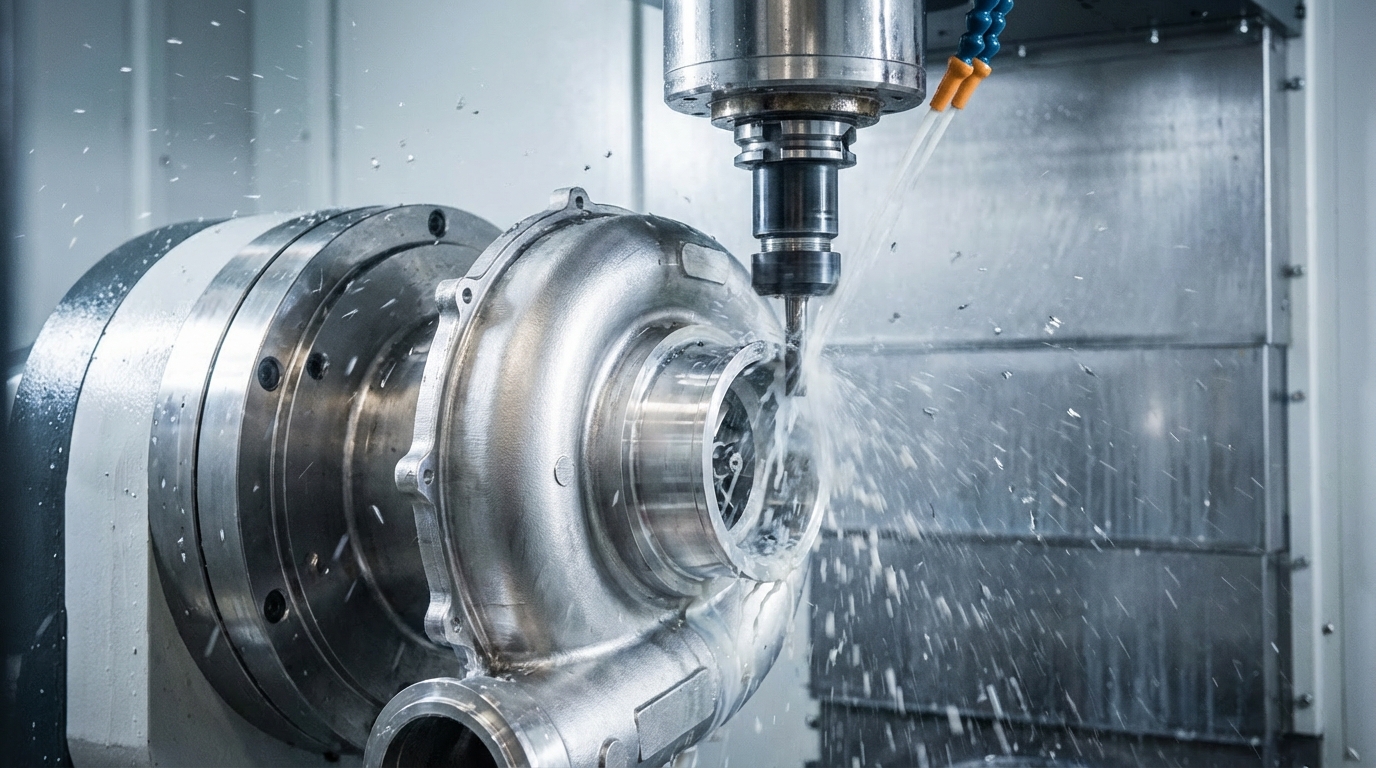
5-axis CNC machining uses simultaneous movement across five axes, with X, Y, and Z linear axes plus A and B rotational axes. This motion enables complex cuts, undercuts, and contoured surfaces that traditional 3-axis systems cannot reach.
Key benefits for defense manufacturing include:
- Tight tolerances: Single-setup workflows eliminate cumulative errors and maintain optimal tool orientation, which supports the +/-0.002″ precision required for mission-critical components.
- Reduced setups: Complex parts machined in single operations often deliver about 50% time savings compared to multiple 3-axis setups.
- Superior surface finishes: Controlled tool angles produce Ra 0.4 μm finishes that support UAV aerodynamics and radar performance.
- Scalable production: Stable processes support a smooth transition from prototype validation to full-rate manufacturing.
Defense applications include aircraft components such as brackets, housings, and mechanical assemblies, turbine blades for propulsion systems, and weapon housings that use ballistic-grade materials. UAV structural components benefit from weight-focused designs that still meet strength requirements. Custom multi-axis solutions support armored chassis and naval structures in technical alloys like steel, titanium, and Inconel while holding dimensional accuracy across large parts.
5-Axis CNC Cost-Benefit Analysis
5-axis CNC systems cost more than 3-axis equipment, which creates higher initial investment and higher hourly rates. Programming complexity also increases, since advanced CAM software and experienced operators must manage tool angles and collision avoidance across five moving axes.
Still, strategic implementation reduces these drawbacks. Advanced CAM software handles complex calculations, and experienced operators use single-setup capabilities to shorten total production time.
Integrated manufacturing facilities, such as the ones seen in Precision Advanced Manufacturing, remove supplier handoffs, which reduces coordination effort and supports predictable costs through consolidated operations.
Partner with Precision Advanced Manufacturing for proven ITAR-compliant 5-axis CNC that scales defense programs from prototype to production.
5-Axis CNC Hourly Rates and Real ROI for Defense Programs
Advanced 5-axis machining typically costs $120-$150 per hour in 2026, reflecting precision equipment and specialized expertise for complex defense geometries. Actual pricing depends on material machinability, part complexity, and compliance requirements beyond the base hourly rate.
|
Factor |
Cost Impact |
Precision Advanced Manufacturing Mitigation |
|
Machine Type |
+$50-100/hr over 3-axis |
Multi-axis efficiency reduces total cost impact |
|
Material (Titanium/Inconel) |
+20-30% machining time |
In-house expertise refines machining processes |
|
ITAR Compliance |
+10-15% documentation overhead |
Built-in AS9100D/ITAR processes |
ROI analysis often shows strong value despite higher hourly rates. Single-setup machining reduces total cost per part for complex geometries by removing repositioning, cutting inspection steps, and shortening delivery times. Defense programs frequently see cost savings per part when complex geometries justify 5-axis machining instead of multiple 3-axis operations.
ITAR, AS9100D, and Cybersecurity for 5-Axis Defense Work
AS9100D builds on ISO 9001 with expanded requirements for risk management, product safety, and supplier oversight that support aerospace and defense programs. 2026 compliance frameworks now connect NIST SP 800-171 cybersecurity requirements with quality management systems, which creates unified control over sensitive technical data.
Common compliance challenges include supplier vetting for ITAR registration, protection of controlled technical data, and full traceability across every production step. ITAR compliance requires assessing operations for controlled items, creating written policies, and maintaining detailed records with access limited to U.S. persons.
Certified partners simplify this work by maintaining active ITAR registration, AS9100D quality systems, and documented procedures that align with prime contractor expectations. This support reduces audit burden and helps keep every production run compliant.
Why Defense Teams Choose Precision Advanced Manufacturing
Precision Advanced Manufacturing provides integrated multi-axis CNC machining with the compliance and capacity defense programs require. Core capabilities include:
- Multi-axis CNC machining: Holding tight tolerances on complex components.
- Integrated services: CNC machining, precision fabrication, welding, and finishing in a single facility.
- Certified compliance: AS9100D, ISO 9001:2015, and ITAR registration with full documentation.
- Proven track record: Trusted partner to SpaceX, Blue Origin, and FireFly for mission-critical components.
- Scalable production: Smooth movement from prototype validation to multi-shift production.
Recent programs include mission-critical UAV structural components delivered on schedule with complete traceability documentation. Complex geometries that required advanced multi-axis machining ran efficiently, removed tolerance stacking, and held dimensional accuracy across every production batch.
Request a quote from Precision Advanced Manufacturing to review your defense program requirements and schedule.
How to Compare and Select 5-Axis CNC Defense Suppliers
Defense procurement teams review suppliers across several criteria to protect program performance and compliance. Specific differentiators separate qualified 5-axis machining partners from general-purpose machine shops.
|
Supplier Type |
Certifications |
Scalability |
Cost Predictability |
|
General Job Shops |
Basic ISO 9001 |
Limited capacity |
Variable pricing |
|
Equipment Vendors |
N/A (sales only) |
Capital purchase |
High upfront cost |
|
Precision Advanced Manufacturing |
AS9100D/ITAR |
Prototype to production |
Quote-based project evaluation |
Strong selection criteria focus on ITAR registration, AS9100D certification, documented tolerance capabilities, and proof of scalability from prototype through production volumes. Case studies that match your defense applications provide added confidence in supplier performance.
Consult with our defense manufacturing specialists to align your program requirements with proven capabilities.
Secure Your Defense Supply Chain with 5-Axis CNC
Defense program success depends on precision, compliance, and reliability that traditional machining often cannot match. Precision Advanced Manufacturing’s integrated 5-axis CNC capabilities reduce the risk of supplier fragmentation and support ITAR compliance with tight dimensional control for mission-critical components.
Request a quote today to strengthen your defense supply chain with proven 5-axis CNC expertise.
Frequently Asked Questions
What are the main limitations of 5-axis CNC machining for defense applications?
The primary limitations include higher equipment costs, which often reach 2-3 times the cost of 3-axis systems, and increased programming complexity that requires advanced CAM software and experienced operators. Part size constraints also appear because the machine envelope limits maximum workpiece dimensions. Programming complexity centers on managing five simultaneous axes while avoiding tool collisions, which demands specialized training and software.
These limitations are often offset by benefits for complex defense geometries, including single-setup machining that removes tolerance stacking, shorter production time, and superior surface finishes for aerodynamic and stealth-focused parts.
How much does 5-axis CNC machining cost per hour for defense parts?
5-axis CNC machining usually costs $120-$150 per hour in 2026, compared to about $60-$90 per hour for 3-axis machining. Total cost per part often drops for complex geometries because single-setup efficiency reduces handling and inspection. Material type affects cost, since titanium and Inconel can add 20-30% to machining time, and compliance requirements also influence pricing.
Defense programs often see lower total production costs through fewer setups, faster delivery, and reduced inspection, which can lead to savings on complex parts even with higher hourly rates.
What defense parts are best suited for 5-axis CNC machining?
5-axis CNC machining works best for complex defense components such as turbine blades with intricate airfoil shapes, weapon housings with precise internal features, and UAV structural components with weight-focused designs. Armored chassis with complex mounting interfaces also benefit.
The technology proves especially useful for parts that need undercuts, angled holes, or contoured surfaces that would require several setups on 3-axis equipment. Components made from difficult materials like titanium, Inconel, and other superalloys benefit from 5-axis capabilities because optimal tool angles reduce vibration and improve tool life.
How does ITAR compliance affect 5-axis CNC machining for defense contractors?
ITAR compliance requires defense contractors to use registered suppliers who maintain controlled access, documented procedures, and secure handling of technical data. 5-axis CNC machining operations must apply access controls that restrict facility entry to U.S. persons, maintain detailed records of all controlled technical data, such as CAD files and inspection reports, and follow cybersecurity protocols aligned with NIST SP 800-171.
Suppliers must show ITAR registration, AS9100D certification, and written compliance procedures that satisfy prime contractor audits. Non-compliance can trigger fines that exceed $1 million and can remove suppliers from active programs.
Can 5-axis CNC machining scale from prototype to full production for defense programs?
5-axis CNC machining supports strong scalability for defense programs that move from prototype validation to full-rate production. The same fixtures, programs, and processes used for prototypes can run across multiple machines for higher volumes. Single-setup capabilities help maintain consistent dimensional accuracy and surface finish at any quantity. Successful scaling still requires suppliers with enough capacity, multi-shift operations, and mature quality systems. Integrated manufacturing facilities support smooth transitions by keeping the same operators, equipment, and procedures throughout the program lifecycle, which avoids the risk that comes with supplier changes during ramp-up.