Last updated: June 26, 2026
Key Takeaways for Defense CNC Sourcing
- CNC machining remains the preferred method for defense prototypes because it delivers material realism, repeatability and certification acceptance that additive processes cannot consistently match.
- Defense prototype parts such as housings, optical mounts and brackets require tight positional tolerances, specific surface finishes and full material traceability to meet program specifications.
- ITAR registration and AS9100D certification are mandatory for any CNC supplier handling defense work and support compliance with export controls and rigorous quality management standards.
- A structured seven-step supplier qualification process, including verification of certifications, multi-axis capability, material control and scaling capacity, reduces program risk and protects timelines.
- Selecting an integrated, certified partner from the start eliminates supplier transitions and supports seamless scaling from prototype to production; contact Precision Advanced Manufacturing to start a defense prototype program on a compliant foundation.
Why CNC Machining Sets the Standard for Defense Prototypes
CNC machining produces parts from the same material stock specified for production. That material realism supports functional testing that reflects real-world performance. A prototype machined from the correct alloy behaves under load, vibration and thermal stress the way the production part will. Many additive processes do not consistently replicate those properties across defense-grade materials.
Repeatability provides a second driver. CNC programs execute the same toolpath on every part. Dimensional variation is controlled by the machine, the fixturing and the quality system, not by operator interpretation. That consistency supports first-article inspection, statistical process control and the documentation trails required in defense quality systems.
Certification acceptance provides the third factor. AS9100D quality management systems align with subtractive machining workflows. Inspection methods, traceability records and process controls map directly to CNC production. Defense program offices and prime contractors have established qualification pathways for CNC-machined parts that do not yet exist at the same maturity level for many additive processes.
Typical Defense Prototype Parts and Required Tolerances
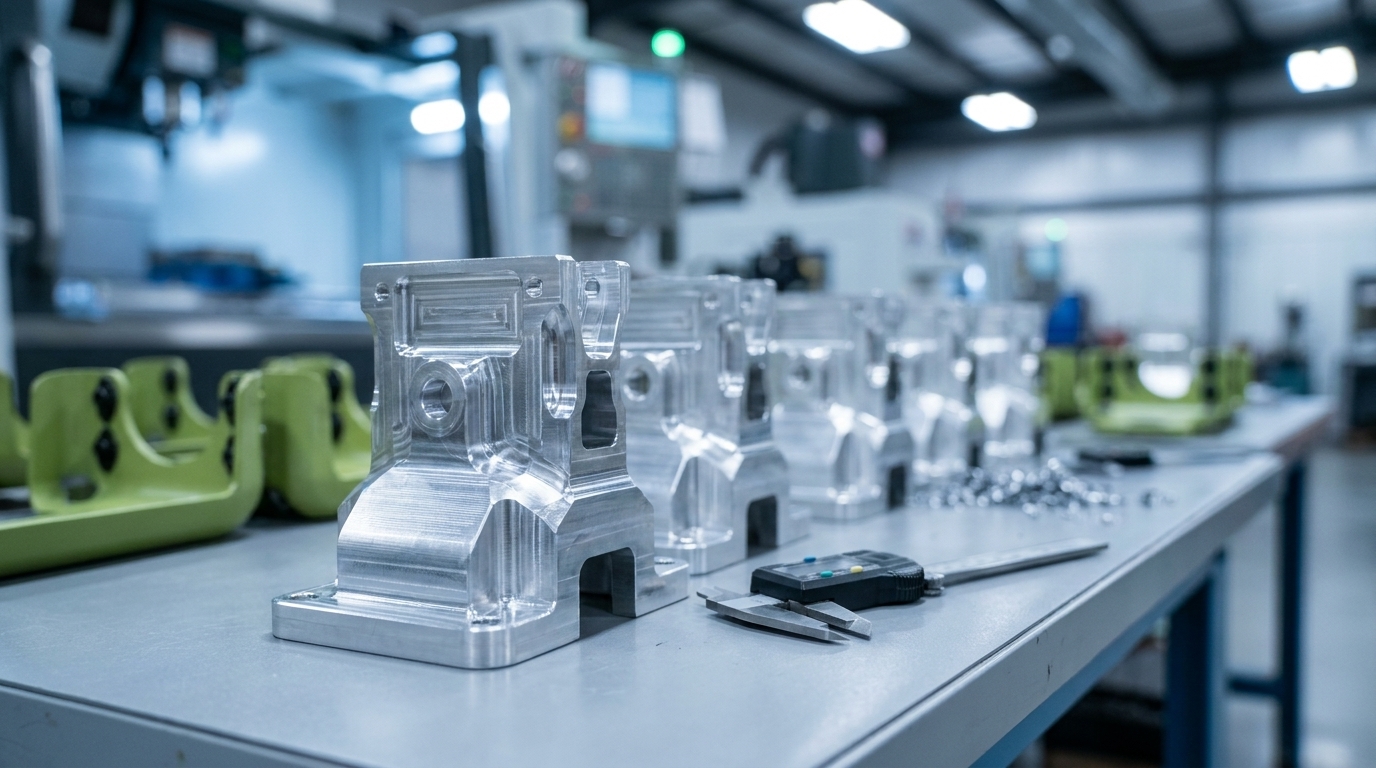
Understanding which components benefit most from CNC machining helps focus supplier qualification efforts. Common CNC-machined defense prototype components include structural housings, mounting brackets, optical mounts, actuator bodies, heat sinks and interface plates. Each category carries distinct dimensional and surface-finish requirements driven by its function in the system.
Structural housings must hold tight positional tolerances on bore locations and mating surfaces to support proper assembly fit. Optical mounts require precise flatness and angular tolerances because small deviations translate directly into system alignment errors. Brackets and interface plates must meet hole-pattern tolerances that align with fastener specifications and load-path requirements.
Surface finish specifications vary by function. Sealing surfaces, bearing bores and optical interfaces require finer finishes than structural faces. Defense programs typically specify surface finish in Ra values and reference applicable military or industry standards in the drawing package. Suppliers must demonstrate the capability to achieve and verify those finishes consistently across the full prototype quantity.
Defense Prototype Materials and Performance Needs
Material selection for defense prototypes reflects the mechanical, thermal and environmental demands of the application. Aluminum alloys appear in airborne and vehicle-mounted systems where weight is a constraint and machinability supports tight tolerances. Titanium alloys support applications where strength-to-weight ratio and corrosion resistance both matter. Stainless steel grades serve components exposed to harsh environments or requiring high surface hardness. Tool steels and specialty alloys support applications with extreme wear or temperature requirements.
Defense programs often specify material certifications, heat treatment conditions and traceability to mill certifications. A supplier must maintain documented material control from receiving inspection through final delivery. Any break in that chain creates a compliance gap that can delay program milestones or trigger nonconformance reports.
Precision Advanced Manufacturing works with a broad range of metals suited to defense and aerospace applications, including stainless steel, aluminum, carbon steel and exotic alloys, supported by full material traceability and documentation at every stage.
ITAR Compliance and AS9100D Quality Expectations
The International Traffic in Arms Regulations govern the export and domestic handling of defense articles and services. Any CNC supplier performing work on defense prototypes must be registered with the Directorate of Defense Trade Controls. ITAR registration does not function as a general export credential. Registered suppliers maintain access controls for technical data and document compliance procedures.
AS9100D extends ISO 9001 with requirements specific to aerospace and defense. It mandates risk management, configuration control, first-article inspection, nonconformance management and supplier flow-down. A supplier operating under AS9100D follows defined processes for every step from order review through final inspection and delivery documentation.
Traceability sits at the center of both frameworks. Every part must be traceable to its material heat or lot, the processes applied and the inspection records generated. That traceability supports failure analysis, corrective action and audit response. Suppliers who cannot provide complete traceability documentation create downstream risk for the prime contractor and the program office.
As an ITAR-registered supplier operating under AS9100D and ISO 9001:2015 certified quality management systems, Precision Advanced Manufacturing maintains the compliance framework these traceability requirements demand.
Seven-Step Checklist to Qualify a CNC Supplier
A structured qualification process reduces the risk of selecting a supplier who cannot meet program requirements. The following seven-step checklist provides a repeatable framework for procurement, program and supplier quality teams.
- Verify certifications. Confirm active AS9100D registration and ITAR registration. Request current certificates and verify registration status through the issuing body. Precision Advanced Manufacturing holds both registrations and can provide current documentation on request.
- Assess multi-axis machining capability. Defense prototype geometries often require simultaneous multi-axis machining to hold positional tolerances. Confirm the supplier operates multi-axis milling and turning equipment suited to the complexity of the parts in scope.
- Review quality system documentation. Request the supplier’s quality manual, inspection procedures and first-article inspection process. A mature quality system produces consistent documentation without special effort for each order.
- Evaluate material control processes. Confirm the supplier maintains receiving inspection, material identification and traceability from mill certification through final delivery. Ask how nonconforming material is segregated and dispositioned.
- Confirm traceability and reporting capability. Request sample inspection reports and certificates of conformance from prior defense or aerospace work. Evaluate completeness, format and alignment with AS9100D requirements.
- Assess integrated finishing and secondary services. Suppliers who perform anodizing, passivation, plating, laser marking and hardware installation in-house reduce handoffs and maintain traceability across the full part lifecycle. This integration closes compliance gaps that can appear when multiple vendors handle different process steps. Precision Advanced Manufacturing consolidates these services under one roof, which eliminates supplier fragmentation.
- Evaluate scaling capacity. Confirm the supplier can support prototype quantities and transition to low-rate or full-rate production without a supplier change. Precision Advanced Manufacturing operates multi-shift production capacity across two specialized facilities in California and Texas, supporting programs from initial prototype through sustained manufacturing.
Request a quote to discuss how Precision Advanced Manufacturing meets each of these qualification criteria for a program.
Planning Prototype-to-Production Scaling
The transition from prototype to low-rate initial production or full-rate production introduces cost, schedule and technical risks. Selecting a supplier capable of both phases from the start helps manage those risks. Changing suppliers between prototype and production requires re-qualification, re-documentation and a new first-article inspection cycle. That process consumes schedule and introduces variation risk.
Process control documentation developed during prototyping must transfer intact to production because it defines the manufacturing baseline. Maintaining consistency in tooling, fixturing, inspection methods and material sources protects that baseline. When deviations occur, engineering review and potentially re-qualification of the affected characteristics become necessary to re-establish the documented baseline. Suppliers who treat prototyping as a separate workflow from production create gaps that often surface during the production transition.
Cost predictability improves when the production supplier participates in the prototype phase. That supplier understands the part, the tolerances, the material behavior and the inspection requirements. Quoting production from a known baseline reduces the risk of scope surprises. This scalable platform uses the same certified quality system throughout the product lifecycle, which supports process consistency from prototype to production.
Start planning a seamless prototype-to-production transition by contacting Precision Advanced Manufacturing for a quote.
CNC and Additive Manufacturing in Functional Testing
Additive manufacturing offers speed advantages for early concept models and non-functional form studies. For functional testing and qualification of defense prototypes, CNC machining provides several structural advantages.
Material properties in CNC-machined parts are isotropic and derived from wrought or cast stock with known, certifiable properties. Additive parts exhibit anisotropic properties that vary by build orientation and process parameters. For components subject to structural loads, vibration or thermal cycling, that variability introduces uncertainty in functional test results.
Repeatability across a prototype lot is more predictable with CNC machining. The same program, the same tooling and the same material stock produce consistent dimensional output. Additive processes introduce layer-by-layer variation that requires more extensive inspection to characterize.
Certification acceptance pathways for CNC-machined parts are mature within AS9100D frameworks. Defense program offices have established inspection and qualification procedures for machined components. Additive manufacturing qualification continues to evolve, and documentation and process control standards for defense acceptance are not yet uniformly defined across programs. For functional testing that feeds directly into qualification and production decisions, CNC machining carries lower compliance risk.
Frequently Asked Questions
What certifications should a CNC supplier hold for defense prototype work?
At minimum, a defense CNC supplier should hold active AS9100D registration and be registered under ITAR. These certifications confirm that the supplier has the quality infrastructure and legal authorization to handle defense work under established regulatory frameworks. ISO 9001:2015 registration provides a baseline quality credential that complements AS9100D. Suppliers should provide current certificates and documentation on request without delay.
What drives cost in CNC machining for defense prototypes?
Cost in defense prototype machining is driven by part complexity, material selection, tolerance requirements, required documentation and quantity. Complex geometries that require multi-axis setups, tight tolerances that demand additional inspection steps and exotic materials with higher raw material costs all increase unit price. Documentation requirements such as first-article inspection reports, material certifications and certificates of conformance add process time. Prototype quantities carry higher cost per unit than production runs because setup time spreads across fewer parts. A supplier with integrated capabilities reduces cost by eliminating handoffs between vendors for finishing, marking and inspection.
How can a defense program manage the risk of transitioning to a new CNC supplier mid-program?
Supplier transitions mid-program carry risk, including re-qualification time, documentation gaps and potential dimensional variation between the outgoing and incoming supplier’s parts. Programs manage this risk by selecting a new supplier with mature AS9100D and ITAR-compliant systems, requesting pilot builds or validation runs before full transition and ensuring complete documentation transfer, including drawings, inspection records and material certifications. A supplier with in-house engineering support can review the existing documentation package and identify gaps before production begins. Precision Advanced Manufacturing supports mid-program transitions with complete documentation, material traceability and engineering review to maintain continuity.
What documentation should accompany defense CNC prototype deliveries?
Defense prototype deliveries should include a certificate of conformance, material certifications traceable to the mill or lot and dimensional inspection reports covering all drawing-controlled characteristics. Any required nonconformance documentation with disposition should appear in the package. First-article inspection reports following AS9102 or equivalent standards are common for initial prototype lots. Process certifications for special processes such as heat treatment, anodizing or passivation should accompany the delivery package. Complete documentation at the prototype stage establishes the baseline for production qualification and simplifies audit response for the prime contractor and program office.
Conclusion: Building a Reliable CNC Path for Defense Programs
Sourcing CNC machining for defense prototypes requires a disciplined evaluation of certification status, quality system maturity, material control, traceability capability and production scalability. The cost of selecting a non-compliant or under-capable supplier appears in rework, schedule loss and compliance exposure, not just unit price. A certified, integrated partner with AS9100D and ITAR registration, multi-axis machining capability and a scalable production platform reduces those risks from the first prototype through full-rate production. Precision Advanced Manufacturing delivers that combination from two specialized U.S. facilities, supported by the documentation and process discipline that defense programs require.