Last updated: April 17, 2026
Key Takeaways for ITAR-Compliant Additive Manufacturing
- CMMC 2.0 enforcement in 2026 mandates NIST 800-171 compliance for over 220,000 defense contractors handling CUI in additive manufacturing.
- ITAR-compliant AM relies on AS9100D certification, Technology Control Plans, and full traceability for materials like Ti-6Al-4V and Inconel 718.
- Hybrid AM-CNC capabilities support reliable scaling from prototypes to production while reducing supplier handoffs and compliance exposure.
- Effective vetting checklists verify ITAR registration, CMMC Level 2 readiness, U.S.-only facilities, and on-site audit capabilities.
- Partner with Precision Advanced Manufacturing for certified ITAR-compliant solutions supported by integrated manufacturing across CA and TX facilities.
What ITAR-Compliant Additive Manufacturing Involves
ITAR-compliant additive manufacturing protects defense technology exports under 22 CFR 120-130 and the U.S. Munitions List. This protection starts with Technology Control Plans that govern who can access technical data and how that data moves through each workflow. Secure CUI handling per NIST 800-171 safeguards models, build files, and process parameters during storage, transfer, and production. AS9100D and ITAR registrations verify that quality systems and export controls meet aerospace and defense expectations. Full traceability for titanium and Inconel parts documents every step in the chain of custody from raw material to finished component. These interconnected controls exist because non-compliance can trigger fines exceeding $1 million and debarment from defense contracts.
ITAR 3D printing for aerospace programs also requires security protocols that go beyond standard manufacturing. Technical data packages that define build orientation, heat treatment, and machining operations qualify as both CUI and export-controlled information. CMMC 2.0 Level 2 self-assessment enforcement began on November 10, 2025, as Phase 1 of the DoD’s three-year rollout, making 2026 the first full year of mandatory compliance for defense additive manufacturing ITAR operations. CMMC Level 2 requires defense contractors to implement all 110 security practices from NIST SP 800-171 Revision 2 with third-party C3PAO assessments for CUI handling.
Key Certifications and Security Protocols for Defense Suppliers
Beyond CMMC compliance, defense suppliers must maintain several core certifications and security controls. AS9100D certification establishes aerospace-grade quality management systems with full traceability requirements. ITAR registration governs the export of defense-related technical data and manufacturing processes. CMMC 2.0 Level 2 requirements are validated through C3PAO audits that assess 320 objectives across those 110 controls. The 2026 enforcement timeline mandates self-assessments for Level 1 and selected Level 2 requirements, while third-party assessments apply when suppliers handle CUI.
CMMC compliant AM providers must demonstrate continuous monitoring, incident response capabilities, and FIPS 140-2 validated encryption for all CUI handling. Continuous monitoring detects suspicious activity before it affects sensitive data. Incident response procedures define how teams contain, investigate, and report security events. FIPS 140-2 validated encryption protects CUI during storage and transmission so only authorized U.S. persons can access it.
The following table shows how Precision Advanced Manufacturing aligns with three critical certification requirements that defense contractors must verify in 2026.
| Certification | Key 2026 Requirements | PrecisionAM Compliance |
|---|---|---|
| AS9100D | Aerospace QMS, traceability | Certified, full documentation |
| ITAR | USML export controls | 100% registered, U.S. facilities |
| CMMC 2.0 L2 | NIST 800-171, C3PAO | Systems, TCPs |
Precision Advanced Manufacturing maintains full compliance across these certifications with in-house engineering, multi-axis CNC machining, and specialty welding capabilities that reduce handoffs between suppliers. This integrated approach preserves a continuous chain of custody for ITAR registered 3D printing companies USA operations and supports reliable scaling from prototype to production volumes.
Get a compliance assessment for your next defense manufacturing project.
Materials and Production Capabilities for Aerospace AM
Ti-6Al-4V offers a high strength-to-weight ratio and corrosion resistance, which supports lightweight structural brackets, engine mounts, and fasteners in aerospace manufacturing. Inconel 718 provides extreme temperature strength exceeding 1000°F and exceptional oxidation resistance, which suits turbine hardware, exhaust components, and manifold sensors. These demanding properties create tight windows for heat treatment, surface finish, and dimensional control, so aerospace ITAR manufacturers need specialized processing expertise to preserve mechanical performance.
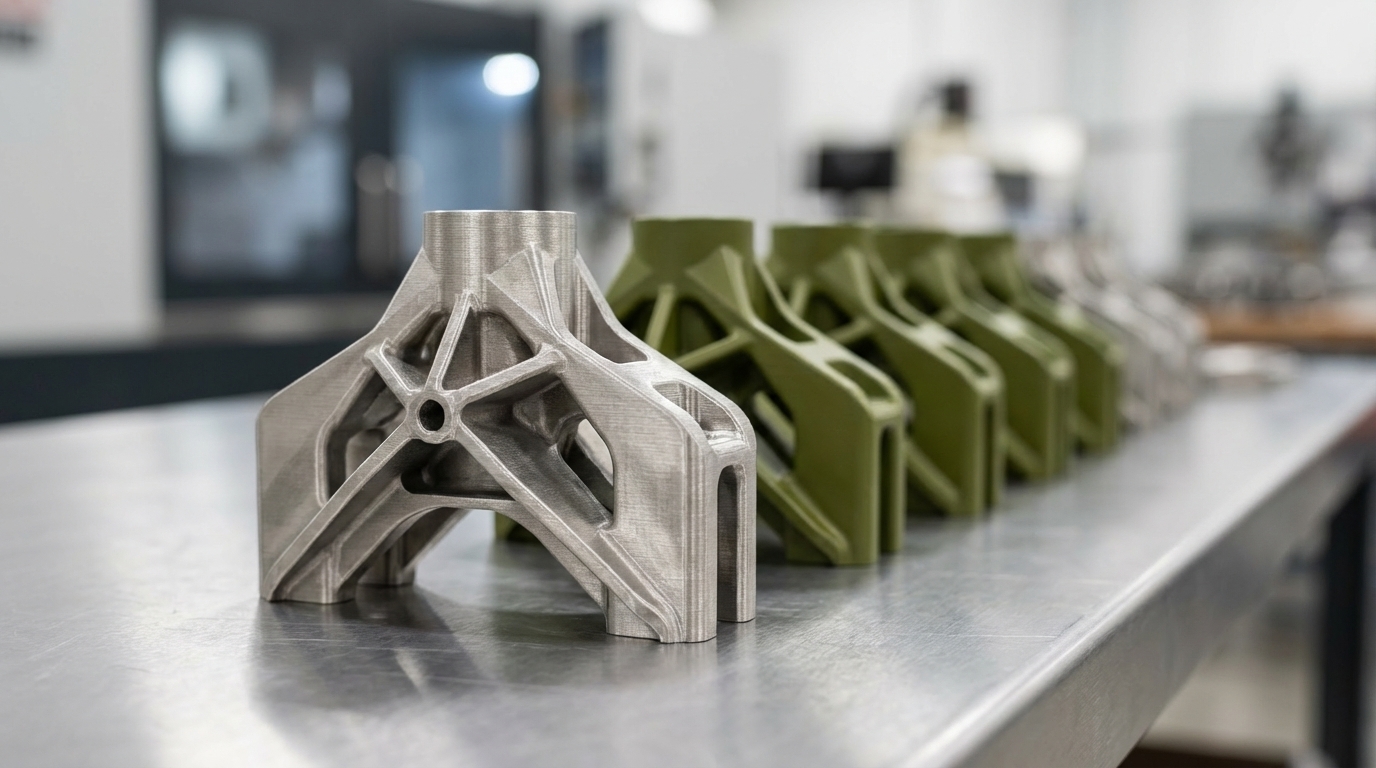
Precision Advanced Manufacturing’s hybrid AM-CNC capabilities bridge additive manufacturing’s geometric freedom with traditional machining’s precision. Additive processes create complex internal channels and weight-saving lattices, while CNC machining finishes critical interfaces and sealing surfaces. The company’s integrated sheet metal fabrication, specialty welding with thermal distortion control, kitting services, and laser marking capabilities deliver complete component solutions under one roof with full AS9100D traceability.
How PrecisionAM Compares to Other ITAR-Registered U.S. AM Providers
Material capabilities and certifications form the foundation of supplier selection, yet they do not fully determine program success. The landscape of ITAR compliant 3D printing suppliers varies in scalability, hybrid capabilities, and geographic coverage, and these factors influence whether a provider can deliver on its certifications. Precision Advanced Manufacturing leads in prototype-to-production scaling through integrated AM-CNC operations across California and Texas facilities. The comparison below evaluates key providers based on certifications, scalability for additive manufacturing for government defense applications, and operational capabilities.
| Provider | Certs (AS9100D/ITAR/CMMC) | Scalability (Prototype-Production) | U.S. Locations/Lead Times |
|---|---|---|---|
| PrecisionAM (Lead) | Yes/Yes/L2 | Hybrid AM-CNC, multi-shift | CA/TX, 2-4 weeks |
| Xometry | Yes/Yes/Yes | On-demand, limited hybrid | National, 5-10 days |
| A3D Manufacturing | Yes/Yes/No | Basic AM | Various, variable |
| Stratasys Direct | Yes/Yes/— | AM-focused | Various, variable |
This integrated model enables the prototype-to-production scaling shown in the comparison above. Precision Advanced Manufacturing’s ability to manage complete component lifecycles without external handoffs supports consistent traceability and predictable costs across defense programs. The company’s multi-shift production capabilities and established California and Texas operations provide geographic redundancy and scalable capacity for mission-critical applications.
Vetting Checklist and Practical Audit Steps
Procurement professionals need a structured approach when evaluating ITAR-compliant AM suppliers. The following 10-point checklist covers essential compliance and operational factors and shows how each step contributes to a complete review.
• Verify ITAR registration status and current compliance documentation, which confirms the supplier is legally authorized to handle defense articles.
• Audit AS9100D certification and quality management systems, which ensures process controls can maintain quality at scale.
• Test hybrid AM-CNC scalability from prototype to production volumes, which validates that quality systems hold up as volumes increase.
• Review CMMC 2.0 documentation and cybersecurity controls, which demonstrates how the supplier protects CUI throughout the data lifecycle.
• Assess facility access controls and personnel security measures, which verifies that only cleared U.S. persons can access ITAR-controlled work areas.
• Evaluate material traceability systems and documentation processes, which confirms that every lot and build can be traced back to source material and process history.
• Confirm U.S.-only production facilities and data handling protocols, which reduces export risk and simplifies ITAR oversight.
• Request customer references for similar defense programs, which provides evidence of performance under comparable requirements.
• Conduct on-site facility audits and capability demonstrations, which allows direct verification of equipment, processes, and security controls.
• Obtain detailed RFQ responses with timeline and cost breakdowns, which clarifies capacity, lead times, and pricing assumptions before award.
Precision Advanced Manufacturing supports thorough supplier evaluations with facility tours, capability demonstrations, and detailed quote packages that highlight integrated manufacturing expertise. The company’s ability to scale programs within a single, controlled environment reduces the risk of disruptive supplier transitions during ramp-up phases.
Case Study: Scaling AM Prototypes with Precision Advanced Manufacturing
A leading UAV manufacturer avoided further schedule slips by shifting from an underperforming AM supplier to Precision Advanced Manufacturing. The original supplier struggled to move from prototype quantities to production volumes while holding tight tolerances. Precision Advanced Manufacturing’s integrated CNC machining and fabrication capabilities enabled a smooth transition to multi-shift production and delivered complex titanium components for space applications on schedule.
The hybrid production approach removed handoffs between separate suppliers, preserved complete traceability, and achieved the dimensional accuracy required for mission-critical assemblies. This case illustrates how a qualified ITAR-compliant partner can prevent costly program disruptions while maintaining regulatory compliance throughout the production lifecycle.
Discuss your prototype-to-production scaling timeline with our engineering team.
Frequently Asked Questions
Does Precision Advanced Manufacturing handle CMMC requirements for additive manufacturing?
Precision Advanced Manufacturing maintains systems with NIST 800-171 controls, Technology Control Plans, and secure CUI handling protocols. The company’s cybersecurity framework includes multi-factor authentication, encrypted data storage, and continuous monitoring systems that meet defense industrial base requirements for protecting controlled unclassified information throughout the additive manufacturing process.
What are the cost implications of ITAR-compliant precision additive manufacturing?
ITAR-compliant additive manufacturing often carries higher initial costs due to certification requirements and security protocols. However, a right-first-time approach can significantly reduce total program costs by cutting rework, scrap, and schedule delays. Precision Advanced Manufacturing’s integrated capabilities and quality systems help avoid the expensive consequences of non-compliant suppliers, which makes certified providers cost-effective for mission-critical programs.
How does scaling from prototype to production work with hybrid AM-CNC?
Precision Advanced Manufacturing’s hybrid approach supports consistent scaling by using the same processes, personnel, and quality systems from initial prototypes through full-rate production. Integrated CNC machining maintains dimensional accuracy on critical features, while additive manufacturing preserves geometric flexibility. Multi-shift operations absorb volume increases without sacrificing quality or delivery performance.
What data security measures protect ITAR-controlled information during additive manufacturing?
ITAR data security relies on Technology Control Plans, facility access controls limited to verified U.S. persons, encrypted data storage and transmission, and secure deletion protocols after production. Precision Advanced Manufacturing implements comprehensive cybersecurity measures that include network segmentation, audit logging, and physical security controls that exceed NIST 800-171 requirements for protecting defense-related technical data.
Which materials does Precision Advanced Manufacturing process for defense applications?
Precision Advanced Manufacturing specializes in aerospace-grade materials including Ti-6Al-4V for high strength-to-weight applications and Inconel 718 for extreme temperature environments. The company’s expertise covers complex geometries and tight tolerances for turbine components, structural assemblies, and mission-critical hardware across commercial aerospace, military defense, and space programs.
What are the benefits of hybrid AM-CNC for defense suppliers?
Hybrid AM-CNC reduces handoffs between suppliers, maintains complete traceability under single-source control, and combines additive manufacturing’s design freedom with CNC machining’s precision. This approach simplifies the supply chain, supports consistent quality during production scaling, and delivers the dimensional accuracy required for mission-critical aerospace components while maintaining full ITAR compliance.
Conclusion and Next Steps for Defense AM Programs
This framework gives defense aerospace suppliers clear criteria for identifying and vetting ITAR-compliant additive manufacturing partners that can scale from prototype to production without adding compliance risk. The combination of certifications, security protocols, material expertise, and scalable capacity separates qualified suppliers from general AM providers in a tightly regulated environment. Precision Advanced Manufacturing’s integrated operations, proven performance, and comprehensive compliance framework position the company as a strong choice for mission-critical applications that demand reliable scaling and consistent quality.
Connect with our ITAR-certified manufacturing specialists to evaluate your program requirements.