Last updated: April 17, 2026
Defense contractors face a critical challenge. You must find CNC machining partners who deliver precise components while maintaining full ITAR compliance. A single compliance failure can trigger penalties over $1 million per violation and jeopardize entire defense programs. This guide gives you a clear, five-step framework to vet and select ITAR-compliant CNC machining partners who can support your programs from prototype through production.
Key Takeaways
- ITAR compliance requires DDTC registration, US persons only, and secure processes to avoid severe financial and program risk.
- Defense CNC machining relies on 5-axis milling, Swiss machining, waterjet cutting, and integrated finishing for complex components with tight tolerances.
- Expertise in titanium, Inconel, and composites is essential for handling defense-grade materials in extreme environments.
- Scalable operations from prototype to production support seamless transitions without quality loss or schedule slips.
- Precision Advanced Manufacturing delivers full ITAR compliance, advanced capabilities, and a proven defense track record, so you can request a quote with confidence.
Step 1: Meet ITAR Compliance Standards for CNC Shops
ITAR compliance starts with the regulatory framework enforced by the Directorate of Defense Trade Controls, or DDTC. ITAR controls defense articles, services, and technical data under 21 United States Munitions List categories, including Category VIII aircraft components and Category XII fire control equipment. Machined components often fall under these classifications, which places CNC shops directly in scope.
Core compliance requirements include DDTC registration at $3,000 annually for Tier 1 registrants. Shops must restrict technical data access to verified US persons and maintain a documented Technology Control Plan. That plan should cover leadership endorsement, segregated work areas, IT controls, personnel screening, and regular audits.
The financial consequences of non-compliance are severe. Civil penalties under ITAR for each violation of 22 U.S.C. 2778 reach up to the greater of the previously noted figure or twice the value of the transaction that is the basis of the violation. RTX Corporation settled for $200 million in 2024 after unauthorized exports of defense technical data, which illustrates the real-world impact of failures.
Precision Advanced Manufacturing maintains 100% ITAR compliance with current DDTC registration and comprehensive audit-ready documentation. Our proven processes remove compliance headaches for defense procurement teams and support clean audit trails.
Step 2: Confirm Advanced CNC Capabilities for Defense Components
Defense programs require advanced manufacturing capabilities that standard machine shops rarely provide consistently. Critical capabilities include:
- 5-axis CNC milling and turning for complex geometries
- Swiss-style machining for precision components
- Waterjet cutting up to 96″x240″ with ±0.005″ tolerances
- TIG, MIG, and laser welding with thermal distortion control
- Integrated finishing including anodizing, passivation, and plating
- Kitting, hardware installation, laser marking, and deburring
Consolidated capabilities under one roof reduce risk for defense programs. Multiple vendor handoffs increase quality variation, extend lead times, and complicate traceability. Precision Advanced Manufacturing’s integrated approach holds tight tolerances on mission-critical components while maintaining full process control from raw material through finished assembly.
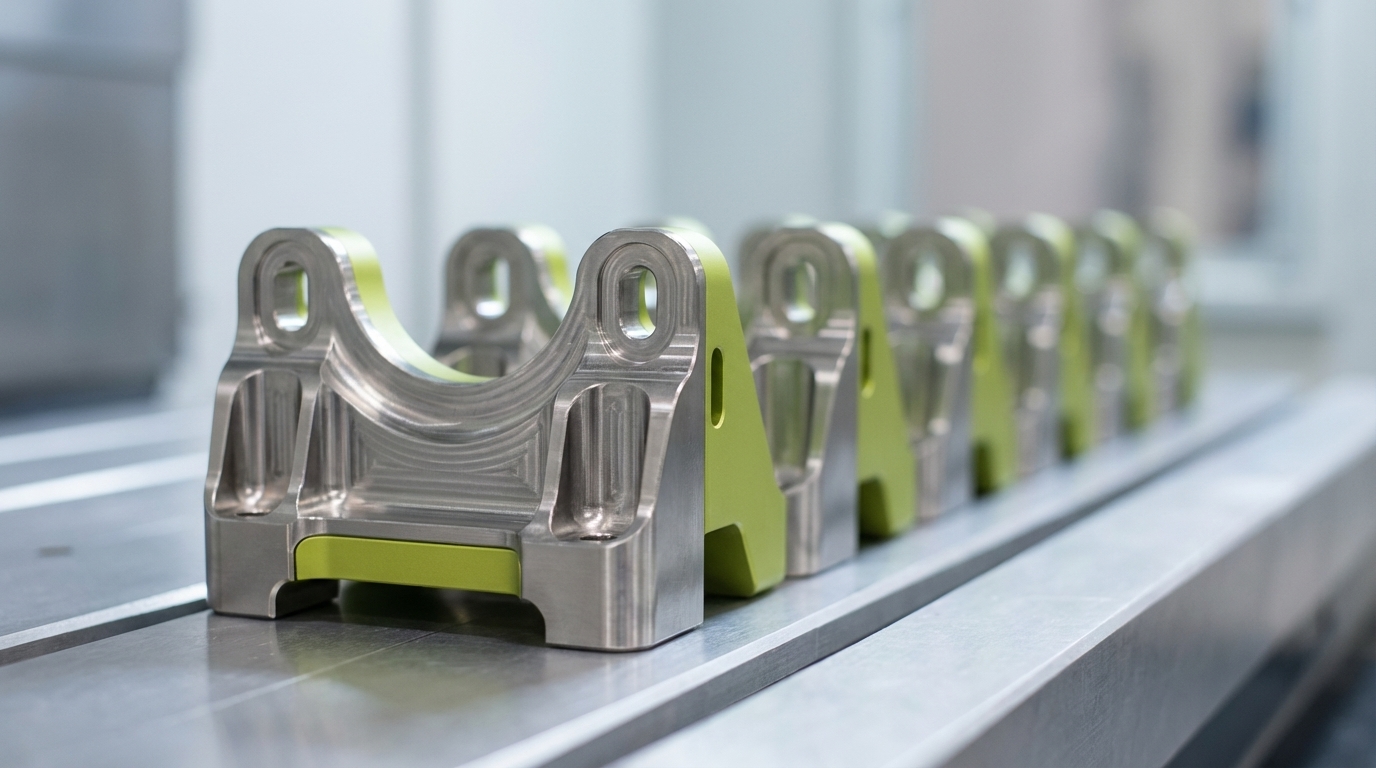
Advanced 5-axis CNC capabilities support production of complex defense components such as UAV housings and weapons system internals in single setups. Single-setup machining reduces production time and improves accuracy. This capability directly supports the demanding geometries required for modern defense applications where traditional 3-axis machining falls short.
Step 3: Require Proven Defense-Grade Materials Expertise
Defense applications depend on specialized materials that demand expert handling and processing knowledge. Critical materials include titanium alloys such as Ti-6Al-4V, Inconel 718, stainless steel grades, armor plating, and advanced composites including Kevlar. Titanium alloys present unique machining challenges due to low thermal conductivity and work hardening characteristics. These properties require specialized tooling, cutting strategies, and process controls.
Titanium alloys are projected to grow at 5.83% CAGR through 2031 in defense applications. Weight reduction requirements drive this growth because lighter structures extend combat radius and improve performance. Precision Advanced Manufacturing’s expertise with exotic materials supports reliable processing of these challenging alloys in extreme defense environments.
Dynamic waterjet technology expands this materials capability. It enables cutting of advanced composites and ballistic materials that conventional methods cannot handle effectively. This capability supports next-generation defense applications that rely on lightweight, high-strength materials.
Step 4: Verify Scalability from Prototype to Production
Defense programs typically move from prototype development into low-rate and then full-rate production. Suppliers must scale seamlessly across these phases without quality degradation. This scaling capability rests on three interdependent factors. Multi-shift manufacturing capacity prevents production bottlenecks as volumes increase. Engineering support throughout the program lifecycle helps refine processes during transitions. Validated processes maintain consistency across volume changes.
Precision Advanced Manufacturing’s platform approach addresses these scaling demands directly. Our multi-shift operations and established processes support smooth transitions from initial prototypes to sustained production volumes. We maintain the same quality standards validated during development phases as volumes rise.
Integrated engineering support becomes crucial during scaling phases. Design modifications, tolerance adjustments, or process optimizations often appear as testing feedback arrives. In-house engineering capabilities remove external dependencies that can delay program milestones and increase risk.
Step 5: Use a Structured ITAR CNC Vetting Checklist
Systematic vetting reduces compliance failures and program delays. Essential verification criteria include DDTC registration status, AS9100D certification, US-based facilities, comprehensive traceability systems, and NIST SP 800-171 Rev 3 cybersecurity compliance. Use this verification framework to evaluate potential partners. Each criterion lists how you can verify it and the specific proof Precision Advanced Manufacturing provides.
| Criteria | Verify Method | PAM Proof |
|---|---|---|
| DDTC Registration | Public portal verification | Current registration, CA/TX facilities |
| Precision Capabilities | Case studies and specifications | Tight-tolerance machining, titanium and Inconel expertise |
| Cybersecurity Compliance | NIST/CMMC documentation review | SP 800-171 Rev 3 aligned systems |
Precision Advanced Manufacturing exceeds all verification criteria mentioned above. The compliance foundation established in Step 1 aligns with this framework and is supported by documented proof that reduces procurement risk and avoids rework costs from non-compliant suppliers.
Why Precision Advanced Manufacturing Fits Defense ITAR Programs
Precision Advanced Manufacturing integrates all critical success factors under one roof. Our US facilities provide advanced manufacturing capability across NAICS codes 332710 and 332721, which support diverse defense applications. We also maintain a proven track record delivering on-time, fully traceable components for mission-critical programs.
This comprehensive approach reduces the coordination challenges and quality risks that come with multi-vendor supply chains. You gain a single accountable partner for machining, fabrication, finishing, and documentation. Connect with our experts to discuss your specific defense manufacturing requirements.
FAQ
What certifications does Precision Advanced Manufacturing hold for defense programs?
Precision Advanced Manufacturing maintains ITAR registration with the Directorate of Defense Trade Controls, AS9100D aerospace quality certification, and ISO 9001:2015 quality management system registration. These certifications support compliance with stringent defense and aerospace requirements and provide the documentation and traceability essential for mission-critical programs.
Can Precision Advanced Manufacturing meet tight defense program deadlines?
Yes. Our integrated operations reduce delays associated with multiple vendor handoffs. By combining CNC machining, fabrication, welding, and finishing under one roof, we maintain direct control over production schedules and respond quickly to urgent requirements. Multi-shift capability and established processes support consistent on-time delivery for defense programs.
Does Precision Advanced Manufacturing scale from prototype to full production?
Yes. Our scalable production platform supports transitions from prototype development through high-volume manufacturing without compromising quality or delivery schedules. Multi-shift operations and validated processes maintain consistent performance across all production volumes. This consistency removes the need to change suppliers as programs mature.
Can Precision Advanced Manufacturing handle exotic materials like titanium and Inconel?
Yes. We specialize in machining challenging materials including titanium alloys, Inconel, and other superalloys commonly used in defense applications. Our dynamic waterjet technology also supports cutting of advanced composites, Kevlar, and ballistic materials that conventional methods cannot process effectively.
How does Precision Advanced Manufacturing address 2026 CUI cybersecurity updates?
Our cybersecurity framework aligns with NIST SP 800-171 Rev 3 requirements and CMMC Level 2 standards. We apply comprehensive controls for handling Controlled Unclassified Information, including access restrictions, encrypted data handling, and audit trails that meet current defense cybersecurity mandates.
These five steps create a practical decision framework for selecting ITAR-compliant CNC machining partners. You define compliance expectations, confirm capabilities, validate materials expertise, verify scalability, and then apply a structured checklist. Start with Precision Advanced Manufacturing’s proven expertise and comprehensive capabilities. Request a quote today to secure your mission-critical manufacturing partnership.