Last updated: June 28, 2026
Key Takeaways for Aerospace Alloys CNC Austin Programs
- Aerospace alloys CNC Austin work covers precision machining of titanium, Inconel and high-strength aluminum for flight-critical aerospace, defense and space programs.
- AS9100D, ISO 9001:2015 and ITAR certifications support documented process controls, full material traceability and regulatory compliance across all operations.
- Integrated multi-axis CNC machining, welding and secondary finishing in one facility reduces handoffs, documentation gaps and schedule variability.
- Scalable production capabilities support the full program lifecycle from prototype development through full-rate manufacturing without supplier requalification.
- Precision Advanced Manufacturing provides certified aerospace alloys CNC Austin services; request a quote to discuss program requirements with the team.
Certified Integrated Capabilities for Aerospace Alloys
Precision Advanced Manufacturing operates under AS9100D and ISO 9001:2015 registrations that cover all production operations, with ITAR registration governing controlled technical data and hardware. These certifications extend across multi-axis CNC milling and turning capabilities that support complex tight-tolerance components. Precision sheet metal fabrication, including stamping, forming and bending, connects with TIG, MIG and laser welding to control thermal distortion in assemblies. Secondary treatments such as anodizing, passivation, plating and deburring prepare parts for durability, corrosion resistance and assembly fit.
Request a quote to receive a tailored production plan aligned with these certified, integrated capabilities.
Austin’s Growing Aerospace Hub and Local CNC Advantages
Austin and the broader Central Texas corridor now operate as a significant node for aerospace and defense manufacturing. The region hosts a concentration of defense contractors, space companies and UAV developers, which sustains demand for local, certified precision machining partners. Local sourcing for aerospace alloys CNC Austin work reduces logistics exposure and supports supply chain resilience for programs with strict domestic sourcing requirements. Fragmented sourcing, where machining, welding and finishing occur at separate vendors, introduces handoff risk, documentation gaps and schedule variability. Single-facility providers that consolidate these operations under one certified quality system reduce those risks and simplify program oversight.
Core Aerospace Alloys and Practical Machining Needs
Titanium alloys, particularly Ti-6Al-4V, support airframe structures, engine components and fasteners across many platforms. Titanium offers a high strength-to-weight ratio and corrosion resistance, yet its low thermal conductivity and work-hardening tendency demand controlled cutting parameters and sharp tooling. Consistent coolant application and stable fixturing help maintain dimensional accuracy on titanium parts.
Inconel and other nickel-based superalloys serve high-temperature environments such as turbine sections and exhaust components. These alloys retain strength at elevated temperatures but generate significant cutting forces and tool wear. Rigid machine setups, appropriate feed rates and experienced process programming help manage heat, extend tool life and protect surface integrity.
High-strength aluminum alloys, including 7075 and 7050 series, appear in structural airframe panels, brackets and UAV frames. These alloys machine more readily than titanium or Inconel but still require precise fixturing and process control to hold tight tolerances across production runs. Stable workholding and consistent tool paths support repeatable results on large or thin-walled aluminum structures.
Each alloy class requires material-specific process knowledge, tooling selection and inspection protocols. Shops without documented experience in these materials increase quality and schedule risk on flight-critical programs, especially when parts move between multiple vendors.
AS9100D CNC Austin Quality and Traceability Standards
AS9100D extends ISO 9001:2015 with requirements specific to aviation, space and defense manufacturing. For CNC machining operations, AS9100D calls for documented process controls, defined inspection checkpoints, calibrated measurement equipment and structured nonconformance management procedures. These elements create consistent production outcomes across prototypes and long-term contracts.
Traceability requirements under AS9100D link every material lot, process step and inspection result to each finished part. Material certifications travel with raw stock from receipt through production, storage and issue. In-process and final inspection records remain retained and retrievable for customer audits and regulatory reviews. ITAR registration adds access control, secure data handling and export compliance requirements that govern how technical data and hardware move through the facility.
Procurement and supplier quality teams evaluating AS9100D CNC Austin partners benefit from confirming that certification scope covers machining, welding and finishing, not only a subset of operations. A single quality system across all processes reduces audit complexity and documentation gaps.
Titanium and Inconel CNC Machining Capabilities in Austin
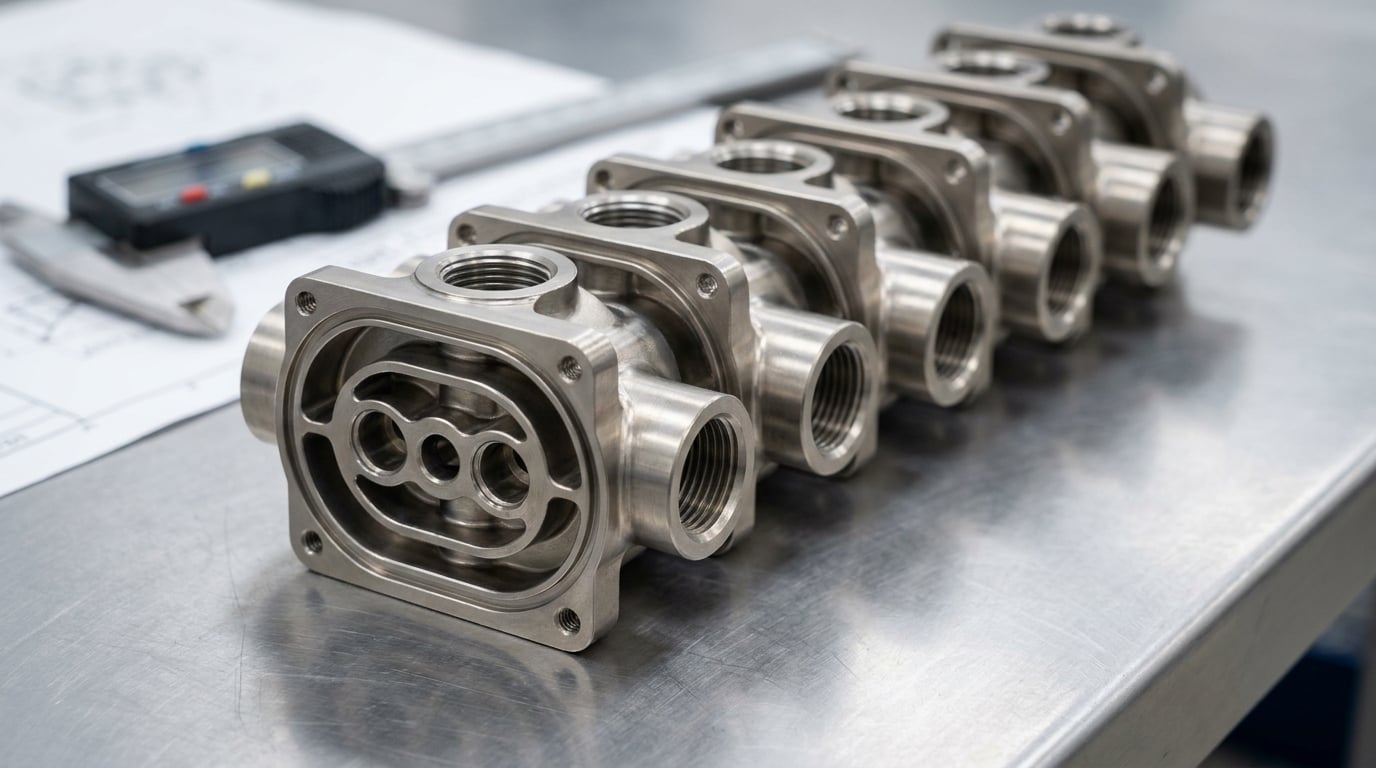
Precision Advanced Manufacturing’s multi-axis CNC equipment supports the complex geometries and tight tolerances common in titanium and Inconel components. Multi-axis milling and turning complete more features in fewer setups, which reduces fixturing variability and improves dimensional consistency across production runs. This approach supports both intricate internal features and demanding surface finish requirements.
Titanium CNC machining Austin programs benefit from process parameters and tooling strategies tuned to titanium’s thermal and mechanical characteristics. Controlled spindle speeds, feed rates and coolant delivery help limit heat buildup and work hardening. Inconel machining Austin work relies on rigid machine setups and controlled cutting conditions that address the alloy’s tendency to work harden and accelerate tool wear.
Many aerospace assemblies combine machined components with welded structures, which can create handoff risk when machining and welding occur at separate facilities. Welding capabilities, including TIG and laser welding with thermal distortion control, extend the facility’s value for assemblies that combine machined titanium or Inconel components with sheet metal structures. Completing machining and welding under one roof reduces dimensional risk and simplifies documentation for complex assemblies.
Scaling from Prototype Builds to Full-Rate Production
Aerospace programs often begin with prototype or qualification builds before moving into full-rate production. Supplier changes between these phases introduce requalification risk, documentation gaps and schedule disruption. Precision Advanced Manufacturing’s scalable production platform supports the full program lifecycle, from initial prototype development through multi-shift, sustained production, under the same certified processes and quality systems.
This continuity allows process parameters validated during prototyping to carry forward into production without reengineering. Inspection data accumulated during early builds informs process refinement before volume ramps. Programs avoid the cost and schedule impact of qualifying a new supplier at a critical production milestone, which supports predictable deliveries and stable quality metrics.
Material Traceability and Documentation for Aerospace Alloys
Traceability for aerospace alloys CNC Austin work begins at material receipt and continues through shipment. Raw stock is verified against material certifications and assigned lot numbers that follow the material through production. Controlled storage and issue practices prevent mix-ups and support accurate inventory records.
These lot numbers connect to in-process inspection records captured at defined checkpoints, which creates a chain of dimensional data for each part. Final inspection reports document conformance to drawing requirements and reference the complete traceability chain before parts ship. This structure supports customer audits and internal reviews.
Precision Advanced Manufacturing’s AS9100D quality system organizes these activities into defined workflows. Documentation packages delivered with shipments include material certifications, inspection reports and any required process certifications. Procurement, program and supplier quality teams receive the records needed for incoming inspection, program audits and regulatory reviews. For ITAR-controlled programs, technical data handling, facility access and shipping documentation follow export control requirements throughout production.
Evaluating an Aerospace Alloys CNC Austin Partner
Procurement and supplier quality teams assessing aerospace alloys CNC Austin partners can apply the following criteria to structure evaluations:
- AS9100D registration with scope that covers all required processes
- Current ITAR registration with defined access controls
- Documented experience with the specific titanium, Inconel and aluminum alloys required
- Multi-axis CNC capability for complex geometries and tight tolerances
- In-house welding and secondary finishing that minimize handoffs
- Full material traceability from raw stock through shipment
- Documented inspection and nonconformance management processes
- Scalable capacity that supports prototype through full-rate production
- Engineering support for design-for-manufacturability review
- Supplier transition support, including pilot builds and documentation continuity
Start an RFQ to evaluate Precision Advanced Manufacturing against these criteria for an active or upcoming program.
Frequently Asked Questions
What certifications does Precision Advanced Manufacturing hold for aerospace CNC work?
Precision Advanced Manufacturing operates under AS9100D and ISO 9001:2015 registered quality management systems and is ITAR registered. These certifications cover machining, fabrication, welding and finishing operations performed at the facility.
How does Precision Advanced Manufacturing handle material traceability for aerospace alloys?
Material traceability begins at receiving, where raw stock is verified against material certifications and lot numbers are recorded. Traceability continues through in-process inspection, final inspection and shipment documentation. Customers receive complete documentation packages with each order.
Can Precision Advanced Manufacturing support a mid-program supplier transition?
The team supports supplier transitions with complete documentation, material traceability records and engineering support that protect production continuity. Pilot builds or validation runs can be structured to reduce risk during the transition period.
What is the process for getting started with Precision Advanced Manufacturing?
The engagement begins with a consultation that defines program requirements, part specifications and timelines. A tailored quote then outlines capabilities, tolerances, materials, certifications and production strategy. Once aligned, production launches under certified quality controls with full traceability in place.
Does Precision Advanced Manufacturing perform secondary finishing in-house?
Secondary finishing, including anodizing, passivation, plating, sandblasting, deburring, brush finishing and laser marking, is integrated into facility operations. Completing finishing in-house removes the handoffs, documentation gaps and schedule variability associated with sending parts to outside vendors.
Conclusion: Integrated Austin CNC Support for Critical Alloys
Aerospace programs sourcing titanium, Inconel and high-strength aluminum components benefit from a CNC partner with verified certifications, documented traceability and integrated capabilities that reduce handoffs and compliance exposure. For programs operating in Central Texas, single-facility sourcing reduces logistics exposure and documentation gaps that occur when operations split across multiple vendors. An integrated AS9100D and ITAR-compliant partner that combines machining, welding and finishing supports supply chain control and schedule reliability from prototype through full-rate production.