
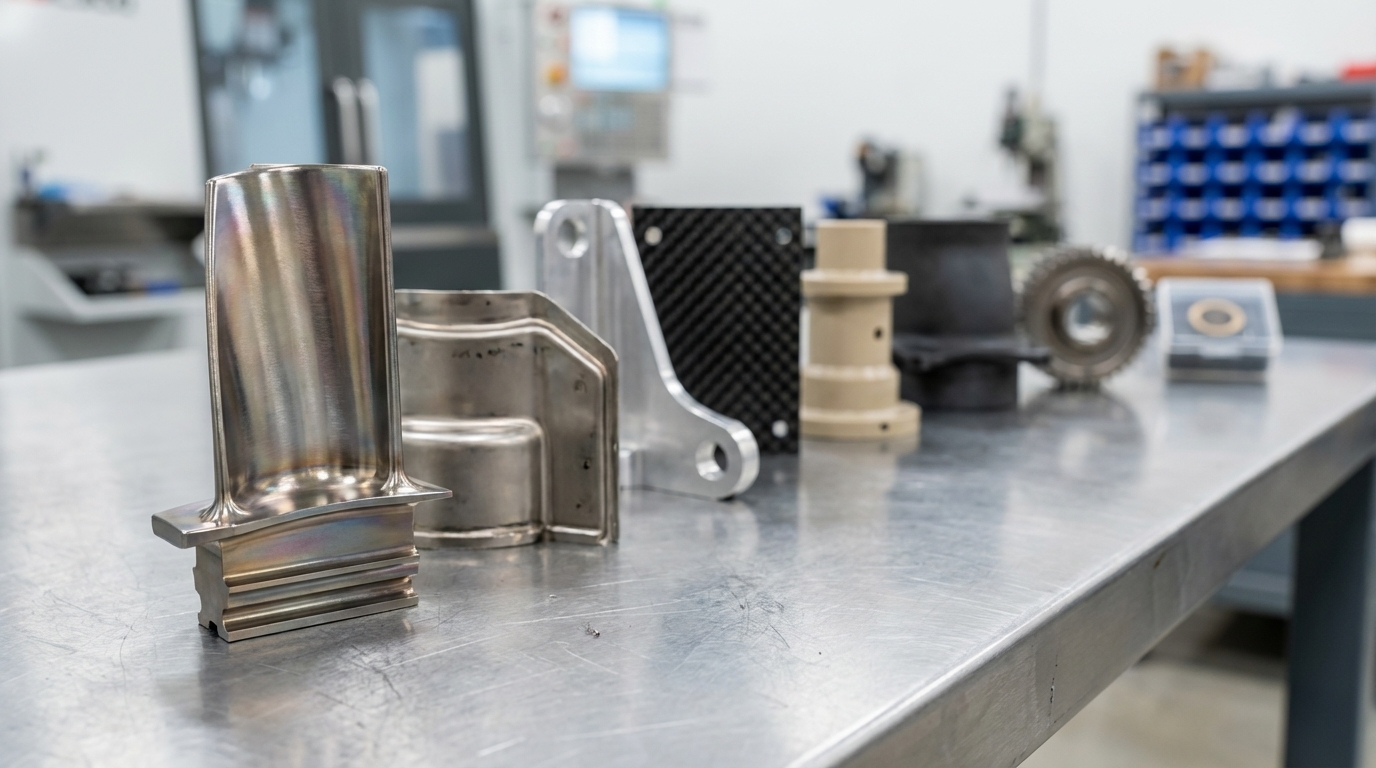
Key Takeaways
-
Ti-6Al-4V delivers 900 MPa strength at 4.5 g/cm³ density, supporting airframes and engines with ±0.0002″ tolerances.
-
Inconel 718 maintains strength from 650-950°C for turbines and rocket engines, despite work-hardening and tool wear challenges.
-
7075 Aluminum supports high-speed machining and 570 MPa strength for structural components at a cost-effective $5-15/kg.
-
CFRP composites cut weight for skins and panels, but require specialized tools and parameters to avoid delamination.
-
Partner with Precision Advanced Manufacturing for ITAR-compliant precision machining across these leading aerospace materials.
1. Ti-6Al-4V: Top Choice for Aerospace Precision Parts
Titanium Ti-6Al-4V dominates aerospace applications with outstanding strength-to-weight performance. This Grade 5 titanium alloy delivers 900 MPa tensile strength at just 4.5 g/cm³ density, which makes it roughly four times stronger than steel per unit weight. The alloy supports sustained operation up to 300°C and short-term exposure to 600°C. These capabilities are critical for engine components and satellite structures.
Ti-6Al-4V supports achievable tolerances of ±0.0002″ during machining, yet its thermal conductivity of just 7 W/m·K concentrates heat in the cutting zone. This heat buildup demands careful thermal management and tool selection.
Recommended cutting speeds range from 100-200 m/min with TiAlN-coated carbide tools that can handle the localized temperature. Current pricing sits at $30-50 per kg, and aerospace applications account for about 30% of the additive manufacturing market in 2025, reflecting strong demand despite machining complexity.
Precision Advanced Manufacturing applies AS9100D-compliant processes to Ti-6Al-4V machining. Our team delivers SpaceX-caliber components with full traceability, stable dimensional control, and repeatable performance from prototype through production.
2. Inconel 718: Heat Resistance Champion for Extreme Environments
Inconel 718 nickel-based superalloy supports aerospace hardware that must survive extreme heat and pressure. Many titanium components perform well up to 300°C, yet some turbine and rocket systems run far hotter. Inconel 718 maintains structural integrity at temperatures between 650-950°C and forms the backbone of NASA’s RS-25 engines and SpaceX’s Raptor engine turbopumps. With density of 8.2 g/cm³ and hardness of 420 HV, it delivers reliable performance in turbine, combustor, and hot-section components.
Inconel 718 presents significant machining challenges, including severe work-hardening and tool wear up to three times faster than stainless steel. Optimal parameters typically use cutting speeds of 20-50 m/min with high-pressure coolant at 70 bar or higher. Carbide tool life often ranges from 20-40 minutes of active cutting time, which directly affects cycle time and cost per part.
Precision Advanced Manufacturing provides compliant Inconel 718 machining for demanding aerospace programs.
Get a quote for your high-temperature turbine and engine components and align your designs with proven Inconel production capability.
3. 7075 Aluminum: High-Speed Machining Excellence
Aluminum 7075 alloy supports fast, economical machining for structural aerospace components. With density of 2.8 g/cm³, hardness of 150 HV, and machinability index of 1.0 relative to free-machining steel, this alloy runs efficiently on modern CNC equipment. The material provides 570 MPa tensile strength, which supports demanding structural and bracket applications.
Thermal conductivity of about 130 W/m·K helps move heat away from the cutting edge, which supports aggressive feeds and speeds while holding tight tolerances. Market pricing typically ranges $5-15 per kg, so 7075 works well for high-volume production runs. Aerospace teams rely on this alloy for structures, frames, and precision housings where weight, cost, and machinability must stay in balance.
4. CFRP Composites: Lightweight Structural Innovation
Carbon Fiber Reinforced Polymer (CFRP) laminates cut weight while preserving strength in aerospace structures. The key advantage lies in strength-to-weight ratios that support complex, thin-walled geometries that metals cannot match. These advanced composites support aerodynamic skins and structural panels where every gram matters. CFRP materials feature anisotropy, high abrasiveness from fibers, and a layered structure. These characteristics demand specialized machining strategies.
Primary challenges include delamination, fiber pull-out, and surface fraying during drilling and trimming. Successful machining relies on diamond-coated tools, controlled feed rates, and rigid workholding that supports the laminate stack. Typical applications include aerospace skins, ribs, and structural panels where weight reduction improves range, payload, and fuel efficiency.
5. PEEK/ULTEM: High-Performance Polymer Solutions
PEEK and ULTEM polymers deliver reliable performance for aerospace interiors and electrical systems. These high-performance polymers provide high glass transition temperatures, dimensional stability, and vibration damping that suit harsh aerospace environments. They excel in electrical insulation, connector housings, brackets, and interior components that require flame resistance and low smoke emission.
PEEK and ULTEM machine cleanly, with excellent dimensional stability and reduced tool wear compared to metals. These polymers support complex geometries and tight tolerances while still meeting strict aerospace flammability and outgassing requirements. Their combination of cost-effectiveness and processing flexibility makes them strong candidates for both prototype runs and long-term production.
Precision Advanced Manufacturing scales precision polymer machining for flight-ready hardware. Get pricing for your PEEK and ULTEM aerospace components and align your designs with proven polymer machining workflows.
6. Beryllium: Specialized Applications with Strict Controls
Beryllium supports niche aerospace applications that demand extreme stiffness and precise thermal control. This material offers an exceptional stiffness-to-weight ratio and strong thermal conductivity, which makes it valuable for satellite mirrors, gyroscope components, and precision optical instruments. However, strict ITAR controls and health safety requirements narrow its use to carefully managed programs.
Machining beryllium requires specialized facilities with environmental controls, air handling, and trained personnel because of its toxicity. Many programs now evaluate alternatives. Ceramic matrix composites (CMCs) and silicon carbide-based ultra-high temperature ceramics show promise as substitutes for some applications, although thermal shock resistance and processing complexity still present challenges.
7. Ceramic Matrix Composites (CMCs): Next-Generation Materials
Ceramic Matrix Composites represent a major step forward for high-temperature aerospace structures. These materials combine ceramic fibers within ceramic matrices to achieve very high temperature resistance while maintaining structural integrity. CMCs can operate at temperatures beyond traditional superalloys, which opens new options for hypersonic vehicles and next-generation propulsion systems.
CMC machining involves extreme hardness and abrasive behavior that require diamond tooling and carefully tuned techniques. Despite these processing hurdles, CMCs deliver meaningful weight savings and temperature capability that justify their use in critical hot-section parts. Adoption continues to grow as manufacturing methods mature and overall system cost benefits become clearer.
8. Maraging Steel: Ultra-High Strength Applications
Maraging steels provide ultra-high strength for specialized aerospace tooling and structural elements. These steels reach strength levels above 2000 MPa through age-hardening heat treatment. Typical aerospace uses include tooling, landing gear components, and high-stress structures that must withstand repeated loads without failure.
Shops usually machine maraging steel in the annealed condition before final heat treatment. This approach keeps machining straightforward while still delivering the required strength after aging. Cost and specialized heat treatment requirements limit maraging steel to critical, high-value components where its performance advantages outweigh added processing steps.
Machining Challenges Across Top Aerospace Materials
Advanced aerospace materials share machining challenges that demand focused expertise and capable equipment. Inconel exhibits the work-hardening behavior described earlier, while titanium’s poor thermal conductivity traps heat at the cutting edge. CFRP composites risk delamination and fiber damage without the right tooling and parameters.
Precision Advanced Manufacturing addresses these issues with multi-axis CNC capabilities, high-pressure coolant systems, and dynamic toolpath strategies. Our AS9100D-compliant processes have achieved 20-30% scrap reduction while maintaining full material and process traceability. Advanced workholding, optional cryogenic cooling, and optimized programming support consistent results across both prototype and production runs.
Frequently Asked Questions
What tolerances can be achieved with Inconel 718 machining?
Inconel 718 can reach tolerances of ±0.0004″ with the right machining techniques, tooling, and process control. Success relies on low cutting speeds, high-pressure coolant, and rigid setups that limit vibration and manage work-hardening. Laser marking and secondary operations then maintain traceability throughout production.
Can ceramic matrix composites be precision machined?
CMC components can be precision machined when shops use diamond tooling and specialized methods. These materials now play a growing role in hypersonic platforms and next-generation propulsion systems. Process engineers must select parameters carefully and maintain environmental controls to achieve the required surface finishes and dimensional accuracy.
Is beryllium machining ITAR compliant?
Beryllium machining requires strict ITAR compliance, facility controls, trained personnel, and robust documentation for controlled material handling. Precision Advanced Manufacturing operates under full ITAR registration for defense and space programs. Beryllium remains excluded from our standard material capabilities because of its specific handling and health restrictions.
How do you scale Ti-6Al-4V from prototype to production?
Scaling Ti-6Al-4V production depends on consistent process parameters, validated tooling strategies, and disciplined quality systems. Our multi-shift operations support a smooth transition from prototype quantities to full-rate production while holding identical quality standards and traceability requirements.
What makes exotic alloy machining challenging?
Exotic alloys create challenges such as work-hardening, poor thermal conductivity, high cutting forces, and rapid tool wear. Successful machining requires specialized tooling, tuned parameters, advanced coolant systems, and experienced programming. Precision Advanced Manufacturing addresses these factors through proven processes and continuous improvement.
Teams with material questions can connect directly with Precision Advanced Manufacturing experts. Start a project review and pricing discussion for your aerospace machining needs.
Conclusion: Turning Advanced Materials into Flight-Ready Hardware
This Top 8 material framework gives aerospace professionals practical guidance for selecting alloys, composites, and polymers for precision machining. Ti-6Al-4V leads strength-to-weight applications, while Inconel 718 supports the most demanding high-temperature environments. CMCs, CFRP, advanced polymers, and ultra-high-strength steels round out a toolkit that covers structures, hot sections, and interiors.
Precision Advanced Manufacturing stands ready as a certified partner for advanced aerospace materials, combining AS9100D compliance with hands-on machining expertise. Get your customized quote for advanced aerospace materials and machining today.