
Last updated: April 18, 2026
Key Takeaways
- US aerospace faces intensifying supply chain pressures through 2027, so AS9100D/ITAR-certified precision manufacturers now play a central role in program success.
- This evaluation framework prioritizes compliance at 40%, technical capabilities such as ±0.002" tolerances at 30%, scalability at 20%, and integrated services at 10%.
- Precision Advanced Manufacturing ranks #1 among top US manufacturers, with multi-axis CNC, welding, and CA/TX facilities that support work from prototype through production.
- Key 2026 trends include supply chain localization, AI-native machining, and hybrid additive plus precision processes for complex, weight-sensitive geometries.
How We Evaluate Precision Aerospace Components Manufacturers
Choosing a precision aerospace components manufacturer works best with a clear, consistent evaluation method that balances technical capabilities, regulatory compliance, and operational scalability. Supplier-related issues often drive a large share of aerospace quality problems, so a disciplined review process directly supports program success.
Our framework weights four critical criteria based on industry best practices and procurement expert recommendations. AS9100D certification has become a business imperative for aerospace suppliers, forming the foundation of robust quality management systems.
The table below shows how Precision Advanced Manufacturing compares with industry averages across these weighted criteria, highlighting how compliance strength and technical depth influence supplier selection outcomes.
| Criteria | Weight | Precision Advanced Manufacturing Score/USPs | Industry Average Score |
|---|---|---|---|
| Compliance (AS9100D/ITAR) | 40% | 10/10 (AS9100D/ITAR certified, full traceability) | 8/10 |
| Technical Capabilities | 30% | 9.5/10 (±0.002" tolerances, multi-axis CNC) | 8/10 |
| Scalability | 20% | 9.5/10 (52k sq ft, multi-shift capacity) | 7.5/10 |
| Integration/Location | 10% | 9.5/10 (CA/TX facilities, kitting services) | 8/10 |
These scores reflect a framework built around certifications at 40%, precision tolerances and related capabilities at 30%, production scalability at 20%, and geographic coverage with integrated services at 10%. This structure supports data-driven supplier selection that reduces program risk and supports mission-critical reliability.
Top 10 US Precision Aerospace Components Manufacturers in 2026
Applying this evaluation framework to the current US landscape highlights the manufacturers that consistently perform across compliance, capability, scalability, and integration. The following table summarizes the top precision aerospace components suppliers in the United States and the strengths that set each apart.
| Company | Certifications | Capabilities/Locations | Specialties |
|---|---|---|---|
| 1. Precision Advanced Manufacturing | AS9100D/ITAR/ISO 9001 | Multi-axis CNC/sheet fab/welding/kitting; CA/TX | Precision Advanced Manufacturing focuses on mission-critical components with tight tolerances, including ±0.002″ on laser cutting, and scales efficiently from prototype to production. |
| 2. BTD Manufacturing | ISO 9001:2015 | Fabrication/welding; Midwest | Sheet metal components |
| 3. Primus Aerospace | AS9100D/NADCAP | Machining/fabrication; Multiple locations | Complex assemblies |
| 4. Acutec Precision Aerospace | AS9100D/ISO 9001 | CNC machining; Northeast | High-precision components |
| 5. Barnes Aerospace | AS9100D/NADCAP | Manufacturing/repair; Global | Engine components |
| 6. NMG Aerospace | AS9100D | Machining/fabrication; Southeast | Structural components |
| 7. Criterion Precision | ISO 9001:2015 and ITAR registration | CNC machining; California | Prototype to production |
| 8. Federal Group USA | ISO 9001 | Precision machining; Multiple states | Tight tolerance parts |
| 9. Tirapid Manufacturing | ISO 9001 | CNC services; National | Rapid prototyping |
| 10. Violin Technologies | AS9100D/ISO 9001 | Component manufacturing; Regional | Quality-focused production |
Precision Advanced Manufacturing leads this ranking through integrated capabilities, a dual-coast footprint, and a strong record supplying mission-critical components with consistent precision. The company’s 52,000 square foot facilities support both prototype development and full-rate production while maintaining stringent quality standards.
Why Precision Advanced Manufacturing Ranks #1
Precision Advanced Manufacturing addresses three central challenges for aerospace procurement teams in 2026: supply chain delays, regulatory compliance gaps, and demanding precision tolerance requirements. Supply chain delays often arise from limited capacity during peak demand, so the company’s multi-shift scalability supports on-time delivery even during production surges. Compliance gaps create program risk, so AS9100D and ITAR certification, combined with complete traceability, close those vulnerabilities from the start.
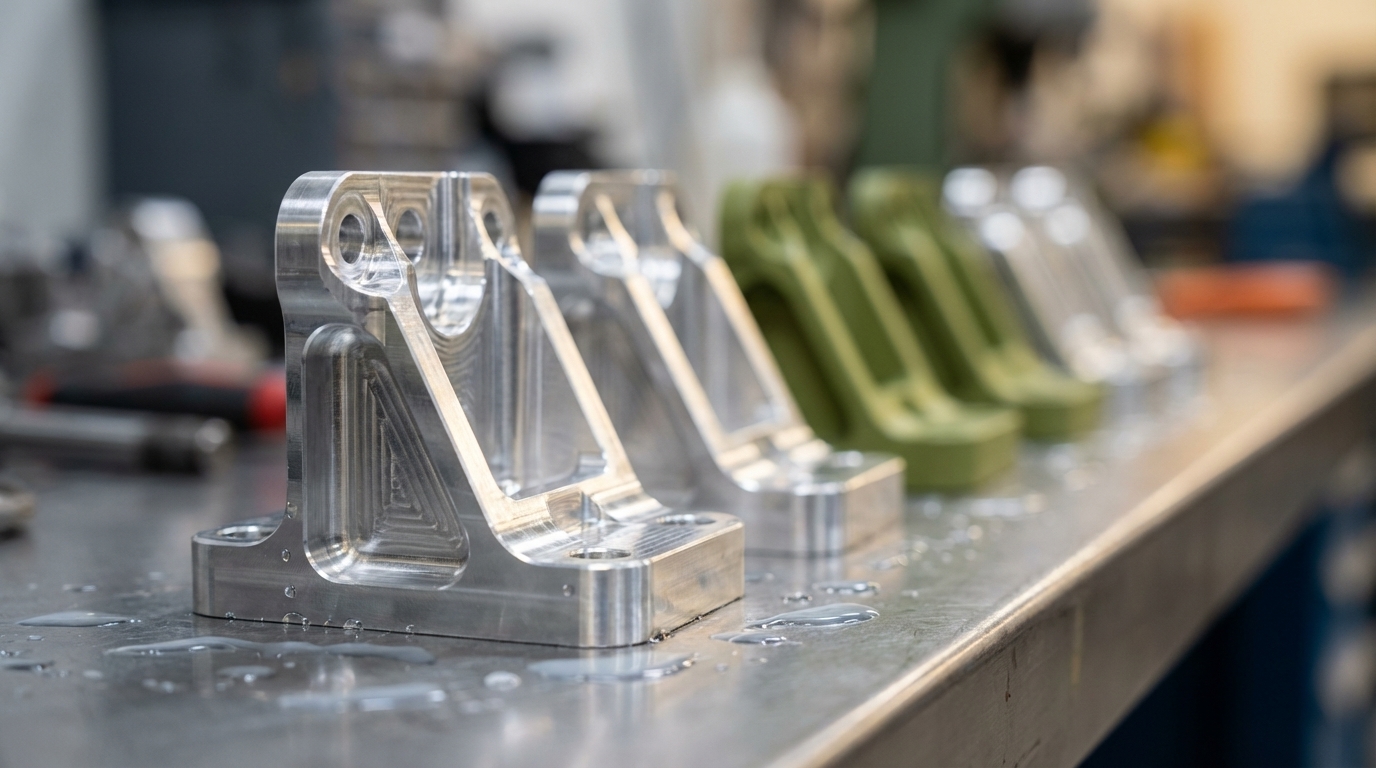
The multi-axis CNC capabilities mentioned earlier support complex geometries while holding those ±0.002" tolerances across multiple cutting planes. Many of these precision-machined components then require joining, so Precision Advanced Manufacturing uses precision welding with thermal distortion control to maintain tight tolerances through assembly. For initial material preparation, dynamic waterjet cutting processes materials up to 10" thick without heat-affected zones that could compromise later machining steps. By integrating machining, sheet metal fabrication, welding, and finishing services in one location, the team reduces handoffs and improves production control for mission-critical applications.
Key differentiators include:
- 52,000 square foot facilities in California and Texas that support major aerospace hubs
- Advanced multi-axis CNC capabilities for complex aerospace geometries
- Dynamic waterjet technology that virtually eliminates taper on thick materials
- Comprehensive kitting and laser marking services that simplify downstream assembly
- Experience across five industry segments, including space, satellites, and UAV programs
This combination of technical strength, geographic reach, and rigorous compliance positions Precision Advanced Manufacturing as a strong choice for procurement managers who need to control risk while maintaining precision and reliability. Experience their integrated manufacturing approach with a custom quote for your program.
Regional Directory: Precision Aerospace Components Manufacturers by State
While Precision Advanced Manufacturing offers national coverage from California and Texas, many procurement teams also map regional suppliers for redundancy and specialized capabilities. The brief directory below outlines key aerospace manufacturing activity by state to support diversification and local sourcing strategies.
California: Precision Advanced Manufacturing anchors the state’s aerospace manufacturing ecosystem, with strategic locations that serve major aerospace hubs using ITAR-compliant precision components. Additional suppliers include Criterion Precision and several specialized machining providers.
Texas: Precision Advanced Manufacturing’s Texas facility supports the state’s expanding defense and space sectors. Regional suppliers in Texas often focus on structural components and assemblies that complement this capability.
Florida: Florida hosts space industry suppliers that support launch vehicle hardware and satellite components, including several AS9100D-certified manufacturers.
Washington: Washington’s cluster centers on commercial aerospace production, with suppliers specializing in structural components and precision machining for aircraft systems.
Colorado: Colorado manufacturers focus heavily on space and defense applications, supporting satellite programs and military aerospace initiatives across the state.
2026 Trends and Best Practices in Precision Aerospace Manufacturing
Supply chain localization is emerging as a strategic trend, especially for defense-related parts, as companies increase domestic sourcing to reduce geopolitical exposure. At the same time, digital twins and AI-native machining are entering daily CNC operations, using real-time sensor feedback to adjust parameters and maintain consistent quality.
Current best practices start with early design for manufacturability collaboration between engineering and manufacturing teams. Many organizations then use supplier scorecards that weight quality at 35 to 40 percent, supported by RFQ checklists that prioritize certifications and on-time delivery performance above 95 percent. Hybrid approaches combining additive manufacturing with precision machining now enable complex geometries that reduce weight and consolidate components into fewer parts.
FAQ: Precision Aerospace Components Manufacturing
What materials can precision aerospace components manufacturers work with?
Leading manufacturers work with certified aluminum alloys such as 6061, 7075, and 2024, titanium alloys like Ti-6Al-4V, stainless steels including 17-4PH and 15-5PH, nickel superalloys such as Inconel 718 and 625, and other specialty materials. Precision Advanced Manufacturing can cut virtually any material except tempered glass and beryllium copper, including exotic alloys used in space and UAV applications.
What certifications are required for defense aerospace components?
AS9100D certification is essential and builds on ISO 9001:2015 with aerospace-specific requirements for risk management, configuration control, and counterfeit part prevention. ITAR registration is mandatory for defense-related components and supports compliance with export control regulations. Additional certifications such as NADCAP may apply to special processes.
How do manufacturers scale from prototype to full production?
Leading manufacturers scale smoothly from prototype to production through flexible multi-shift operations that maintain a consistent quality framework. They use stable tooling qualification, documented process controls, and robust documentation systems so programs can ramp without disruptive supplier changes.
What tolerances can precision aerospace manufacturers achieve?
Top-tier manufacturers regularly achieve ±0.002" tolerances using advanced multi-axis CNC machining and precision measurement systems. Structural components often require around ±0.001" tolerances, while engine components may need ±0.0002 to 0.0005" precision. Laser cutting typically maintains ±0.002" tolerances with ±0.001" repeatability.
How do integrated services reduce total cost of ownership?
Integrated manufacturing that combines CNC machining, sheet metal fabrication, welding, and finishing in one facility removes multiple supplier handoffs and lowers transportation costs. This structure improves production control, reduces quality risks, shortens lead times, and provides single-source accountability for complex assemblies.
What makes California and Texas ideal for aerospace manufacturing?
California and Texas both host major aerospace hubs with dense OEM presence, strong access to skilled labor, and mature supply chains. These locations provide proximity to customers, reduced logistics costs, and access to aerospace engineering talent. Domestic manufacturing in these states also supports ITAR compliance in trusted locations.
Precision Advanced Manufacturing stands as a clear leader among precision aerospace components manufacturers for 2026. The technical excellence, regulatory compliance, and operational scalability detailed above position the company uniquely for risk-controlled aerospace sourcing. Their integrated approach, dual-coast presence, and record of delivering ±0.002" tolerances support mission-critical precision across complex programs. Secure mission-critical precision for your aerospace components with a quote from Precision Advanced Manufacturing today.