Last updated: April 17, 2026
Key Takeaways
- Aerospace and defense programs face severe supply chain disruptions, with 5,300+ aircraft delivery shortfalls and $11B in bottlenecks as of 2025. Reliable US-based precision manufacturing partners now play a critical role in program success.
- Procurement and program teams should prioritize AS9100D and ITAR certifications, multi-axis CNC precision, prototype-to-production scalability, integrated services, and exotic materials expertise.
- Precision Advanced Manufacturing stands out with 52,000 square feet of facilities, 5-axis CNC machining, welding, kitting, and scalability to 10,000+ units for UAV and space applications.
- Integrated single-source capabilities remove supplier handoffs, support on-time delivery, maintain zero-defect quality, and address scaling and cost control concerns in one coordinated platform.
- Partner with Precision Advanced Manufacturing for certified, ITAR-compliant precision components, and request a quote today to strengthen your supply chain.
8 Essential Factors When Selecting Precision Manufacturing Partners in Aerospace & Defense
Choosing a precision manufacturing partner for aerospace and defense programs starts with a clear set of technical and operational requirements. The following eight factors form a practical checklist for building reliable, scalable component supply.
1. AS9100D and ITAR Certifications: The International Aerospace Quality Group expects to release the final IA9100 standard in late 2026, aligning with ISO 9001:2026 and strengthening risk-based thinking, digital systems integration, safety, security, ethical conduct, and leadership accountability. Current AS9100D certification confirms aerospace-specific quality management systems that go beyond ISO 9001 requirements.
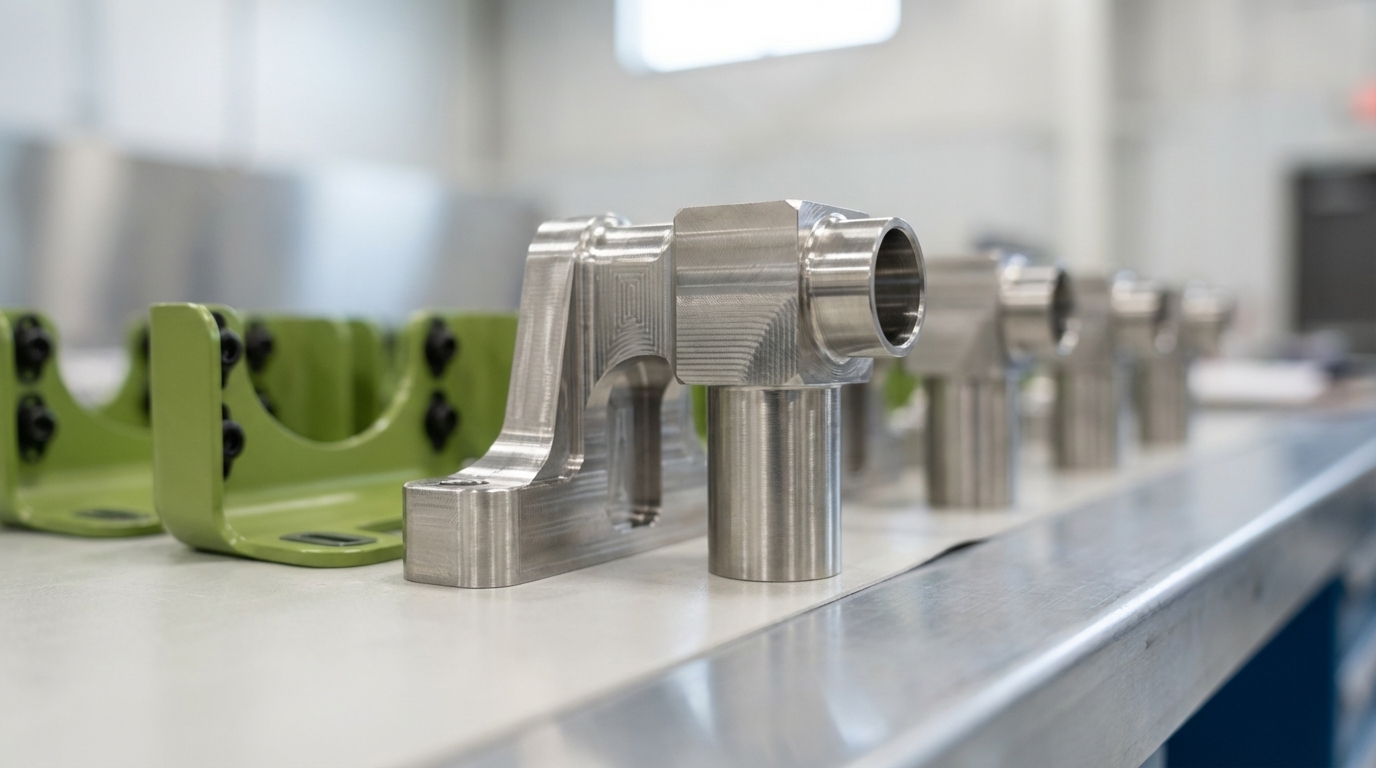
2. Multi-Axis CNC Precision: 5-axis and 6-axis CNC machines machine complex geometries in a single setup, which reduces error-prone repositioning and setup time. Tolerances of ±0.002″ or better remain essential for mission-critical components that must perform under extreme conditions.
3. Prototype-to-Production Scalability: Partners must show that they can move from single prototypes to multi-shift production while holding quality and delivery schedules steady. Documented processes, capacity planning, and proven ramp histories provide evidence of this capability.
4. Integrated Fabrication Services: Single-source capabilities that include welding, finishing, and kitting remove handoffs that introduce delays and quality risks. A unified workflow shortens lead times and simplifies program management.
5. Exotic Materials Expertise: Experience with titanium, Inconel, composites, and other aerospace-grade materials supports reliable machining of difficult components. Specialized tooling, feeds, speeds, and thermal control techniques protect part integrity.
6. Full Traceability Systems: Complete documentation and material certification systems support aerospace compliance requirements. Lot tracking, serial number control, and digital records create a clear audit trail for every component.
7. On-Time Delivery Performance: A documented record of meeting critical program milestones without delays reduces schedule risk. Performance metrics, customer references, and delivery scorecards help verify this track record.
8. US-Based Manufacturing: Domestic facilities support ITAR compliance and reduce geopolitical supply chain risks. US-based production also simplifies communication, logistics, and oversight for defense programs.
These criteria help ensure that partners can support current program requirements and future scalability as the global UAV drones market reaches USD 44.94 billion in 2026, expanding to support heavier sensors and advanced mission equipment.
Top 5 ITAR-Compliant Precision Manufacturing Partners for A&D Components
The comparison below highlights how integrated capabilities, certification depth, and facility scale differentiate leading precision manufacturing partners for aerospace and defense components.
| Company | Certifications | Capabilities/Scalability | Facilities/Edge |
|---|---|---|---|
| Precision Advanced Manufacturing | AS9100D, ITAR, ISO 9001 | 5-axis CNC, welding, kitting, prototype to 10k+ units | 52k sq ft CA/TX, dynamic waterjet, integrated finishing |
| ALIGN Precision | AS9100D, ITAR | Multi-axis machining, limited fabrication | multiple Centers of Excellence across the country, specialized tooling |
| Acutec Precision Aerospace | AS9100D, NADCAP | CNC machining, sheet metal | facilities in Pennsylvania and South Carolina |
| Primus Aerospace | AS9100D, ITAR | Machining, assembly | Multiple locations |
| BTD Manufacturing | ISO 9001 | Precision machining | Midwest operations |
These five partners meet core aerospace and defense requirements, yet they differ in how fully they integrate capabilities under one roof. Precision Advanced Manufacturing leads this comparison through integrated capabilities that solve the handoff problems that affect many aerospace supply chains. Their combination of multi-axis CNC machining, precision welding, and finishing services in a single operation removes delays and quality risks that often appear when multiple suppliers share a program.
This integrated approach delivers particular value for UAV and space applications that rely on lightweight structures, tight thermal control, and complex assemblies. As UAV platforms carry heavier sensors and more advanced mission equipment, programs benefit from suppliers that can manage complexity without adding schedule or quality risk.
Given these integration advantages, the next section examines how the leading partner in this comparison delivers these capabilities across real-world aerospace and defense programs.
Leading Partner Profile: Precision Advanced Manufacturing for Mission-Critical Components
Precision Advanced Manufacturing provides end-to-end support for aerospace and defense components, from early prototypes through sustained production. The company operates 52,000 square feet of certified manufacturing space across California and Texas, which supports both development work and high-volume programs.
Their integrated platform combines advanced multi-axis CNC machining, precision sheet metal fabrication, specialty welding with thermal distortion control, kitting services, laser marking, and comprehensive finishing capabilities. This structure allows engineering, production, and finishing teams to coordinate in real time, which reduces rework and compresses lead times.
The integrated approach outlined above translates into specific operational advantages for procurement and program managers. On-time delivery performance reduces the program delays that have become common in aerospace supply chains. When paired with zero-defect quality systems, this reliability cuts the rework costs that totaled over USD 11 billion across the aerospace industry in 2025. Together, these capabilities support scalability from prototype to 10,000+ unit production runs without supplier transitions that can reset schedules and quality validation.
Program teams working on emerging applications gain particular value from this combination of capabilities. UAV programs benefit from lightweight structures, precision thermal control components, and assemblies prepared for rapid fielding. Space and satellite applications draw on experience with exotic materials and extreme environment requirements, including tight tolerance control over large, complex parts.
The combination of AS9100D, ITAR, and ISO 9001 certifications provides a compliance foundation for mission-critical defense programs. These certifications, supported by documented processes and regular audits, give procurement teams confidence that quality and regulatory requirements remain under control as volumes grow.
Request a tailored quote to review how Precision Advanced Manufacturing’s integrated capabilities align with your specific aerospace or defense program requirements.
Addressing Buyer Concerns on Scaling, Costs, and Supplier Transitions
Procurement and program leaders often share similar concerns about precision manufacturing partnerships, especially around cost, scalability, and transition risk. Understanding how a partner manages each of these areas helps teams make confident sourcing decisions.
Cost Management: Cost control starts with right-first-time production that removes rework and expediting charges that drive program overruns. Integrated capabilities also reduce markup and coordination costs that appear when multiple suppliers split machining, welding, and finishing work.
Scaling Confidence: Strong cost controls create a foundation for predictable scaling. Pilot production runs validate processes before full-rate manufacturing begins. Multi-shift capacity and established procedures then support volume increases while maintaining quality and delivery performance.
Transition Support: Once scaling is under control, teams often focus on the risk of moving work from existing suppliers. Complete documentation and material traceability support smooth transitions, while engineering support protects critical specifications and fit, form, and function requirements.
Material Capabilities: Material expertise underpins each of the previous concerns, because difficult alloys can introduce both cost and schedule risk. Experience with exotic alloys up to 10″ thick, composites, and specialized aerospace materials reduces technical uncertainty for complex components.
Supply chain resilience grows more important as armed conflicts, tariffs, and supplier-related risks create production delays, extended lead times, and higher costs. Established US-based partners with proven capabilities give aerospace and defense programs a stable base for long-term success.
Frequently Asked Questions
What tolerances can precision manufacturing partners achieve for aerospace components?
Leading precision manufacturing partners consistently achieve tolerances of ±0.002″ for structural components and ±0.0005″ for critical flight hardware. Advanced multi-axis CNC equipment with in-process measurement capabilities maintains repeatability across production runs. Surface finishes meet aerospace requirements for smooth surfaces and fatigue resistance.
How do precision manufacturers scale from prototype to full production?
Scalable precision manufacturers rely on validated processes that move from single prototypes to multi-shift production without disruption. This approach includes established tooling procedures, documented work instructions, and capacity planning that supports volume increases without major setup changes. Multi-shift operations and automated systems then enable 24/7 production for high-volume programs.
What ITAR compliance capabilities should aerospace suppliers provide?
ITAR-registered precision manufacturers maintain fully compliant facilities with controlled access, cleared personnel, and secure data handling procedures. This structure includes segregated work areas for ITAR-controlled components, documented export control procedures, and regular compliance audits. All personnel handling ITAR materials hold appropriate clearances and receive ongoing training.
Which exotic materials can precision manufacturing partners machine effectively?
Advanced precision manufacturers work with titanium alloys, Inconel, aluminum-lithium composites, carbon fiber reinforced plastics, and other aerospace-grade materials. Specialized tooling, cutting parameters, and thermal management techniques support consistent results with difficult-to-machine materials. Experience with materials up to 10″ thick enables production of large structural components.
How should companies transition to new precision manufacturing partners?
Successful transitions start with complete documentation transfer, material certification verification, and pilot production runs that validate processes. Leading precision manufacturers provide engineering support to maintain specification continuity and quality validation. Phased transitions with parallel production reduce risk while new supplier relationships mature.
Conclusion & Next Steps for Aerospace and Defense Teams
Selecting precision manufacturing partners for aerospace and defense components requires a structured review of certifications, capabilities, and scalability against program-specific requirements. The criteria outlined above provide a practical framework for identifying partners that can support current needs and future growth as the market growth mentioned earlier accelerates toward USD 209.91 billion by 2035.
Connect with Precision Advanced Manufacturing experts and receive a free quote within 24 hours to evaluate how integrated precision manufacturing capabilities can strengthen your supply chain and support mission-critical program success.