Key Takeaways
- Tight tolerances in turbine blades and fuel nozzles protect airflow, combustion efficiency and engine performance through 5-axis CNC and EDM machining.
- Landing gear bores and sensor mounts rely on precision grinding and multi-axis CNC for load-bearing integrity and alignment accuracy under extreme conditions.
- Radar housings, missile gyroscopes and satellite brackets use processes like wire EDM and thermal controls to maintain EMI shielding and structural stability.
- Advanced verification methods including CMMs, statistical process control and temperature-controlled environments support compliance with AS9100D and ITAR standards.
- Partner with Precision Advanced Manufacturing for integrated, scalable tight tolerance machining that reduces risk in aerospace and defense programs.
Tight Tolerance Requirements for Aerospace & Defense Parts
Critical aerospace and defense components rely on precise tolerances to support mission success. AS9100 standards require tight tolerances to meet certification and safety compliance. These requirements shape how programs select materials, processes and manufacturing partners.
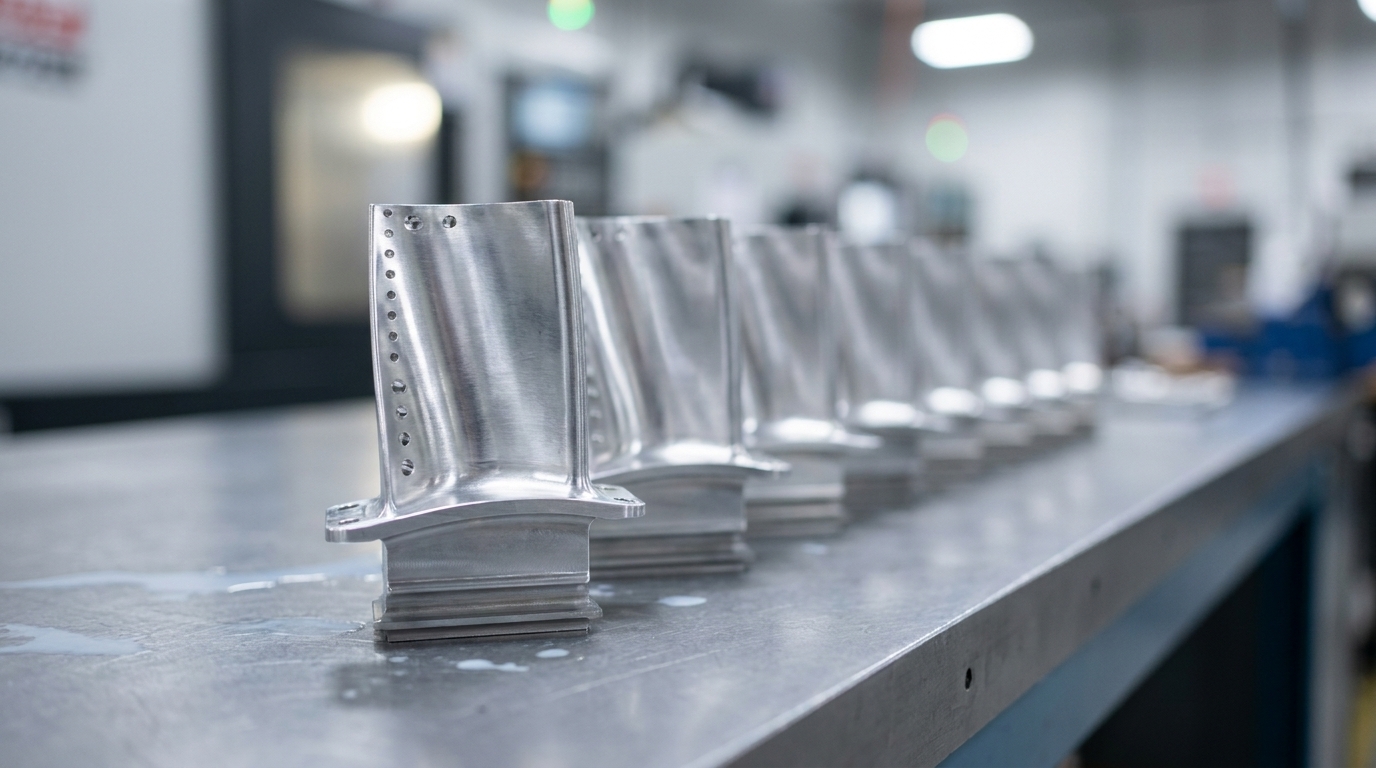
These tolerance requirements appear differently across component types. Turbine blades rely on 5-axis CNC machining to maintain airflow efficiency, while fuel nozzles use EDM and precision CNC for combustion control. Load-bearing components such as landing gear bores depend on precision grinding for structural integrity, and sensor mounts use multi-axis CNC to achieve alignment precision. Aerospace industry components governed by AS9100 standards commonly require tight CNC machining tolerances for precise mating bearing movement or critical load conditions.
Ten Examples of Tight Tolerance Machining in Practice
These ten examples show how tight tolerance requirements translate into specific processes, materials and verification methods across aerospace and defense programs.
1. Turbine Blades
Turbine blades require exact airfoil profiles and tip clearances because minor deviations alter airflow dynamics and reduce efficiency. Minor deviations alter airflow dynamics and reduce efficiency. Achieving these tolerances demands 5-axis CNC machining, which produces complex curved surfaces while maintaining dimensional accuracy. Precision Advanced Manufacturing uses integrated capabilities that reduce handoffs and limit tolerance stack-up across operations.
2. Fuel System Nozzles
Fuel injectors demand tight tolerances for internal geometries to control fuel atomization and flow rates. These components require exact internal geometries for fuel atomization, flow rates, combustion efficiency, emissions and engine performance. EDM and precision CNC machining create micron-level holes and passages that support these functions. Temperature-controlled environments limit thermal expansion during production so internal features remain within specification.
3. Landing Gear Pivot Bores
Landing gear assemblies require tight tolerances on pivot bores and hydraulic cylinders to ensure reliable extension and retraction under extreme loads. These systems require precise tolerances to ensure reliable extension and retraction. Precision grinding and honing create the surface finishes and diameters that support smooth motion. Material traceability then confirms that each component can withstand the forces encountered during takeoff, landing and taxi operations.
4. Sensor Mounting Systems
Sensor mounts for navigation and guidance systems depend on tight alignment tolerances to protect measurement accuracy. Gyroscope housings made from titanium require tight tolerances to protect sensitive stabilization sensors. Multi-axis CNC machining maintains positional accuracy across complex geometries and mounting features. Vibration dampening during machining limits stress-induced distortion that could shift sensor alignment. Get a quote for your sensor mounting project to review alignment and stability requirements.
5. Radar Housing Assemblies
Radar system housings rely on tight dimensional control to support electromagnetic interference shielding and environmental sealing. Avionics housings require precise tolerances for dimensions to ensure proper sealing. Precision sheet metal fabrication and welding maintain structural integrity across panels and joints. Thermal distortion control during welding preserves flatness and fit so covers, gaskets and connectors seat correctly.
6. Missile Gyroscope Components
Guidance system gyroscopes demand tight tolerances for rotational balance and stable operation. Ballistic missile defense interceptor components demand tight tolerances to ensure successful intercepts. 5-axis simultaneous machining produces complex geometries in titanium alloys while maintaining symmetry. Dynamic balancing verification then confirms that rotating elements meet stability requirements across the operating speed range.
7. Satellite Structural Brackets
Satellite mounting brackets require tight dimensional control to withstand launch vibrations and thermal cycling while holding payloads in position. Aerospace part requirements vary by feature criticality. Lightweight aluminum and titanium alloys call for specialized tooling strategies that manage chatter and heat. Stress relief processes reduce residual stresses so bracket geometry remains stable during orbital operations.
8. UAV Propeller Hub Assemblies
Unmanned aerial vehicle propeller hubs depend on tight tolerances for rotational balance and vibration control. Firstar achieved tight tolerances by manufacturing components for an unmanned aerial vehicle engine manufacturer. Precision turning and milling operations maintain concentricity between mounting features and bearing seats. Dynamic balancing verification confirms smooth operation at high RPM and protects airframe structures and onboard electronics.
9. Hydraulic System Fittings
Hydraulic fittings demand tight tolerances on sealing surfaces to prevent leakage under pressure. Thread tolerances must maintain engagement strength while still allowing assembly and service. CNC turning and threading operations create the required surface finishes and thread forms. Pressure testing then validates seal integrity across temperature ranges and duty cycles.
10. Avionics Enclosure Interfaces
Avionics housing interfaces require tight tolerances for connector alignment and environmental sealing, building on the sealing requirements described for radar and avionics housings above. Avionics housings require precise tolerances for dimensions to ensure proper sealing. Precision machining maintains flatness and perpendicularity specifications across mounting faces and connector cutouts. Coordinate measuring machine verification confirms assembly compatibility with mating hardware.
Key Processes for Tight Tolerance Machining in Aerospace and Defense
Aerospace-grade tolerances depend on advanced manufacturing processes and controlled environments. 5-axis CNC machining maintains tight tolerances in aerospace aluminum projects. This multi-axis approach allows complete machining in a single setup, which reduces the setup variations that create tolerance stack-up errors.
For hardened materials where traditional machining can introduce mechanical stress, wire EDM delivers tight tolerances for hardened steel precision features in ballistic missile defense manufacturing. Electrical discharge machining produces complex geometries in hardened materials while preserving material properties. These capabilities support components such as missile guidance hardware and hardened inserts.
Structural assemblies often combine machined features with formed sheet metal. Precision sheet metal fabrication integrates with CNC machining to create enclosures, brackets and housings with consistent fit. Specialty welding with thermal distortion control maintains dimensional accuracy during joining operations. Discuss your integrated machining requirements with the Precision Advanced Manufacturing engineering team.
Environmental and measurement controls complete the process stack. Temperature-controlled environments limit thermal expansion during production and inspection. Coordinate measuring machines provide verification with measurement uncertainty below part tolerances. Statistical process control tracks dimensional trends and maintains consistency across production runs.
These process requirements call for manufacturing partners with integrated capabilities and quality systems that can hold tolerances from prototype through full-rate production.
Why Choose Precision Advanced Manufacturing for Tight Tolerance Programs
Precision Advanced Manufacturing delivers mission-critical components through AS9100D, ISO 9001 and ITAR-compliant processes. The integrated facility combines multi-axis CNC machining, precision fabrication and specialty welding under one roof, which reduces handoffs that can introduce dimensional variation.
Scalable production platforms support prototype builds through full-rate manufacturing while maintaining consistent quality standards. Engineering support and manufacturability analysis refine designs for tight tolerance production and efficient throughput. Complete traceability and documentation systems support regulatory compliance and long-term program continuity.
Temperature-controlled machining environments and advanced metrology equipment protect dimensional accuracy throughout production. Start your quote for schedule-driven tight tolerance machining that aligns with program milestones.
Frequently Asked Questions
What tolerances are required for defense parts?
Defense components require tight tolerances for mission-critical applications, with MIL-SPEC standards defining both dimensional limits and required process traceability. These standards also specify material documentation that supports lifecycle tracking. Guidance systems, sensor mounts and precision assemblies represent component categories where these tolerances directly affect operational performance.
How does ITAR compliance affect tight tolerance machining?
ITAR registration governs secure handling of defense-related technical data and components throughout the manufacturing process. Compliant facilities maintain controlled access, secure data transfer protocols and documented chain of custody for all defense articles. These controls operate alongside the same precision standards used for aerospace machining while adding cybersecurity and access protections for sensitive information.
What is considered a tight tolerance in aerospace machining?
Aerospace applications define tight tolerances as more precise than standard commercial manufacturing limits. Ultra-precision aerospace components apply these tolerances to critical features such as turbine blade profiles, fuel system components and guidance system interfaces. These features often require specialized processes, tooling and inspection plans.
How are tight tolerances verified in aerospace manufacturing?
Verification relies on coordinate measuring machines with measurement uncertainty below part tolerances. First article inspections validate initial production against design intent. In-process monitoring maintains consistency throughout production runs. Statistical process control tracks dimensional trends and helps prevent drift from specification limits.
What materials require the tightest tolerances in aerospace applications?
Titanium alloys, Inconel and aerospace-grade aluminum often carry the tightest tolerances because they support critical structures and systems. These materials present machining challenges that include thermal expansion, work hardening and tool wear. Temperature-controlled environments and specialized tooling strategies help maintain consistent results across these demanding alloys.
The ten examples above show how tight tolerance machining moves from specification to execution across aerospace and defense applications. Each component type presents distinct challenges, from turbine blade airfoil profiles to gyroscope rotational balance, that require matching processes and materials to tolerance requirements. Precision Advanced Manufacturing combines integrated capabilities, certified quality systems and a proven track record to support these programs. Connect with our team to discuss mission-critical machining requirements.