Last updated: June 30, 2026
Key Takeaways
- Certification and traceability, not location, determine CNC reliability for aerospace and defense programs.
- AS9100D and ISO 9001 certification plus ITAR registration provide documented process control that reduces compliance and quality risk.
- Full material traceability and CMM inspection protect programs from out-of-spec parts, rework and audit findings.
- Scalable, multi-shift production capacity keeps prototype-to-full-rate transitions under the same validated quality system.
- Precision Advanced Manufacturing delivers these capabilities across California and Texas facilities; request a quote to evaluate support for the next mission-critical program.
The Problem: Certification Gaps That Create Program Risk
Many CNC shops in the Austin area operate without aerospace-grade quality registrations. A shop without AS9100D certification has no externally audited obligation to maintain documented process controls, inspection records or material traceability. For a commercial aerospace or defense program, that gap translates directly into risk.
The consequences follow a familiar pattern. Parts arrive out of specification. Inspection burden shifts to the customer quality team. Rework and scrap drive up total program cost. When a compliance audit arrives, undocumented processes become findings. When production volume increases, a shop without scalable capacity becomes a bottleneck that delays the entire program.
Sourcing decisions based on proximity rather than certification rigor routinely produce these outcomes. The evaluation framework must start with documented process discipline, not a zip code. The following section explains how certified contract manufacturers structure operations to remove these risks.
Evaluate a certified manufacturing partner built for mission-critical programs.
Four Pillars of Reliable Certified CNC Manufacturing
Certified contract manufacturers address the certification gap through four operational pillars: process discipline, integrated capability, engineering support and scalable production.
Process discipline means every production step follows documented procedures that are audited against AS9100D and ISO 9001 requirements. This foundation supports integrated capability, where multi-axis CNC machining, precision fabrication, specialty welding and secondary finishing operate under one roof and one quality system. That structure reduces handoffs that introduce variation and delay.
Engineering support strengthens this platform. In-house programming and tooling expertise enter early, so manufacturability is refined before the first cut. Scalable production then carries the validated process from prototype into multi-shift, full-rate manufacturing without a supplier change or a reset learning curve.
Precision Advanced Manufacturing combines these four pillars at facilities in California and Texas. The company supports aerospace, defense, space and satellite, UAV and advanced-industrial programs under AS9100D, ISO 9001:2015 and ITAR-registered quality systems.
Certification and Traceability Expectations for CNC Partners
AS9100D is the aerospace sector quality management standard. It extends ISO 9001 with requirements specific to aviation, space and defense, including risk management, configuration control and first-article inspection. ITAR registration governs the handling of defense-related technical data and hardware. Both frameworks require documented evidence at every production stage.
Material traceability sits at the center of these frameworks. Each raw material lot must be traceable from the mill certificate through every process step to the finished part. During an audit or a field event, that chain of custody can turn a potential program disruption into a focused, one-day investigation.
Sourcing managers benefit from a consistent evaluation routine. Request current AS9100D and ISO 9001 certificates with scope statements, ITAR registration confirmation, sample material certifications and a sample first-article inspection report. A supplier that cannot produce these documents on request is not audit-ready.
Tolerance Control and Inspection Rigor
Out-of-spec parts are a direct source of program delay. A part that fails incoming inspection must be dispositioned, reworked or scrapped. Each outcome consumes schedule and budget. The root cause often traces back to weak in-process inspection at the supplier.
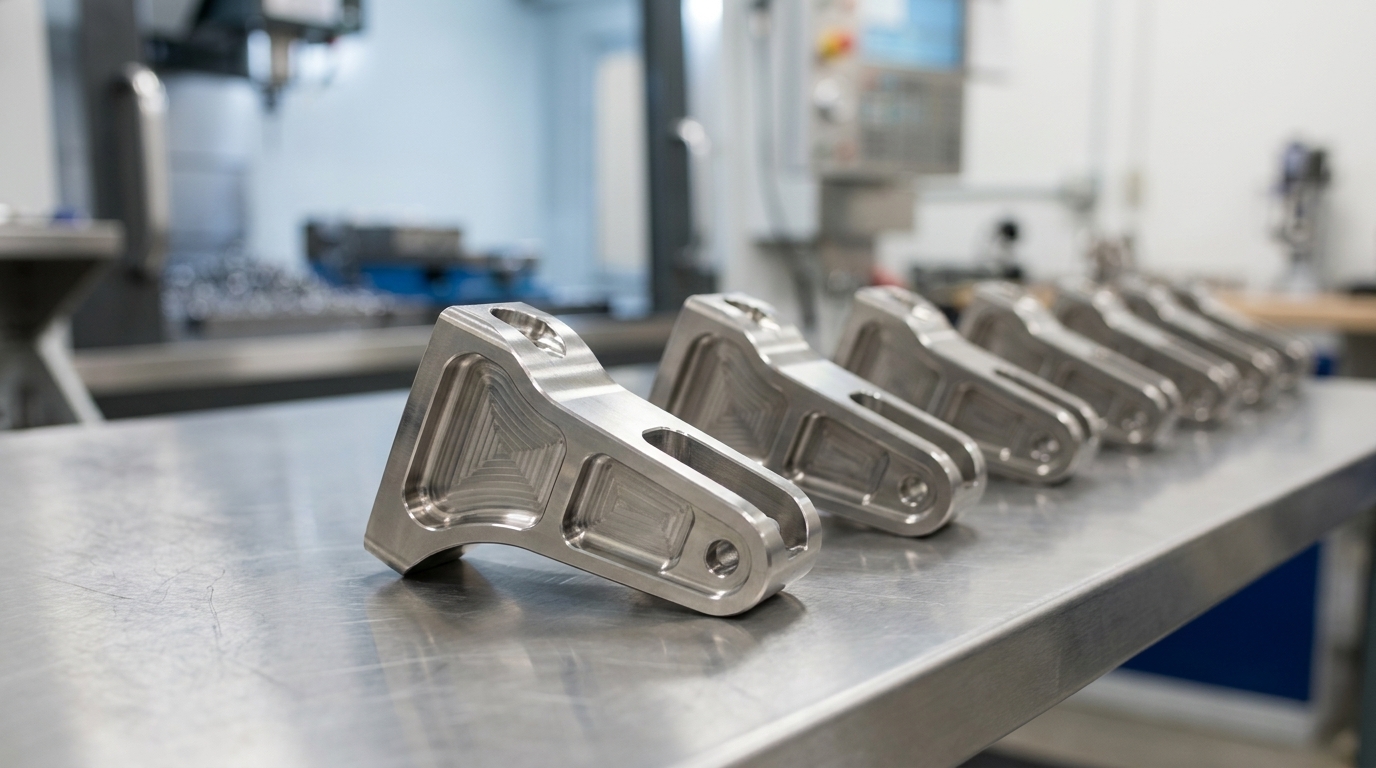
Certified manufacturers use coordinate measuring machine, or CMM, inspection and defined in-process checkpoints to catch dimensional deviations before shipment. Final inspection packages include dimensional reports, material certifications and process records. That documentation allows the customer quality team to accept parts with confidence instead of repeating full inspection.
Useful evaluation criteria for inspection rigor include CMM use for critical dimensions, availability of in-process inspection records and completeness of the final inspection package. Strong documentation should support the customer quality records without supplemental verification.
Managing On-Time Delivery Risk with Scalable Production
Prototype-to-production transitions often introduce program risk. A shop that performs well on a 10-piece prototype run may lack the scheduling discipline, capacity or process documentation to sustain a 500-piece production order on schedule. When that gap appears mid-program, the options include expedited orders, emergency supplier transitions or schedule slips.
Scalable production platforms reduce this exposure. Validated processes established during prototyping carry forward into full-rate manufacturing. Multi-shift capacity and disciplined scheduling allow production volume to increase while quality and delivery performance remain stable.
Sourcing managers gain clarity by asking prospective suppliers to describe capacity planning, multi-shift capability and methods for maintaining quality as volume scales. Vague or incomplete answers signal a scheduling risk.
Reducing Risk in Mid-Program Supplier Transitions
Supplier transitions mid-program create disruption by default. Knowledge of part geometry, material behavior, tooling parameters and inspection criteria often lives in the outgoing supplier institutional memory. When that knowledge is not documented, the incoming supplier must rebuild it through trial and error, which costs time and introduces defect risk.
A certified contract manufacturer mitigates transition risk through complete documentation. Process travelers, inspection records, material certifications and CNC programs live inside the quality system, not in informal storage. Engineering support allows the incoming supplier to review existing documentation, conduct pilot builds and validate conformance before full-rate production.
Effective transition readiness evaluation focuses on documentation and validation. Confirm that the prospective supplier can accept and interpret existing documentation packages, conduct a structured pilot run and provide a validation report before production begins.
Discuss transition requirements with Precision Advanced Manufacturing and its engineering team.
Comparing CNC Sourcing Options for Aerospace and Defense
Three supplier categories commonly appear in aerospace and defense sourcing strategies. Each carries a distinct risk and capability profile.
- General job shops: Typically offer competitive pricing and geographic proximity. Most operate without AS9100D or ITAR registration. Documentation and traceability practices vary widely. Scaling capacity is often limited. Total cost of ownership rises when rework, scrap and compliance findings enter the picture.
- Certified regional contract manufacturers: Operate under AS9100D, ISO 9001 and ITAR-registered quality systems. Provide full traceability, CMM inspection and complete documentation. Support prototype-to-production scaling under the same quality framework. Align closely with aerospace and defense program requirements for Tier-2 and Tier-3 sourcing.
- Large global suppliers: Offer broad capacity and multi-site redundancy. Minimum order requirements and program prioritization practices can disadvantage smaller or mid-volume programs. Engineering responsiveness and schedule flexibility often face limits created by organizational scale.
Focused Due-Diligence Checklist for CNC Partners
- Certifications: Confirm current AS9100D and ISO 9001:2015 certificates with applicable scope. Confirm ITAR registration for defense and space programs.
- Sample documentation: Request a sample first-article inspection report, a sample material certification and a sample process traveler to assess documentation completeness.
- Pilot-run protocol: Ask whether the supplier conducts structured pilot or validation runs before full-rate production and whether a formal conformance report is issued.
- Inspection capability: Confirm CMM availability and clarify which dimensions are measured in-process versus at final inspection.
- Scalability: Ask about multi-shift capacity, scheduling methodology and how quality is maintained as volume increases.
- Transition readiness: Confirm the process for accepting existing documentation packages and conducting validation builds for mid-program transitions.
- Site visit: Schedule a facility visit to observe production floor organization, equipment condition and quality system implementation firsthand.
Frequently Asked Questions
How does AS9100D certification reduce program risk?
AS9100D certification requires an organization to implement and maintain documented process controls, risk management practices and traceability systems audited by an accredited third party. Those requirements exist because undocumented processes produce inconsistent outcomes. A certified supplier presents externally verified evidence that its quality system functions as documented, which reduces the probability of out-of-spec parts, compliance findings and delivery failures.
What does ITAR registration mean for a CNC supplier?
ITAR registration authorizes a supplier to manufacture, handle and discuss defense-related hardware and technical data under the International Traffic in Arms Regulations. For defense and space programs, working with an unregistered supplier creates legal exposure for both customer and supplier. ITAR registration serves as a baseline requirement, not a differentiator, for any supplier handling controlled defense articles or data.
How does full material traceability protect a program?
Full material traceability links every finished part to its raw material lot, mill certificate and process history. If a field event or audit requires root-cause analysis, that documentation allows engineers to isolate the affected lot and determine whether other parts from the same material are at risk. Without traceability, a single quality event can trigger a broad containment action that affects the entire program.
Can one certified supplier handle both prototype and full-rate production?
A supplier with a scalable production platform and multi-shift capacity can support the full product lifecycle under the same quality system. This structure removes the risk of a supplier transition between prototype and production, which often causes knowledge loss and schedule disruption. The key requirement is documented quality processes, tooling and inspection methods that carry forward as volume increases.
What should a sourcing manager prioritize in a mid-program supplier transition?
Documentation completeness sits at the top of the list. The incoming supplier must reconstruct the production process from existing records rather than tribal knowledge from the outgoing supplier. A structured pilot run with a formal conformance report comes next. Engineering support from the incoming supplier during the transition reduces the risk of new variation while resolving the issues that triggered the transition.
Conclusion: Decision Checklist for Austin CNC Reliability
Austin CNC reliability rests on documented process discipline, not location. For aerospace, defense and advanced-industrial programs, supplier evaluation should center on certification rigor, inspection capability, traceability systems and scalable production capacity.
Use the following checklist when making a final vendor decision:
- AS9100D and ISO 9001:2015 certificates confirmed with current scope
- ITAR registration confirmed for applicable programs
- Sample documentation reviewed and found complete
- CMM inspection capability confirmed for critical dimensions
- Pilot-run protocol defined and conformance reporting confirmed
- Multi-shift scalability and scheduling methodology verified
- Transition readiness confirmed through documentation review and pilot-build process
- Facility visit completed
Precision Advanced Manufacturing meets each criterion on this checklist. The company operates under AS9100D, ISO 9001:2015 and ITAR-registered quality systems across two specialized facilities, with integrated multi-axis CNC machining, precision fabrication, engineering support and scalable production capacity built for mission-critical programs.
Request a quote to begin the evaluation process with Precision Advanced Manufacturing.